Facts
The petitioner, an Assistant Conservator of Forest and the then Public Information Officer, received an RTI application dated 25.05.2022 from Respondent No. 2 seeking certified copies of the Cash Book of Bakawand Range for the financial year 2018–19.
Source reference: para. 2The petitioner initially offered inspection of the relevant records. Respondent No. 2 thereafter sought copies of the Cash Book for specified months.
Source reference: para. 2The petitioner declined disclosure on the ground that the records contained personal particulars of employees, labourers and other third parties, attracting the exemption under Section 8(1)(j) of the Right to Information Act, 2005 (“RTI Act”).
Source reference: para. 2The First Appellate Authority affirmed that decision by a reasoned order dated 19.10.2022. In second appeal, however, the Chhattisgarh State Information Commission directed disclosure of the Cash Book by order dated 08.08.2024.
Source reference: paras. 2–3Issues
Whether the Cash Book containing personal particulars of employees, labourers and other third parties was exempt from disclosure under Section 8(1)(j) of the RTI Act?
Source reference: paras. 2, 5Whether the State Information Commission could direct disclosure without examining the severability of exempt information under Section 10 of the RTI Act and the privacy implications of disclosure?
Source reference: para. 5Whether the petitioner’s offer of inspection constituted a reasonable mode of providing access to the records in the circumstances of the case?
Source reference: para. 5Law Applied
The Court applied Section 8(1)(j) of the RTI Act, which exempts personal information whose disclosure has no relationship to public activity or interest, or would cause an unwarranted invasion of privacy, unless disclosure is justified by larger public interest.
Source reference: paras. 2, 5It also relied on Section 10 of the RTI Act, which permits severance of exempt portions of a record so that non-exempt information may be disclosed, subject to an appropriate identification and separation of the protected material.
Source reference: para. 5The Court further considered the manner of access under the RTI Act, including inspection of records, and noted the petitioner’s reliance on Section 7(9) concerning the form in which information may be supplied.
Source reference: para. 2Reasoning
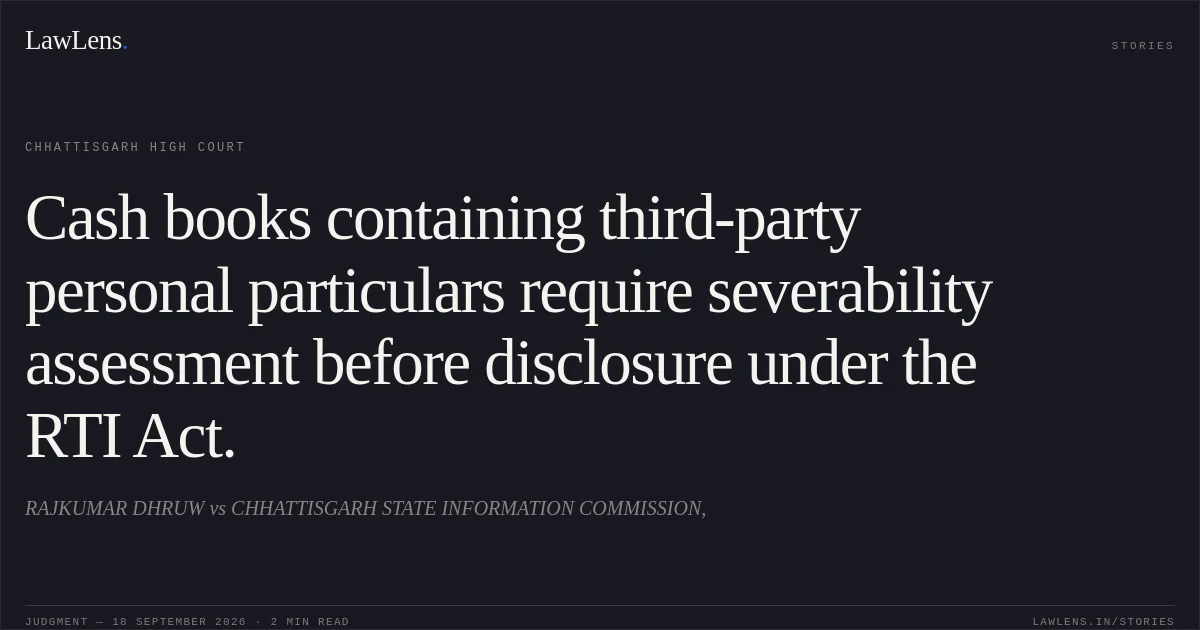
The Court found that the Cash Book contained personal particulars relating to employees, labourers and other third parties, thereby engaging the privacy exemption under Section 8(1)(j).
Source reference: para. 5The petitioner had invoked that exemption and the First Appellate Authority had affirmed the refusal through a reasoned order.
Source reference: para. 5The State Information Commission, while directing disclosure, failed to adequately examine the nature of the information and whether disclosure would invade third-party privacy.
Source reference: para. 5Although Section 10 permits severance, such disclosure required a proper examination of the records and identification of portions that could lawfully be disclosed without compromising privacy; the Commission’s order contained no such consideration.
Source reference: para. 5The Court also treated the offer of inspection as a reasonable course in the circumstances.
Source reference: para. 5Holding
The High Court held that the order dated 08.08.2024 passed by the Chhattisgarh State Information Commission was unsustainable in law and set it aside.
The order dated 19.10.2022 of the First Appellate Authority affirming the Public Information Officer’s decision was restored.
Source reference: para. 6The writ petition was accordingly allowed.
Source reference: para. 7Acts & Sections Cited
3 provisions across 1 statute referred to in this judgment. Each provision opens on LawLens.
Right to Information Act, 20053
Original Court PDF
RAJKUMAR DHRUWvsCHHATTISGARH STATE INFORMATION COMMISSION,
Click to open original judgment
Original judgment, available to read, download and summarize on LawLens.in