Facts
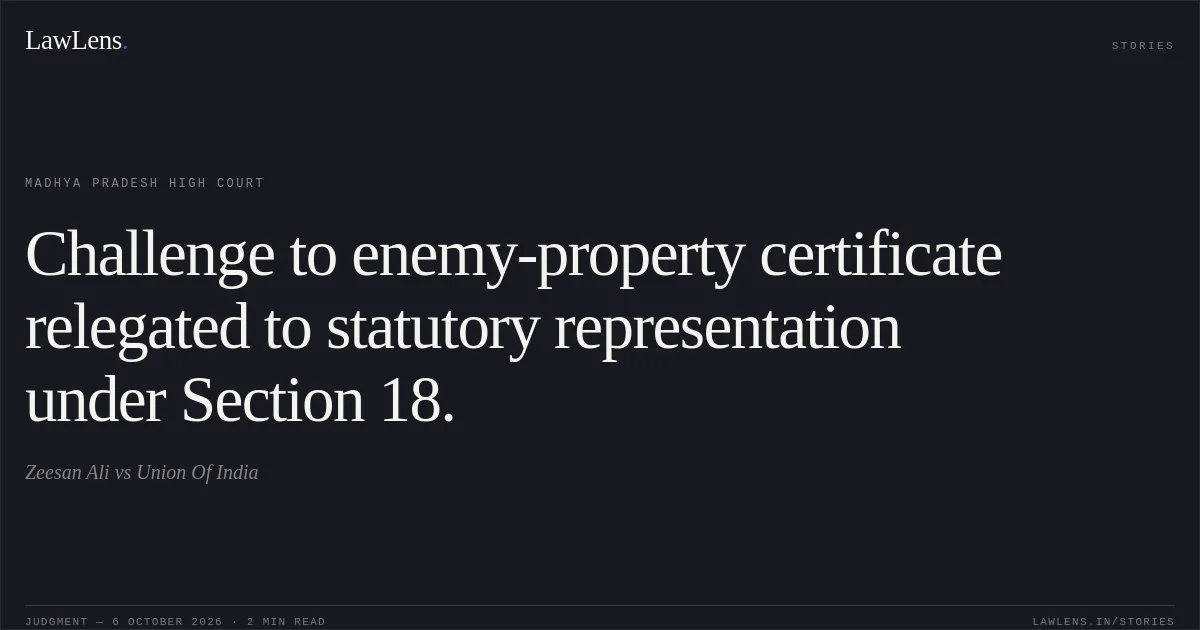
The petitioner challenged a certificate declaring the disputed property to be enemy property and a show-cause notice issued by the Sub-Divisional Officer on its basis.
Source reference: para. 1He alleged that the certificate had been issued without prior notice and sought, among other reliefs, to quash both the certificate and notice.
Source reference: para. 1The Union of India opposed the writ petition on the ground that the petitioner had not first pursued the representation remedy under Section 18 of the Enemy Property Act, 1968.
Source reference: paras. 2–3Another occupant of the same property had already filed a Section 18 representation, which was pending before the Central Government.
Source reference: paras. 2–3, 6The judgment identifies the challenged certificate as dated 29 April 2024 in the reliefs, but refers to it as dated 29 September 2024 in its discussion of the record.
Source reference: paras. 1, 6Issues
1. Whether the petitioner should be required to pursue the representation remedy under Section 18 of the Enemy Property Act, 1968, rather than obtain writ relief at this stage.
Source reference: paras. 2–3, 6–72. Whether the Sub-Divisional Officer’s proceedings should continue while that representation is pending.
Source reference: paras. 8–9Law Applied
Section 18 of the Enemy Property Act, 1968 provides a representation remedy against the relevant enemy-property action or certificate.
Source reference: para. 6The Court considered that remedy appropriate in this case and directed that the representation be decided on its merits, after a hearing and by a reasoned order; it further directed that the representation not be rejected on limitation grounds.
Source reference: paras. 8, 11The petitioner cited Shane Francisco Dias v. Union of India, 2019 SCC OnLine Bom 492, in support of approaching the High Court, but the Court did not rely on or analyse that decision in its reasoning.
Source reference: para. 2Reasoning
The Court noted that the Sub-Divisional Officer’s action was founded on the certificate and that another occupant of the same property had already invoked Section 18, with that representation pending before the Central Government.
Source reference: paras. 2, 6In those circumstances, the Court considered it proper for the petitioner also to use the statutory remedy, including to raise his contention that no notice had been given before the certificate was issued.
Source reference: paras. 6–7Rather than determine the certificate’s validity or the notice issue, it declined writ interference at that stage and preserved the petitioner’s position by keeping the related proceedings in abeyance pending the representation’s decision.
Source reference: paras. 7–9Holding
The petition was disposed of, with the petitioner relegated to the Section 18 remedy.
If he filed a representation within 15 days, the competent authority/Central Government was directed to decide it within a further 60 days by a reasoned and speaking order, after hearing him, and not to reject it on limitation grounds.
Source reference: paras. 8, 11The Sub-Divisional Officer’s proceedings under the impugned notice were to remain in abeyance, with no coercive steps against the petitioner, until the representation was decided.
Source reference: paras. 9–10Any adverse order was not to be given effect for seven days after it was passed.
Source reference: para. 12Acts & Sections Cited
1 provisions across 1 statute referred to in this judgment. Each provision opens on LawLens.
Enemy Property Act, 19681
Original Court PDF
Zeesan AlivsUnion Of India
Click to open original judgment
Original judgment, available to read, download and summarize on LawLens.in