01Facts
The petitioner, a University chowkidar, was appointed in 2002 and made permanent in 2004.
¶ 1Following allegations of repeated unauthorised absence, the University conducted an inquiry and, by order dated 10 September 2012, treated 461 days’ absence as dies non and imposed stoppage of one increment without cumulative effect.
¶ 1The petitioner returned to duty that day.
¶ 1The University subsequently issued three months’ notice and, by order dated 16 April 2013, compulsorily retired him, relying on his absenteeism and prior punishment.
¶ 1His representation was rejected on 11 July 2018, after which he filed this writ petition challenging both orders.
¶ 1–2The University maintained that the petitioner’s service record was unsatisfactory and that his absenteeism adversely affected its work.
¶ 302Issues
i.Whether the University could impose compulsory retirement as a penalty under Clause 57(1)(e) of Statute 31 without conducting a departmental inquiry.
¶ 7(i)ii.Whether the petitioner was entitled to back wages for the period he remained out of service.
¶ 7(ii)03Law Applied
Under Section 35 of the Chhattisgarh Vishwavidyalaya Adhiniyam, 1973, University statutes have legal force and govern the service conditions of University employees.
¶ 8–9Clause 57 of Statute 31 provides for penalties, while the Court applied Rules 10 and 14 of the Chhattisgarh Civil Services (Classification, Control and Appeal) Rules, 1966: compulsory retirement is a major penalty, and a penalty specified in Rule 10(v)–(ix) cannot be imposed without an inquiry conducted in accordance with Rule 14.
¶ 10–11Vidya Ram Misra v. Managing Committee, Shri Jai Narain College, (1972) 1 SCC 623, supports the enforceability of University statutes as binding service conditions.
¶ 8The Court relied on State of Gujarat v. Umedbhai M. Patel, (2001) 3 SCC 314, for the principles that compulsory retirement in the public interest is ordinarily non-punitive, must not be used to avoid a departmental inquiry where one is warranted, and must not be imposed as a punitive measure.
¶ 13It also relied on S.S. Das v. Union of India, 2026 SCC OnLine SC 1809, concerning the limits on compulsory retirement and its impermissible use as a backdoor disciplinary proceeding.
¶ 14Back wages depend on the facts of the case, including the employee’s conduct and whether the employee was gainfully employed, as stated in Pradeep v. Manganese Ore (India) Ltd., (2022) 3 SCC 683.
¶ 18Provisions in the judgment · 10
Central University of Himachal Pradesh (Amendment) Statutes, 2019 Section 57Section 13Section 10
Chhattisgarh Vishwavidyalaya Adhiniyam, 1973 Section 35
Aligarh Muslim University Act, 1920 Section 32Section 6
College Code Section 7Section 8
Ordinance (unresolved) Section 7Section 8
04Reasoning
The Court found that the University had already dealt with the absenteeism through an inquiry, treating the relevant period as dies non and imposing stoppage of one increment.
¶ 11–15The subsequent compulsory-retirement order relied on the same absenteeism and prior punishment and was therefore punitive in substance, rather than a bona fide, non-punitive measure taken in the public interest.
¶ 11–15Because compulsory retirement was imposed as a major penalty, the University was required to follow the prescribed departmental inquiry procedure; it could not use compulsory retirement to bypass that procedure.
¶ 11–15As to back wages, the petitioner filed his representation and writ petition several years after the retirement order and had not pleaded that he was unable to obtain other employment despite efforts. The Court therefore declined back wages.
¶ 1705Holding
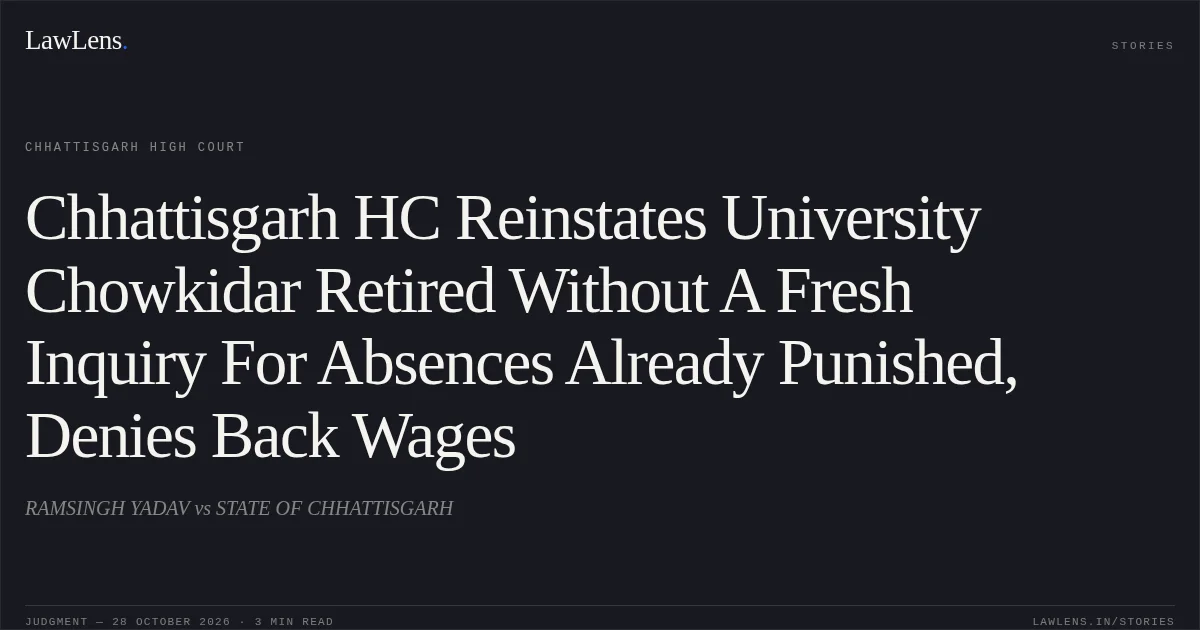
The Court held that the compulsory-retirement order was imposed as a penalty without the required departmental inquiry and was unsustainable.
¶ 19It allowed the petition in part, set aside the orders dated 16 April 2013 and 11 July 2018, and directed the respondents to reinstate the petitioner with continuity of service and notional wage fixation, but without back wages, within two months of production of a certified copy of the order.
¶ 19Original Court PDF
RAMSINGH YADAVvsSTATE OF CHHATTISGARH
Click to open original judgment
Original judgment, available to read, download and summarize on LawLens.in