01Facts
The petitioners (Accused Nos. 1 to 5) sought quashing under Section 528 BNSS (Section 482 CrPC) of C.C. No. 1121/2026, arising from Crime No. 170/2026 at Chikkodi Police Station, for offences under Sections 9, 10 and 11 of the Prohibition of Child Marriage Act, 2006.
p. 3 · ¶ 2Respondent No. 2 lodged the complaint, and Respondent No. 3, the alleged victim, is now 18 years old.
p. 4 · ¶ 3 · p. 5, affidavitBoth parties, with the intervention of elders, executed a compromise and filed an I.A. under Section 359 r/w Section 528 BNSS, signed by them and their counsel.
p. 3 · ¶ 3 · pp. 4–5 · ¶ 3Respondent No. 3's affidavit states she has attained majority, is living happily with her husband, and supports the compromise.
pp. 5, affidavit paras 1–3 · p. 6The learned HCGP did not object to the compromise.
p. 6 · ¶ 6The Court perused the complaint, FIR, I.A. and charge-sheet.
p. 5 · ¶ 4The Court records that Respondent No. 2 filed the case "with misconception of facts and in a fit of anger," and that Respondent No. 3 now wishes to withdraw it.
p. 12 · ¶ 902Issues
i.1. Whether the High Court may quash criminal proceedings under the Prohibition of Child Marriage Act, 2006 (Ss. 9–11) on the basis of a settlement between the parties, where the offences are not expressly compoundable.
p. 7 · ¶ 8 (Narinder Singh, Principles I–II) · p. 13 · ¶ 10ii.2. Whether the settlement and the circumstances of the case (family dispute, remote chance of conviction, early stage) justify quashing under the Narinder Singh principles.
p. 12 · ¶ 9 · p. 13 · ¶ 1003Law Applied
Section 528 BNSS (corresponding to Section 482 CrPC) preserves the High Court's inherent power to quash proceedings to secure the ends of justice or prevent abuse of process.
p. 3 · ¶ 2Section 359 BNSS (compounding) was invoked as the procedural vehicle for the settlement.
p. 3 · ¶ 3Narinder Singh v. State of Punjab, (2014) 6 SCC 466, holds that the inherent power to quash non-compoundable offences is to be exercised sparingly and with caution.
p. 7 · ¶ 8, Principle IQuashing is justified where the guiding factors of ends of justice or abuse of process are met.
p. 7, Principle IISuch power must not be exercised for heinous or serious offences of mental depravity, or for offences under special statutes.
pp. 7–8, Principle IIIQuashing is appropriate for cases of predominantly civil character, including family disputes, once the parties have resolved their disputes.
p. 8, Principle IVThe High Court must assess whether conviction is remote or bleak and whether continuation would cause oppression or injustice.
p. 8, Principle VTiming of settlement is relevant, with greater liberality at the investigation stage.
p. 9, Principle VIIProvisions in the judgment · 11 · Linked ones open on LawLens
Bharatiya Nagarik Suraksha Sanhita, 2023 Section 528Section 359
Prohibition of Child Marriage Act, 2006 Section 9Section 10Section 11
Code of Criminal Procedure, 1973 Section 482Section 320
Indian Penal Code, 1860 Section 307Section 324Section 323Section 34
04Reasoning
The Court treated the dispute as a family dispute, arising from a complaint filed "in a fit of anger" under a misconception of facts, which the victim has since withdrawn with the support of elders.
p. 12 · ¶ 9The Court relied on the parties' decision to live peacefully as an "important consideration."
p. 12 · ¶ 9On the likelihood of conviction, the Court found that the role attributed to the accused was unclear, that the complainant did not clearly allege a direct nexus with them, and that witnesses were unlikely to support the prosecution after the compromise. It therefore held that conviction was "very remote."
pp. 12–13 · ¶ 9The Court also considered that the matter was at a pre-trial stage, with the possibility of further investigation or charge-sheet noted.
p. 12 · ¶ 9The reasoning is limited to the family-dispute and remote-conviction factors. The judgment does not analyse whether the PCMA offences, which concern child marriage and the protection of a minor, fall within Principle III as offences of a serious social character or under a special statute, nor whether they are compoundable under Section 359 BNSS.
The judgment does not discuss the victim's age at the time of the alleged marriage, beyond recording her present majority.
p. 5, affidavit para. 205Holding
The compromise was to be accepted and continuation of the proceedings would be unnecessary, as conviction was remote.
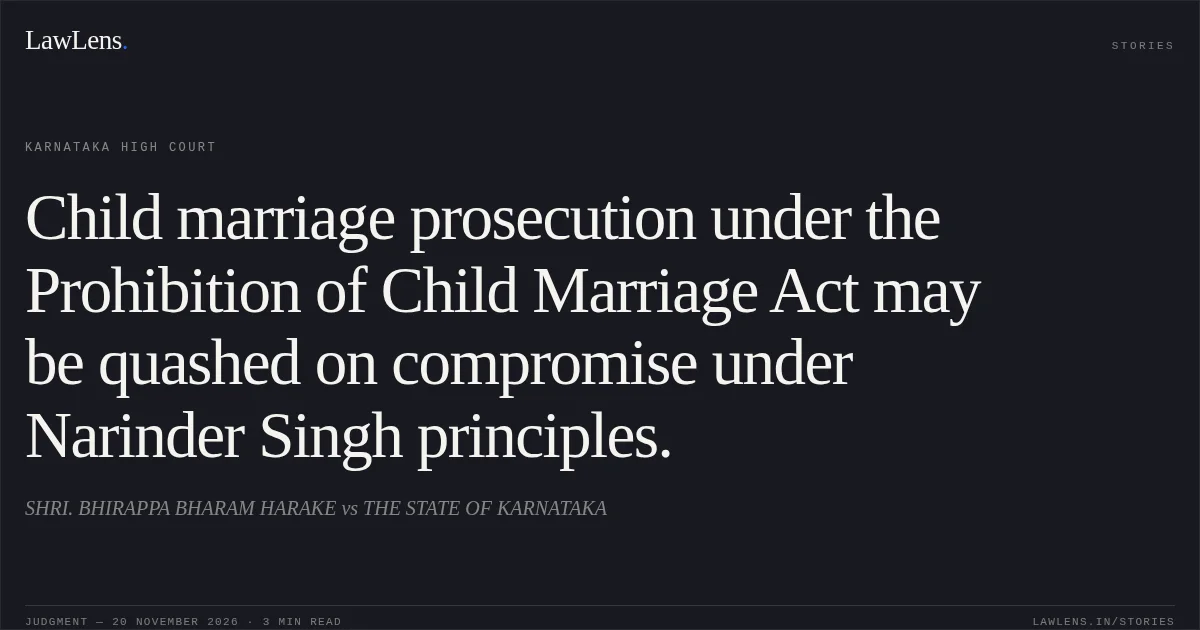
pp. 12–13 · ¶ 9The Criminal Petition was allowed and the entire proceedings in C.C. No. 1121/2026 (Crime No. 170/2026, Chikkodi PS) against Accused Nos. 1 to 5 under Sections 9, 10 and 11 of the PCMA, 2006 were quashed. The compromise petition was accepted, and pending I.A.s were disposed of.
p. 13 · ¶ 10Original Court PDF
SHRI. BHIRAPPA BHARAM HARAKEvsTHE STATE OF KARNATAKA
Click to open original judgment
Original judgment, available to read, download and summarize on LawLens.in