01Facts
On the complaint of Respondent No. 2 (Shabbir Dastgir Sanadi), Market P.S. Crime No. 209/2018 was registered against the petitioners. The original FIR cited Sections 143, 147, 148, 324, 326 r/w 149 IPC, but the charge-sheet was filed under Sections 143, 147, 148, 308 r/w 149 IPC and is pending as S.C. No. 42/2026 before the X Addl. District and Sessions Court, Belagavi.
¶ 3 · pp. 5–6The petitioners (Accused Nos. 1, 3, 4, 6, 9 in Crl.P 102660/2026, and Accused No. 10 in Crl.P 103370/2026) sought quashing of the entire proceedings under Section 482 CrPC (Section 528 BNSS).
¶ 2 · pp. 3–4The parties, through elders of both families, settled the dispute. They filed joint applications under Section 359 BNSS for compounding and supporting affidavits, stating that the complainant had no objection to quashing and would not file further cases.
¶ 4–5 · pp. 5–10The HCGP and counsel supported acceptance of the compromise.
¶ 6 · p. 10The court noted that the offences are non-compoundable.
¶ 7 · pp. 10–1102Issues
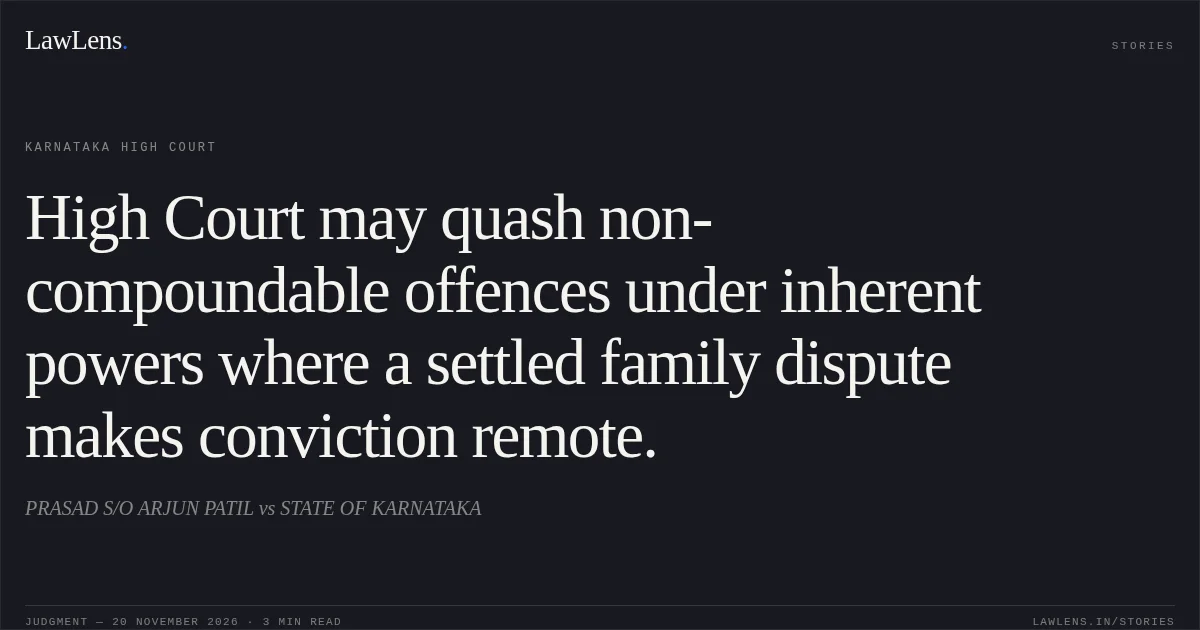
i.1. Whether the High Court can exercise its inherent power under Section 482 CrPC (Section 528 BNSS) to quash criminal proceedings for non-compoundable offences under Sections 143, 147, 148, 308 r/w 149 IPC on the basis of a settlement between the parties.
¶ 8, 10 · pp. 11–12, 17–18ii.2. Whether the settlement, the nature of the allegations, the stage of the case and the remoteness of conviction justify quashing the proceedings in the interest of justice and to prevent abuse of process.
¶ 9 · pp. 16–1703Law Applied
The court relied on Section 482 CrPC (Section 528 BNSS), which preserves the High Court's inherent power to prevent abuse of process and secure the ends of justice, and which is distinct from compounding under Section 320 CrPC.
¶ 8, Narinder Singh, principle I · pp. 11–12The court also referred to Section 359 BNSS, the compounding provision invoked in the joint applications.
pp. 5–8The court applied the principles in Narinder Singh v. State of Punjab (2014) 6 SCC 466, paras 31(I)–(VII). Under these principles, the power is exercised sparingly. Quashing is permissible for non-compoundable offences where the settlement secures the ends of justice. It is not appropriate for heinous or serious offences of mental depravity, such as murder or rape. Family, matrimonial or predominantly civil disputes may be quashed upon full settlement. The court must assess whether conviction is remote and whether continuation would cause oppression. Offences under Section 307 IPC are treated as serious, but the court must examine the nature of injuries, weapons and the strength of evidence. The stage of the case is also relevant.
¶ 8 · pp. 11–16Provisions in the judgment · 14 · Linked ones open on LawLens
Code of Criminal Procedure, 1973 Section 482Section 320
Indian Penal Code, 1860 10 provisions
Section 143Section 147Section 148Section 308Section 149Section 324Section 326Section 307Section 323Section 34Bharatiya Nagarik Suraksha Sanhita, 2023 Section 528Section 359
04Reasoning
The court held that the dispute was essentially private and arose from a family or village disagreement. The complainant had filed the case "with misconception of facts and in a fit of anger" and later sought to withdraw it on the advice of elders, who had intervened and secured peaceful future relations.
¶ 9 · pp. 16–17Applying Narinder Singh, the court found that the trial had not yet produced substantial evidence and that witnesses were unlikely to support the prosecution after the compromise. It also observed that the role of the accused was unclear and that the complainant had not clearly alleged a direct nexus between the accused and the injuries. On that basis, the court concluded that the chances of conviction were "very remote" and that continuing the proceedings would be unnecessary and an abuse of process.
¶ 9 · p. 17The order does not discuss the nature of the injuries or any medical evidence in relation to Section 308 IPC, which the court would ordinarily consider under principle VI of Narinder Singh. The reasoning therefore rests mainly on the private character of the dispute, the settlement, the unclear role attributed to the accused and the remoteness of conviction.
pp. 13–14 · ¶ 9 · p. 1705Holding
The High Court accepted the compromise and held that continuing the proceedings would be an abuse of process, relying on the private character of the dispute, the settlement, the unclear role of the accused and the remoteness of conviction.
¶ 9–10 · pp. 17–18Both criminal petitions were allowed. The entire proceedings in S.C. No. 42/2026 before the X Addl. District and Sessions Court, Belagavi, arising out of Crime No. 209/2018 of Market P.S., Belagavi, were quashed insofar as Accused Nos. 1, 3, 4, 6, 9 and 10 are concerned. Pending I.A.s, if any, were disposed of as not surviving for consideration.
p. 18Original Court PDF
PRASAD S/O ARJUN PATILvsSTATE OF KARNATAKA
Click to open original judgment
Original judgment, available to read, download and summarize on LawLens.in