Facts
The petitioner, a minor, alleged that she was sexually assaulted when she was eight years old.
Source reference: para. 5An FIR was registered under Sections 376-AB and 120-B of the Indian Penal Code and Sections 5(m) and 6 of the POCSO Act; after investigation, a charge-sheet was filed under the relevant provisions.
Source reference: para. 5, 7Although the child was taken for medical examination, consent was not given for the particular examination relating to penetrative assault, so no injury report of the kind required by Entry 7 of Annexure 1 to the Uttar Pradesh Rani Lakshmi Bai Mahila Evam Bal Samman Kosh Rules, 2015 was prepared.
Source reference: para. 6, 18The District Steering Committee rejected her application for ₹3,00,000 in assistance because that report was unavailable.
Source reference: para. 8, 12The petitioner challenged the rejection; the State defended the report as a mandatory eligibility document.
Source reference: para. 9–14Issues
Whether an injury report indicating penetrative sexual assault could validly be made an indispensable condition for assistance under Entry 7, including where the report was unavailable because the victim did not consent to the relevant examination.
Source reference: para. 15, 29Whether that condition was arbitrary and violated Article 14 by frustrating the welfare purpose of the Scheme.
Source reference: para. 15, 35–42Whether the Court could strike down the condition and grant effective relief despite the absence of a specific prayer challenging its validity.
Source reference: para. 14, 44–45Law Applied
Rule 4(a) of the 2015 State Scheme establishes its purpose as providing immediate monetary and medical relief, and supporting victims’ maintenance, education, health and rehabilitation; Entry 7 prescribed an FIR, an injury report indicating penetrative sexual assault and a charge-sheet as pre-requisites for assistance.
Source reference: para. 16, 18Under Article 14, a classification must rest on an intelligible differentia having a rational nexus with the measure’s objective, and arbitrary State action is also constitutionally vulnerable.
Source reference: para. 37Sections 3, 5(m) and 6 of the POCSO Act define penetrative and aggravated penetrative sexual assault; the offence does not require proof of a visible injury.
Source reference: para. 22–26Section 27(1) of the POCSO Act, read with Section 164-A(7) CrPC and Section 184(7) BNSS, protects the requirement of consent to medical examination.
Source reference: para. 30Section 33(8) of the POCSO Act and Rule 9 of the POCSO Rules, 2020 provide for compensation and preserve relief under other schemes.
Source reference: para. 17The Court also relied on Lillu alias Rajesh v. State of Haryana on consent, dignity and bodily integrity; Dalip Kumar alias Dalli v. State of Uttaranchal and Lok Mal alias Loku v. State of Uttar Pradesh on the absence of injury not being fatal to proof of sexual assault; and Dwarka Nath v. Income Tax Officer and other authorities on the High Court’s power to mould effective relief.
Source reference: para. 24–25, 31, 45Reasoning
The FIR and charge-sheet invoked the relevant POCSO provisions, while the report was absent because the victim did not consent to the specific examination.
Source reference: para. 6–7, 46The Court held that an injury report may assist the authority but is neither conclusive of assault nor indispensable to establishing the offence; making it an absolute condition would exclude victims whose injuries are not visible, whose examination occurs after physical signs disappear, or who do not consent to the examination.
Source reference: para. 20, 23–29, 41That exclusion bore no rational nexus to the Scheme’s rehabilitative purpose and effectively penalised the exercise of a choice protected by law.
Source reference: para. 33–39, 42The condition was severable: the entry could operate on the basis of the FIR and charge-sheet, with any available medical report considered but not required.
Source reference: para. 43Because the State had defended the condition and the issue had been fully argued, the absence of a specific prayer did not prevent the Court from granting effective relief.
Source reference: para. 44–45Holding
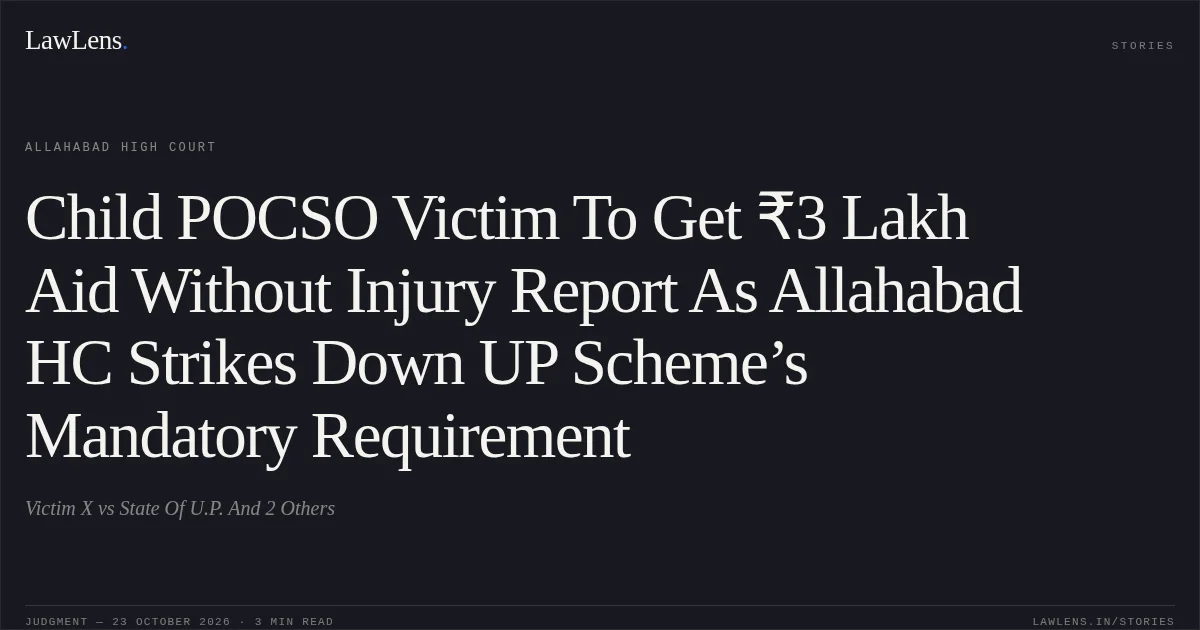
The Court held that the requirement of an “injury report indicating penetrative sexual assault” as an indispensable condition for assistance under Entry 7 was unconstitutional under Article 14 and struck it down.
It quashed the District Steering Committee’s rejection and allowed the petition, finding that the FIR and charge-sheet satisfied the surviving requirements.
Source reference: para. 46The State was directed to release ₹3,00,000 within ten days, by deposit in the victim’s protected bank account or through another lawful arrangement safeguarding the minor’s interests.
Source reference: para. 47Acts & Sections Cited
11 provisions across 3 statutes referred to in this judgment. Each provision opens on LawLens.
Indian Penal Code, 18602
Protection of Children from Sexual Offences Act, 20128
Bharatiya Nagarik Suraksha Sanhita, 20231
Original Court PDF
Victim XvsState Of U.P. And 2 Others
Click to open original judgment
Original judgment, available to read, download and summarize on LawLens.in