Facts
Pinky Devi and Ashok Kumar married in 2017 and have two children, aged seven and five at the time of the proceedings. The parents had lived separately since 2020. The mother alleged that the father had taken the children from her custody without consent, prevented her from meeting them, and that his conduct endangered their welfare. She sought their production and custody by a writ of habeas corpus.
Source reference: para. 2.1–2.9, 3The High Court entertained the petition, directed the father to produce the children, and facilitated an interim arrangement under which they went with their mother.
Source reference: para. 48–50The matter was reserved after hearing the parties.
Source reference: para. 51–52Issues
1. Whether a habeas corpus petition under Article 226 is maintainable in a dispute over the custody of minor children where the children are with their father, a natural guardian, and statutory remedies are available
Source reference: para. 15–22, 34–352. Whether, having regard to the children’s welfare and the circumstances of the case, their custody should remain with the father or be placed with the mother
Source reference: para. 67–72Law Applied
Article 226 confers discretionary jurisdiction to issue habeas corpus in child-custody matters, but the remedy is extraordinary and is ordinarily appropriate where a minor’s custody is illegal or without authority; where detailed fact-finding is required, parties may be directed to the statutory forum [Tejaswini Gaud v. Shekhar Jagdish Prasad Tewari, as discussed at paras. 16–20; Nirmala v. Kulwant Singh, discussed at paras. 19–20].
Source reference: para. 16–20The availability of an alternative remedy is a relevant consideration, not an absolute bar to writ jurisdiction [Maharashtra Chess Association v. Union of India, paras. 27–28].
Source reference: para. 27–28In every custody decision, the child’s welfare is paramount and prevails over the competing legal rights of the parents [Rosy Jacob v. Jacob A. Chakramakkal, para. 23 and quoted at para. 40; Gaurav Nagpal v. Sumedha Nagpal, para. 24; Nil Ratan Kundu v. Abhijit Kundu, para. 25].
Source reference: para. 23, 40The Court also referred to the Guardians and Wards Act, 1890, including Section 25, and Section 7(1)(g) of the Family Courts Act, 1984, as providing statutory avenues for custody relief.
Source reference: para. 21It applied its parens patriae jurisdiction to assess the children’s welfare, including their comfort, health, education and development.
Source reference: para. 38–39, 46Reasoning
The Court held the petition maintainable because the circumstances and the children’s welfare warranted examination despite the availability of statutory remedies; alternative forums did not automatically oust Article 226 jurisdiction.
Source reference: para. 21–22, 34–35It noted the mother’s allegations of forcible removal and denial of access, the children’s ages, and the interim arrangement under which they were with her.
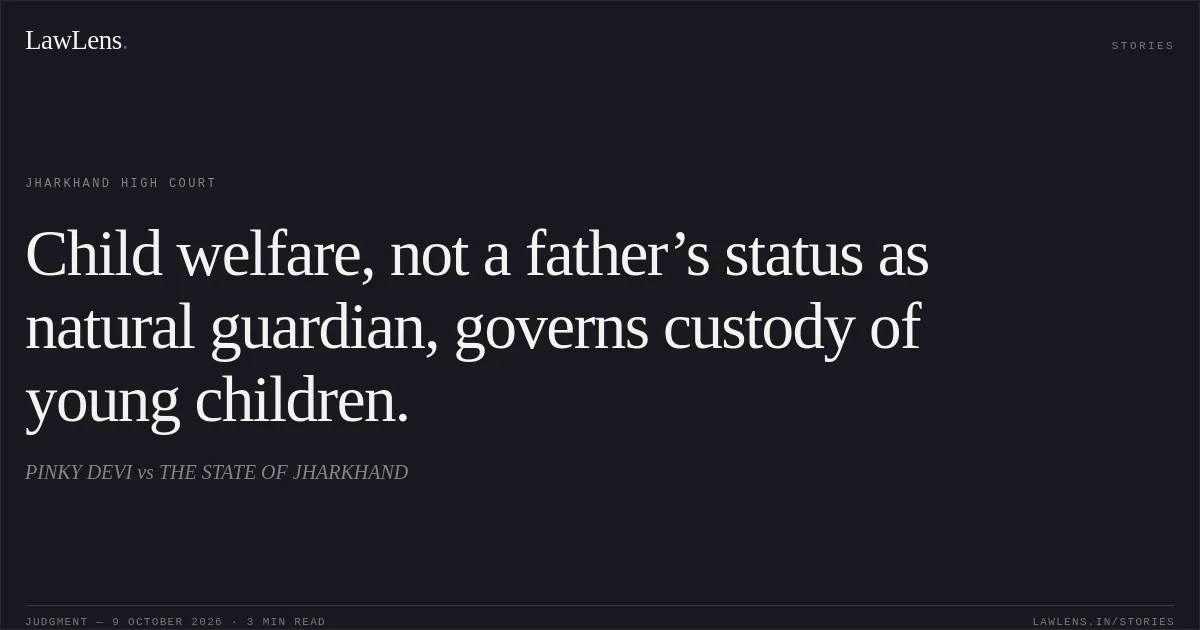
Source reference: para. 63–67Although the Court acknowledged that the father was the natural guardian and that the allegations raised disputed factual questions, it concluded that welfare—not parental status alone—controlled the decision. It found that, in the circumstances, the children’s interests were better served by remaining with their mother.
Source reference: para. 32, 67–71The judgment’s custody directions were expressly temporary, leaving the parties free to seek a full determination before the competent court.
Source reference: para. 79–81Holding
The High Court held the habeas corpus petition maintainable and directed that custody of both children remain with the mother, who was required to ensure that their education was not disrupted.
The father was granted visitation at the mother’s residence or parental home every Sunday from 4:00 p.m. to 6:00 p.m., without taking the children outside.
Source reference: para. 76–78The directions were temporary; either parent could apply to the competent court, which was directed to decide any such application expeditiously and independently on its merits.
Source reference: para. 79–82Acts & Sections Cited
22 provisions across 6 statutes referred to in this judgment. Each provision opens on LawLens.
Bharatiya Nagarik Suraksha Sanhita, 2023
Hindu Marriage Act, 19551
Hindu Minority and Guardianship Act, 19561
Guardians and Wards Act, 18901
Family Courts Act, 19841
Original Court PDF
PINKY DEVIvsTHE STATE OF JHARKHAND
Click to open original judgment
Original judgment, available to read, download and summarize on LawLens.in