Facts
The appellant was convicted by the Additional Sessions Judge, Patan, on 09.11.2017 for the murder of his wife, Ramila, under Sections 302, 498A, and 201 of the IPC
Source reference: p. 1The prosecution case alleged that on 18.11.2013, the appellant strangled the deceased due to suspicions regarding her character
Source reference: p. 2The complainant (PW-1) found the deceased with ligature marks and a cut on her neck; the appellant was absent from the scene
Source reference: p. 2The trial court relied on circumstantial evidence, including "last seen together," motive (past marital disputes), and the appellant's conduct (absconding)
Source reference: p. 8, 11The appellant challenged the conviction, arguing that the chain of circumstances was incomplete and based on hearsay
Source reference: p. 6Issues
1. Whether the prosecution established a complete chain of circumstantial evidence consistent only with the hypothesis of the appellant’s guilt
Source reference: p. 19, para 312. Whether the burden of proof shifted to the appellant under Section 106 of the Indian Evidence Act to explain the death occurring within the privacy of the matrimonial home
Source reference: p. 17, para 253. Whether the testimony of interested witnesses and medical evidence was sufficient to sustain a conviction under Section 302 IPC
Source reference: p. 14, 16Law Applied
The court applied Section 302 (Murder), Section 498A (Cruelty), and Section 201 (Causing disappearance of evidence) of the IPC
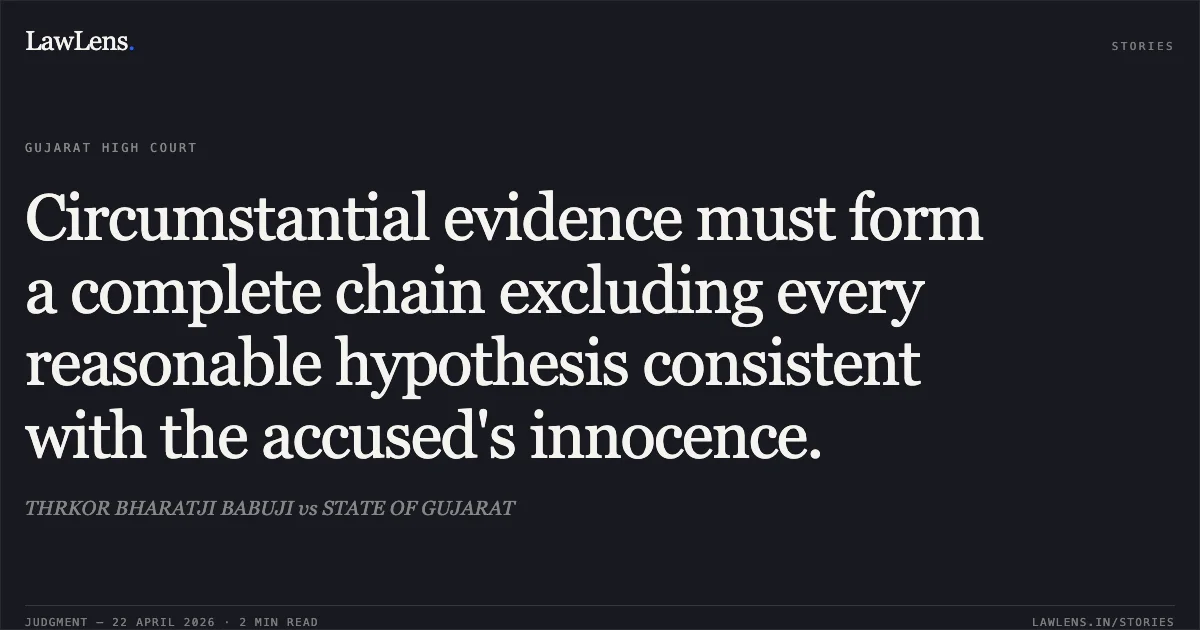
Source reference: p. 1It strictly adhered to the principles of circumstantial evidence laid down in Sharad Birdhichand Sarda v. State of Maharashtra and Shailendra Rajdev Pasvan v. State of Gujarat, which require a complete chain of evidence excluding every hypothesis of innocence
Source reference: p. 20, para 32It further interpreted Section 106 of the Indian Evidence Act, clarifying that the burden of proving "special knowledge" only shifts after the prosecution proves foundational facts
Source reference: p. 17Reasoning
The High Court found that the trial court erred in placing the burden of proof on the accused before the prosecution had established a prima facie case
Source reference: p. 17, para 25.3The court noted that PW-1 was not an eyewitness and his testimony regarding the manner of death was based on assumption
Source reference: p. 10Inconsistencies regarding the nature of injuries (strangulation vs/ cut marks) were not resolved
Source reference: p. 14Crucially, the "last seen together" theory was weakened because no witness actually saw the appellant fleeing the scene
Source reference: p. 16, para 22The court emphasized that while medical evidence confirmed homicidal death (asphyxia due to pressure), it did not link the appellant to the act
Source reference: p. 16, para 24Since the appellant's own relatives turned hostile, the prosecution's reliance on interested witnesses (the deceased's family) failed to form a complete chain
Source reference: p. 18, para 27Holding
The High Court allowed the appeal and quashed the judgment dated 09.11.2017
The court held that the trial court wrongly invoked Section 106 of the Evidence Act as the prosecution failed to prove foundational facts beyond a reasonable doubt
Source reference: p. 17Finding that a link in the chain of circumstantial evidence was missing, the court acquitted the appellant of all charges and ordered his immediate release
Source reference: p. 21Acts & Sections Cited
2 provisions across 1 statute referred to in this judgment. Each provision opens on LawLens.
Indian Penal Code, 18602
Original Court PDF
THRKOR BHARATJI BABUJIvsSTATE OF GUJARAT
Click to open original judgment
Original judgment, available to read, download and summarize on LawLens.in