Facts
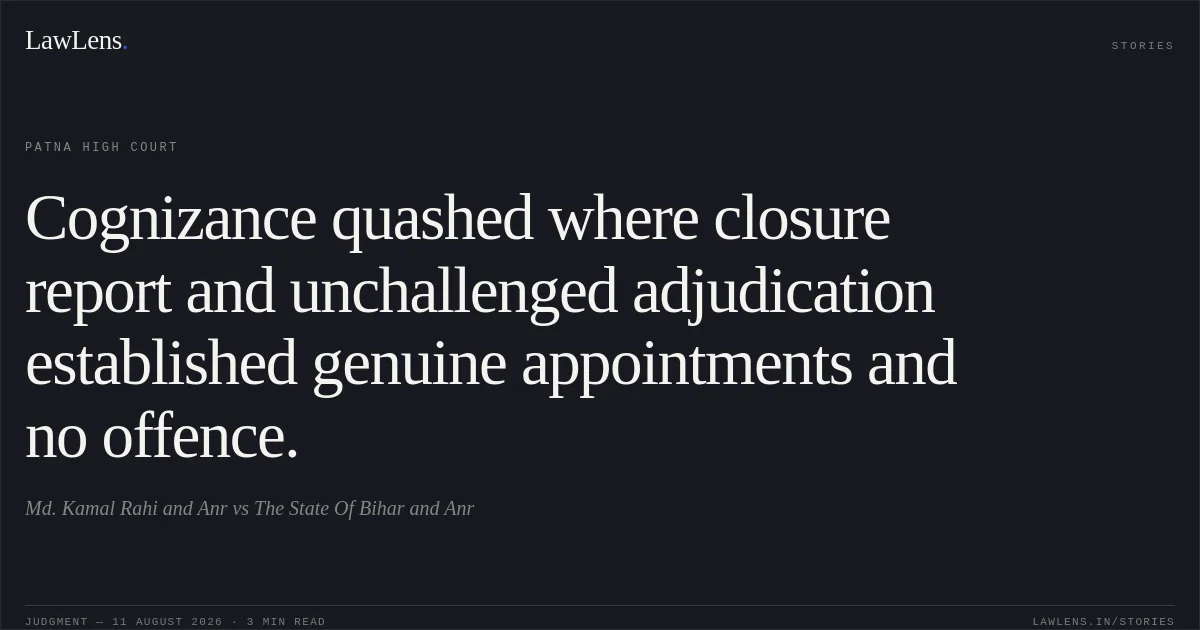
The petitioners—Md. Kamal Rahi and Smt. Shahanaj Begam—were alleged to have participated in the fabrication and use of a forged appointment letter by which petitioner no. 1 obtained appointment as a Panchayat Teacher.
Source reference: paras. 3–4; pp. 2–3Petitioner no. 2, his sister and the Headmistress of the concerned school, was alleged to have facilitated the appointment.
Source reference: paras. 3–4; pp. 2–3Andhramath P.S. Case No. 28 of 2011 was registered for offences under Sections 420, 406, 409 and 468 read with Section 34 of the IPC.
Source reference: paras. 4–5; p. 3After investigation, the police submitted a closure report finding the case false.
Source reference: paras. 4–5; p. 3The petitioners had also approached the District Teachers Employment Appellate Authority pursuant to an earlier High Court order.
Source reference: paras. 7–9, 12; pp. 3–7The Appellate Authority consequently directed payment of the petitioners’ salaries, and the order was not challenged before any higher forum.
Source reference: paras. 7–9, 12; pp. 3–7Issues
Whether the Magistrate’s order taking cognizance under Sections 420 and 468 read with Section 34 IPC could be sustained when the police had submitted a closure report and subsequent quasi-judicial proceedings had found the petitioners’ appointment letters genuine?
Source reference: paras. 5–6, 12; pp. 3, 7Whether continuation of the criminal proceedings amounted to an abuse of the process of law warranting exercise of the High Court’s inherent jurisdiction under Section 482 CrPC in terms of the principles laid down in State of Haryana v. Bhajan Lal?
Source reference: paras. 10–12; pp. 4–7Law Applied
The Court considered the offences under Sections 420 and 468 read with Section 34 IPC, concerning cheating, forgery for the purpose of cheating, and common intention.
Source reference: paras. 10–11; pp. 4–6It exercised the High Court’s inherent jurisdiction under Section 482 CrPC to prevent abuse of process and secure the ends of justice.
Source reference: paras. 10–11; pp. 4–6The Court relied on State of Haryana v. Bhajan Lal, 1992 Supp. (1) SCC 335, particularly categories (3) and (5) of paragraph 102: criminal proceedings may be quashed where the uncontroverted allegations and evidence collected do not disclose the commission of any offence, or where the allegations are so absurd and inherently improbable that no prudent person could conclude that sufficient grounds exist to proceed against the accused.
Source reference: paras. 10–11; pp. 4–6Reasoning
The Court found that the police investigation had resulted in a closure report against the petitioners.
Source reference: para. 5; p. 3More importantly, the competent Teachers Employment Appellate Authority, acting in a quasi-judicial capacity, had adjudicated upon the appointment dispute, accepted the genuineness of the appointment letters, and directed payment of salary; that decision remained unchallenged.
Source reference: paras. 8–9, 12; pp. 4, 7In light of these circumstances, the material available against the petitioners did not disclose the commission of the alleged offences, satisfying the third Bhajan Lal category.
Source reference: para. 12; p. 7The continuation of prosecution was also considered unjustified under the fifth category, as the foundational allegation of forged appointment documentation was contradicted by the subsequent adjudicatory finding.
Source reference: para. 12; p. 7Holding
The Magistrate’s cognizance order was therefore held liable to be quashed.
The Patna High Court allowed the application and quashed the order dated 31 July 2018 passed by the Judicial Magistrate, 1st Class, Jhanjharpur, in G.R. No. 751 of 2011 arising out of Andhramath P.S. Case No. 28 of 2011, insofar as it concerned both petitioners and offences under Sections 420 and 468 read with Section 34 IPC.
Source reference: paras. 12–13; p. 7A copy of the judgment was directed to be communicated to the trial court.
Source reference: para. 14; p. 7Acts & Sections Cited
8 provisions across 2 statutes referred to in this judgment. Each provision opens on LawLens.
Indian Penal Code, 18605
Code of Criminal Procedure, 19733
Original Court PDF
Md. Kamal Rahi and AnrvsThe State Of Bihar and Anr
Click to open original judgment
Original judgment, available to read, download and summarize on LawLens.in