Facts
The petitioner’s father, an employee of the State Bank of India working as a Messenger, died in harness on 13 June 2013.
Source reference: paras. 1–4Her mother applied on 14 October 2013 for compassionate appointment for the petitioner, followed by a reminder dated 12 November 2020.
Source reference: paras. 1–4The Bank rejected the claim by order dated 14 December 2020, holding that the petitioner did not fall within the categories covered by Clause 5 of the Bank’s compassionate appointment scheme dated 13 May 2011.
Source reference: paras. 1–4The Bank also contended that the petitioner’s mother had accepted Rs. 4,00,000 in lieu of compassionate appointment under an agreement dated 16 September 2013.
Source reference: paras. 1–4The petitioner challenged the rejection and sought appointment under the compassionate appointment scheme
Source reference: paras. 1–4Issues
Whether the petitioner was eligible for compassionate appointment under Clause 5 of the State Bank of India scheme dated 13 May 2011, despite her father’s death in harness?
Source reference: paras. 6–9Whether the alleged payment of Rs. 4,00,000 to the petitioner’s mother in lieu of compassionate appointment affected the petitioner’s claim?
Source reference: para. 8Whether the rejection order dated 14 December 2020 was arbitrary, discriminatory, or otherwise liable to be quashed?
Source reference: paras. 3, 6, 9Law Applied
The Court applied Clause 5 of the State Bank of India’s compassionate appointment scheme dated 13 May 2011, which limited applicability of the scheme to cases where an employee died while performing official duty as a result of violence, terrorism, robbery or dacoity, or where the employee died within five years of first appointment or before attaining 30 years of age, whichever was later, leaving a dependent spouse and/or minor children
Source reference: para. 7The Court further applied the principle that compassionate appointment is governed by the applicable policy in force at the relevant time and that the appointing authority must decide eligibility in accordance with that policy
Source reference: para. 9Since the petitioner did not challenge the validity of Clause 5, the Court assessed her claim within the limits of that clause
Source reference: para. 9Reasoning
The Court found that the petitioner’s father did not die in circumstances involving violence, terrorism, robbery or dacoity.
Source reference: paras. 4, 7, 9He was also approximately 56 years old at the time of death and therefore did not satisfy the alternative age-related eligibility condition under Clause 5
Source reference: paras. 4, 7, 9Accordingly, the Bank had correctly applied the governing scheme and rejected the claim.
Source reference: paras. 4, 7, 9Although the respondents relied on the alleged payment of Rs. 4,00,000 in lieu of compassionate appointment, the rejection order did not refer to that payment as a ground for refusal.
Source reference: para. 8The Court therefore declined to accept that contention as a basis for upholding the order, but held that the independent ground based on Clause 5 was sufficient
Source reference: para. 8The petitioner’s challenge to the policy was also unavailable because Clause 5 had not been challenged
Source reference: para. 9Holding
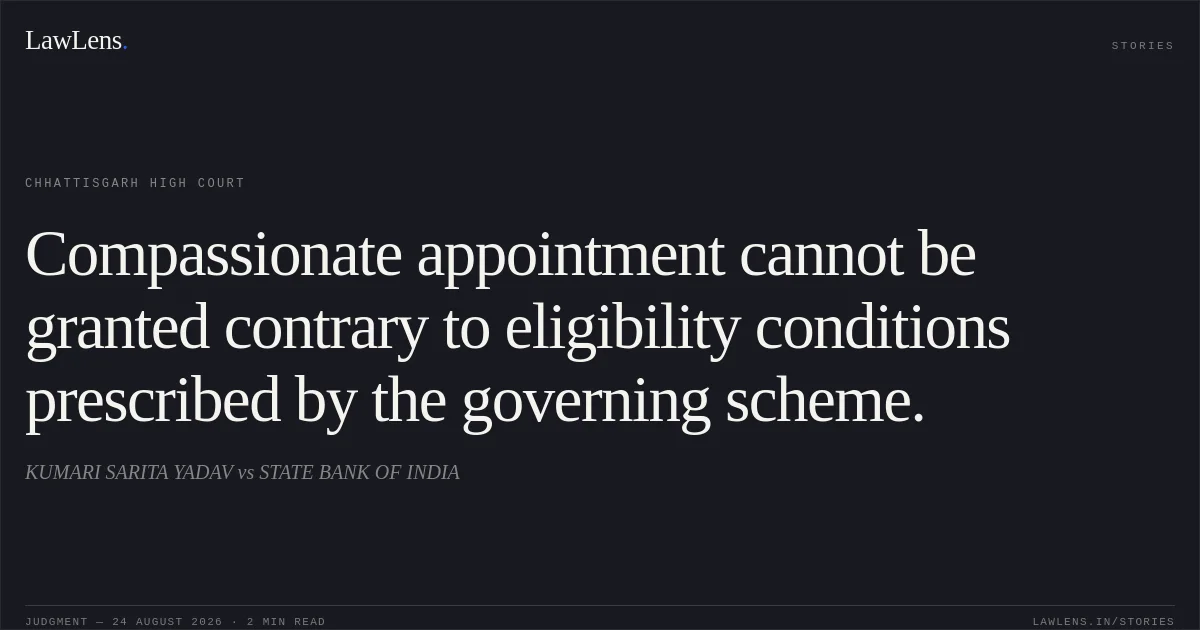
The Court held that the petitioner was not eligible for compassionate appointment under Clause 5 of the applicable SBI scheme and that the Bank had rightly rejected her application.
The challenge to the order dated 14 December 2020 was dismissed, and the petition seeking quashing of the rejection order and a direction for appointment was accordingly dismissed
Source reference: paras. 9–10Original Court PDF
KUMARI SARITA YADAVvsSTATE BANK OF INDIA
Click to open original judgment
Original judgment, available to read, download and summarize on LawLens.in