Facts
The applicant is the widow of Late Durga Prasad Patel, an Examiner (High Skilled) at Ordnance Factory Khamaria, who died following a fatal accident while performing duties on 29.04.2011
Source reference: p. 2The applicant applied for compassionate appointment for her younger son on 21.06.2011
Source reference: p. 2, 4The respondents evaluated the family’s financial status and family members, allotting 46 marks out of 100 based on departmental guidelines
Source reference: p. 2, 5Between 2013 and 2019, the Board of Officers (BOO) considered the application multiple times during annual reviews
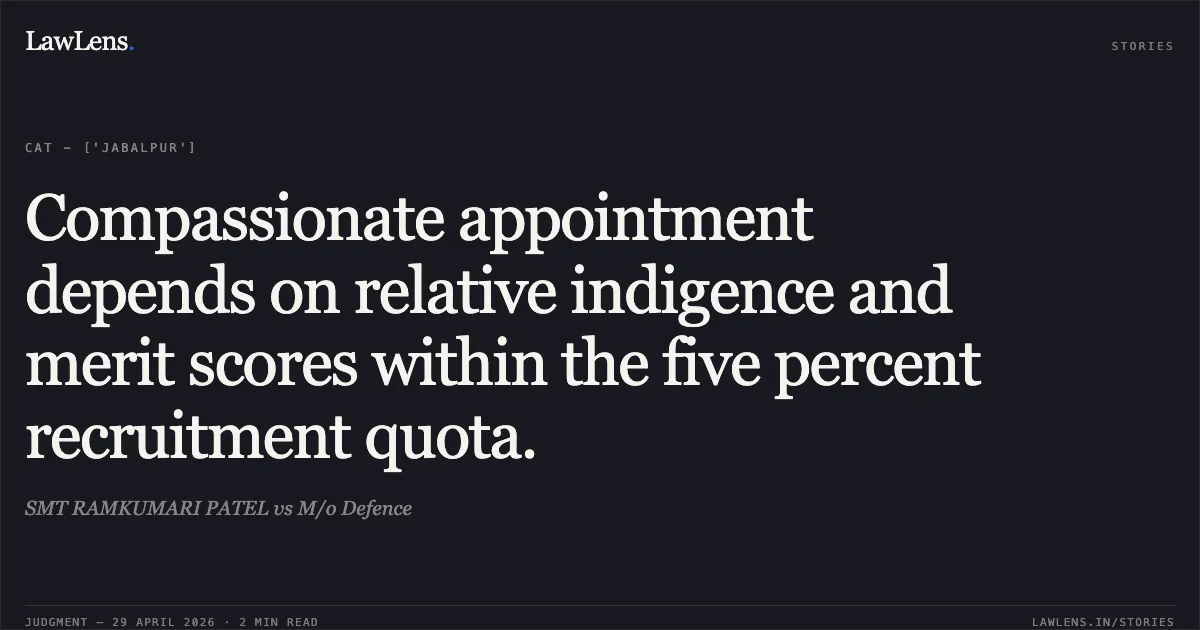
Source reference: p. 3, 5-6On each occasion, the applicant’s score (45-46 marks) fell below the cut-off marks of recommended candidates, which ranged from 63 to 76 marks
Source reference: p. 5-6Aggrieved by the continued non-selection, the applicant filed this Original Application
Source reference: p. 2Issues
1. Whether the respondents acted arbitrarily or in violation of the prescribed policy by denying compassionate appointment to the applicant’s son despite multiple considerations
Source reference: p. 2, 72. Whether the applicant was entitled to appointment regardless of her relative merit score under the 5% direct recruitment quota
Source reference: p. 7Law Applied
The court applied the Department of Defence Production/Ordnance Factory Board guidelines for compassionate appointment, specifically the 100-mark point-based system (Score Sheet) introduced via instructions dated 11.08.2010 and 25.01.2018
Source reference: p. 5-6The Tribunal followed the principle that compassionate appointment is not a vested right but an exception to the general rule of recruitment, limited to a 5% ceiling of direct recruitment vacancies
Source reference: p. 7It further noted Instruction No. 112/2012/PCC(A/A) and OFB Letter dated 16.09.2015, which withdrew the three-year time limit for reviewing cases, allowing applications to be considered indefinitely as long as the indigence persists
Source reference: p. 6-7Reasoning
The Tribunal examined the respondents' records, which demonstrated that the applicant’s case was objectively assessed against the prevailing policy
Source reference: p. 7The court noted that the respondents followed a transparent merit-based selection by allotting marks for indigence and comparing them against other applicants
Source reference: p. 5The analysis revealed that the Board of Officers considered the applicant’s case continuously for over seven years (2013–2019)
Source reference: p. 7The failure to secure an appointment was attributed strictly to the fact that other candidates possessed higher "indigency scores" than the applicant
Source reference: p. 7The Tribunal found no evidence that any candidate with fewer marks than the applicant (46) was recommended for appointment
Source reference: p. 7-8Since the vacancies were limited to the 5% quota, the court determined that the department rightly prioritized those found more "indigent" through the marshalling of available marks
Source reference: p. 8Holding
The Tribunal held that there was no merit in the Original Application as the case was considered fairly and in accordance with the Scheme
The Court answered the issues in the negative, finding that the respondents fulfilled their obligation by reviewing the case annually and that the applicant had no absolute right to appointment over more meritorious/indigent candidates. The O.A. was dismissed, and all pending miscellaneous applications were disposed of
Source reference: p. 7-8Acts & Sections Cited
1 provisions across 1 statute referred to in this judgment. Each provision opens on LawLens.
Administrative Tribunals Act, 19851
Original Court PDF
SMT RAMKUMARI PATELvsM/o Defence
Click to open original judgment
Original judgment, available to read, download and summarize on LawLens.in