Facts
The petitioner’s father, Laxman Singh Banjare, was a Head Master employed under the respondent authorities and died in harness on 31 March 2021.
Source reference: paras. 1–2The petitioner applied for compassionate appointment, but his claim was rejected on the ground that his brothers, Jayprakash Banjare and Subhash Banjare, were already employed in government service.
Source reference: paras. 1–2The petitioner earlier approached the High Court in WPS No. 4702 of 2021, pursuant to which the authorities were directed to reconsider his claim after examining the question of dependency.
Source reference: paras. 5–6On reconsideration, the claim was again rejected by order dated 17 December 2021.
Source reference: paras. 5–6The petitioner challenged that order, asserting that he lived separately with his mother and that his government-employed brothers did not financially support him.
Source reference: paras. 5–6Issues
Whether the petitioner was entitled to compassionate appointment when other eligible family members of the deceased government servant were already employed in government service under Clause 6A of the applicable policy?
Source reference: paras. 3, 5, 7Whether the Court could direct an inquiry into the petitioner’s individual financial dependency or the financial support provided by his government-employed brothers despite the express bar contained in Clause 6A?
Source reference: paras. 3, 6–7Law Applied
Compassionate appointment is not a vested or inherent right and must be granted strictly in accordance with the applicable government policy.
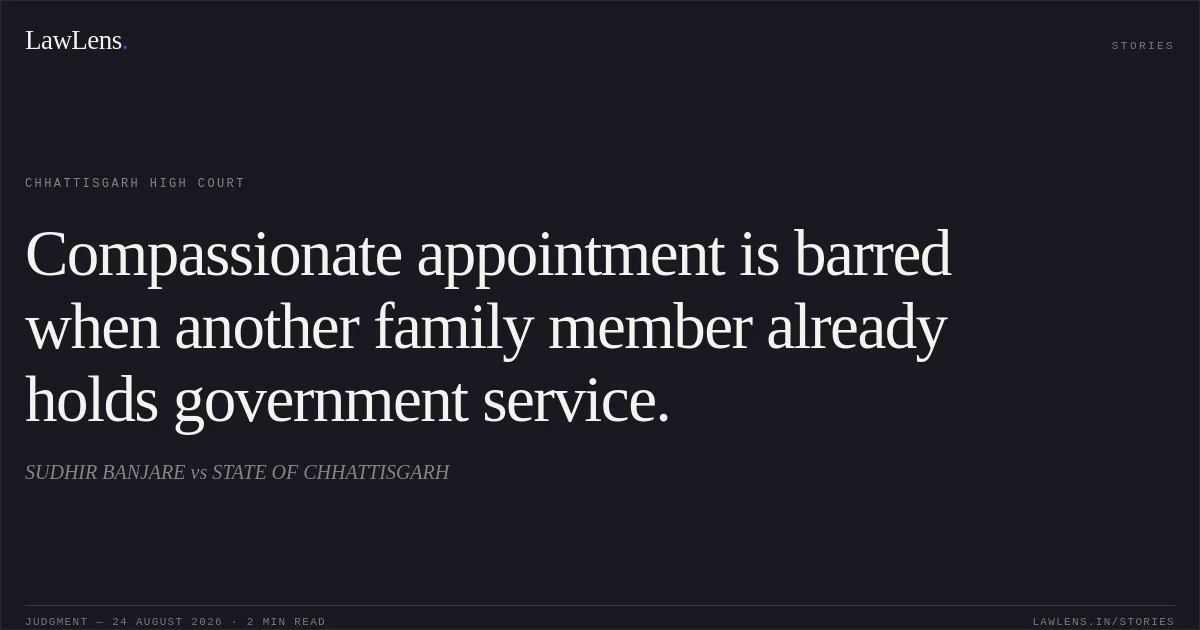
Source reference: para. 8Clause 6A of the compassionate appointment policy provides that where any member of the family of a deceased government servant is already in government service, another family member is not eligible for compassionate appointment.
Source reference: para. 5In State of Chhattisgarh v. Muniya Mukharjee, W.A. No. 33 of 2022, the Division Bench held that the policy does not contemplate an inquiry into the financial condition or inter se support arrangements of family members when the policy expressly bars appointment.
Source reference: paras. 3, 5The Full Bench decision in State of Chhattisgarh & Ors. v. Umesh Thakur, W.A. No. 236 of 2022, further held that directing such an inquiry under Article 226 would amount to rewording or revising the applicable policy, which is impermissible.
Source reference: para. 7Reasoning
The Court found that the petitioner’s brothers were government employees and fell within the relevant category of family members under the compassionate appointment scheme.
Source reference: para. 5Consequently, Clause 6A expressly barred the petitioner’s claim.
Source reference: para. 5The petitioner’s assertion that his brothers did not maintain or financially support him could not override the plain terms of the policy.
Source reference: paras. 5–7Following Muniya Mukharjee and the Full Bench ruling in Umesh Thakur, the Court held that it could not order a separate inquiry into actual financial dependency, because doing so would effectively modify the eligibility conditions prescribed by the Government.
Source reference: paras. 5–7Since compassionate appointment had to be considered strictly in accordance with the governing policy, the authorities’ rejection of the petitioner’s claim was legally sustainable.
Source reference: para. 8Holding
The Court answered the issues against the petitioner.
It held that the existence of government-employed family members attracted the bar under Clause 6A and that no inquiry into whether those members actually supported the petitioner was permissible.
Source reference: para. 9Finding no ground to interfere with the order dated 17 December 2021, the High Court dismissed the writ petition and made no order as to costs.
Source reference: para. 9Original Court PDF
SUDHIR BANJAREvsSTATE OF CHHATTISGARH
Click to open original judgment
Original judgment, available to read, download and summarize on LawLens.in