01Facts
The petitioner, daughter of a deceased employee, sought compassionate appointment under the Dying-in-Harness Rules.
¶ 1 · p. 1Her father, a Senior Administrative Officer, died in harness on 01.09.2020.
¶ 2 · pp. 1–2Her mother, also a departmental employee (Chief Administrative Officer), applied on 03.10.2020 for appointment for the elder daughter, citing continuing financial hardship.
¶ 2 · pp. 1–2After the elder daughter completed a B.Tech, the mother sought appointment for the younger daughter.
¶ 2 · pp. 1–2The matter was referred to the District Magistrate for an enquiry into the family's financial condition.
¶ 2 · pp. 1–2The claim was rejected because the mother was drawing dual pensions: a family pension following her husband's death and her own pension, having retired in 2019.
¶ 2 · pp. 1–2The petitioner challenged the rejection and relied on two instances, paras 16 and 17 of the petition, in which compassionate appointments were granted to other dependants, including a daughter (Ms. Ekta Tamta) whose mother was still employed as a teacher.
¶ 3 · p. 2The respondents contended that the mother held a Class II post, is in receipt of dual pensions, that one daughter has completed a B.Tech and the other is pursuing MBBS, and that no claim to parity arises under the Rules.
¶ 5 · p. 302Issues
i.1. Whether the rejection of the claim for compassionate appointment was justified where the surviving mother receives dual pensions and the family was not in immediate financial crisis.
¶ 6 · p. 3 · ¶ 7 · p. 4 · ¶ 8 · p. 4ii.2. Whether the petitioner can claim parity with other compassionate appointments granted in comparable cases under Articles 14 and 16 of the Constitution.
¶ 4 · p. 2 · ¶ 5 · p. 3 · ¶ 7 · p. 303Law Applied
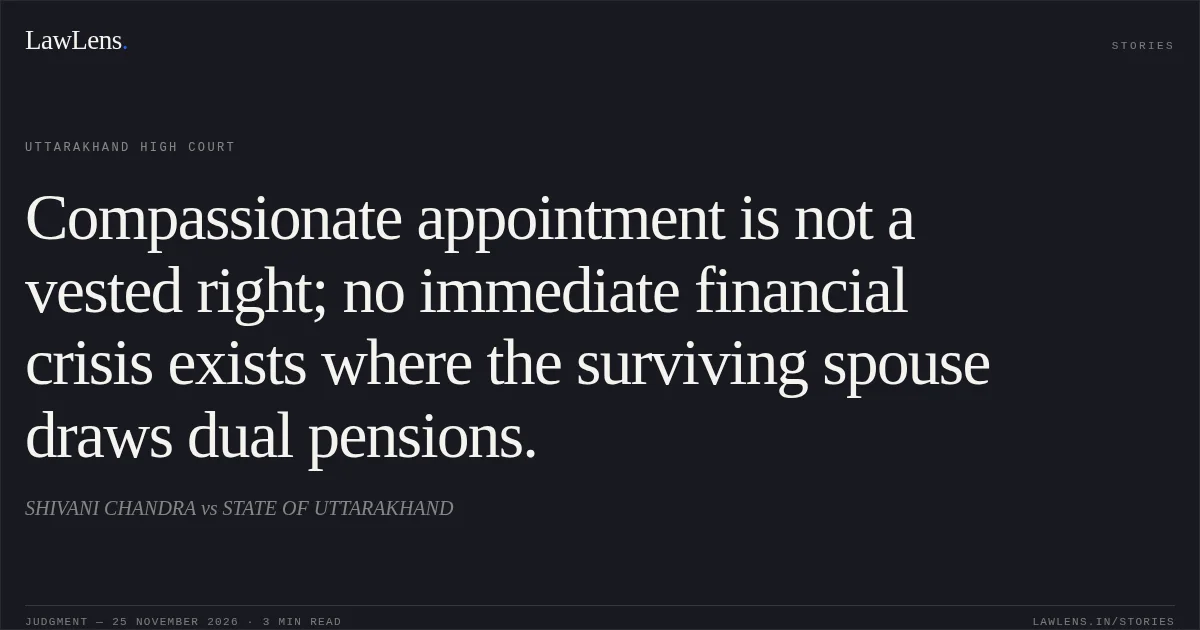
Compassionate appointment is not a vested right, nor a hereditary claim to recruitment, and must be tested against Articles 14 and 16 of the Constitution.
¶ 7 · pp. 3–4The essential precondition for such relief is immediate financial crisis, which must be shown to exist on the date of consideration.
¶ 7 · p. 4The Dying-in-Harness Rules are beneficial legislation, but each claim is decided independently on its own merits, and parity with other cases cannot be claimed as a matter of right.
¶ 5 · p. 3The judgment cites no specific precedent.
04Reasoning
The court examined the family's overall socio-economic position. It noted that the deceased was survived by a wife and two daughters, one of whom had completed a B.Tech and the other was pursuing MBBS.
¶ 6 · p. 3The mother was a retired senior government officer who had superannuated as Chief Administrative Officer and was drawing both her own pension and a family pension.
¶ 6 · p. 3The court held that these facts demonstrated "strong socio-economic stability" and an absence of sudden financial crisis.
¶ 6 · p. 3Applying the immediate-crisis requirement, the court held that the essential precondition was "completely absent" given the mother's high-ranking post and dual pensions.
¶ 7 · p. 4On the parity plea, the court did not examine the cited instances (Ekta Tamta and others) on their facts. It relied instead on the principle that each claim is decided on its own merits and that parity is not a matter of right under the Rules.
¶ 5 · p. 3 · ¶ 8 · p. 4The judgment does not expressly address the petitioner's specific comparators.
05Holding
The court held that compassionate appointment is not a vested right.
¶ 7 · pp. 3–4The family's stable financial position, evidenced by the mother's dual pensions, the daughters' education, and the mother's senior retired status, negated the essential requirement of immediate financial crisis.
¶ 6–7 · pp. 3–4Parity with other cases does not entitle the petitioner to relief under the Dying-in-Harness Rules.
¶ 5 · p. 3 · ¶ 8 · p. 4The petition is dismissed as devoid of merit, and the rejection order is upheld.
¶ 8 · p. 4No further directions or costs are recorded.
Original Court PDF
SHIVANI CHANDRAvsSTATE OF UTTARAKHAND
Click to open original judgment
Original judgment, available to read, download and summarize on LawLens.in