01Facts
The Assistant Labour Commissioner, Udham Singh Nagar, by order dated 19.07.2024, in proceedings under Section 6H(1) of the U.P. Industrial Disputes Act, 1947 ("the Act"), directed the employer to deposit the amount claimed by workmen under a settlement within ten days, failing which coercive action would follow.
¶ 1–2The employer challenged this order. Its case was that the settlement was never registered because of objections raised by workmen, and that under Section 6B an unregistered settlement is not binding.
¶ 3For the workmen, Senior Counsel argued that the employer had honoured the settlement by granting annual increments and other benefits to some workmen and therefore could not deny the same benefits to other signatories.
¶ 5The employer deposited the amount pursuant to the order dated 27.08.2024.
¶ 1502Issues
i.1. Whether a settlement arrived at outside conciliation proceedings, which has not been registered (or has been refused registration) under Section 6B of the U.P. Industrial Disputes Act, 1947, is binding and enforceable in proceedings under Section 6H(1) of the Act.
¶ 3, 12–13ii.2. Whether the decisions under the Central Industrial Disputes Act, 1947 (Wearwell, Cipla), which treat unregistered settlements as enforceable, govern the interpretation of Section 6B of the U.P. Act.
¶ 5–703Law Applied
The Court relied on Section 6B of the U.P. Act, under which a settlement outside conciliation binds the parties only as provided in sub-section (4), and which requires that a party apply for registration to the Conciliation Officer.
¶ 4, 13Under sub-section (4), a settlement refused registration "shall not be binding under this Act".
¶ 4, 13The Court also considered Section 18 of the Central Act, which makes a non-conciliation settlement binding without any registration requirement.
¶ 8The Court relied on Raza Textile Labour Union v. R. Mohan (All. HC, 1964), which held that registration under Section 6B is mandatory, so that a settlement cannot bind workmen unless registered, to protect collective workmen interests.
¶ 9The Court relied on Bhuvnesh Kumar Dwivedi v. Hindalco Industries Ltd., (2014) 11 SCC 85, following U.P. State Sugar Corporation v. Om Prakash Upadhyay, (2002) 10 SCC 89, for the proposition that the U.P. Act is unaffected by the Central amendments.
¶ 10The Court relied on Engineering Kamgar Union v. Electro Steels Castings Ltd., (2004) 6 SCC 36, holding that the U.P. Act, having received Presidential assent under Article 254(2), prevails over the Central Act in the field of overlap.
¶ 11The Central Act decisions in Wearwell and Cipla were cited by the workmen in support of enforceability of unregistered settlements.
¶ 5, 6Provisions in the judgment · 10
U.P. Industrial Disputes Act, 1947 Section 6HSection 6BSection 6NSection 6V
Industrial Disputes Act, 1947 Section 18Section 10ASection 1Section 31Section 2
Indian Evidence Act, 1872 Section 114
04Reasoning
The Court first noted that the Assistant Labour Commissioner did not examine whether the settlement had been registered under Section 6B.
¶ 12Applying the plain language of Section 6B(4), the Court held that a settlement refused registration is not binding under the Act, and that the Commissioner had not considered this provision.
¶ 13The Court distinguished the workmen's authorities. The Central Act, under Section 18, contains no registration requirement, whereas the U.P. Act makes registration a condition of binding effect.
¶ 7–9The U.P. Act's registration framework therefore operates independently of the Central Act, and the Court's reliance on Bhuvnesh Kumar and Engineering Kamgar confirms that the State enactment, with Presidential assent, governs.
¶ 10–11The Court did not expressly decide whether the settlement was in fact unregistered, nor did it address the workmen's argument that partial implementation by the employer created an obligation to extend the same benefits to all signatories.
¶ 5Because the registration question had not been examined, the impugned order was vitiated and the matter required fresh determination.
¶ 1305Holding
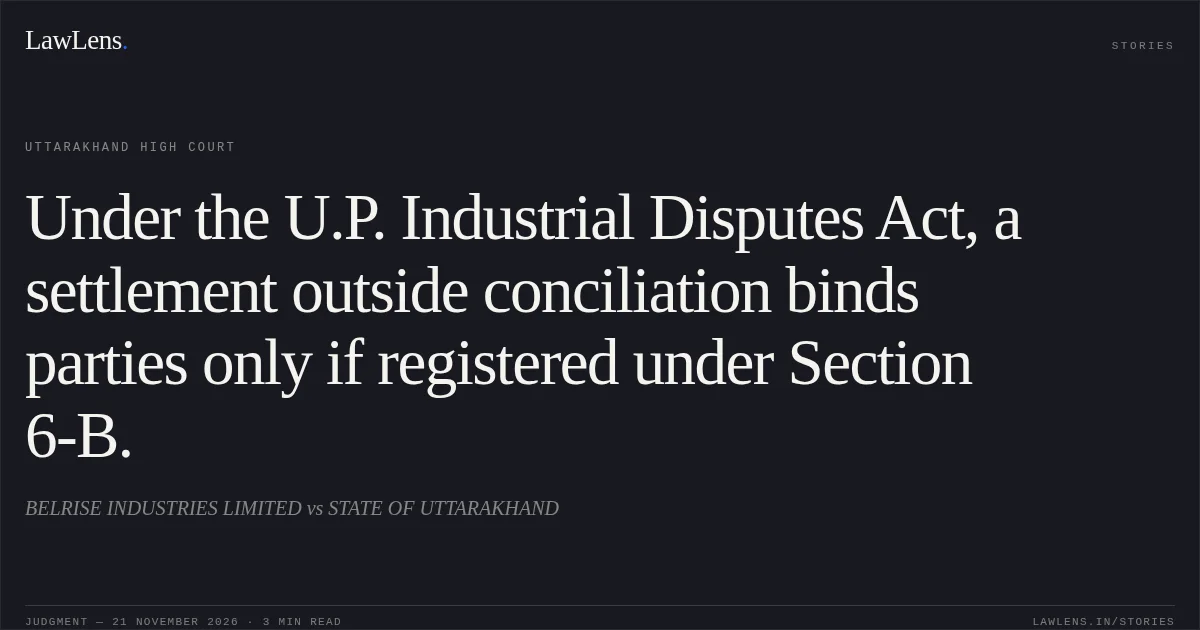
The Court held that an unregistered settlement, or one refused registration under Section 6B, is not binding under the U.P. Industrial Disputes Act, 1947.
¶ 13The Central Act precedents relied upon by the workmen do not override this statutory requirement.
¶ 7–11The order dated 19.07.2024 is set aside, and the workmen's application under Section 6H(1) is restored to the Assistant Labour Commissioner for fresh decision after considering all relevant aspects, including registration status under Section 6B(4).
¶ 14The amount deposited by the employer under the order dated 27.08.2024 is to be refunded within two weeks, and the writ petition is disposed of in these terms.
¶ 15, 16Original Court PDF
BELRISE INDUSTRIES LIMITEDvsSTATE OF UTTARAKHAND
Click to open original judgment
Original judgment, available to read, download and summarize on LawLens.in