Facts
The petitioners were appointed as ‘Badli’ workers (substitutes for regular employees) at the Delhi Milk Scheme (Respondent No. 2) during the year 1999
Source reference: p. 2Their employment was governed by Certified Standing Orders, which mandated that a ‘Badli’ worker who "actually worked" for at least 240 days in a 12-month period be transferred to the regular establishment
Source reference: p. 2The petitioners claimed they met this threshold by counting weekly holidays, national holidays, and—crucially—compensatory holidays granted in lieu of working on Sundays
Source reference: p. 2-3The Central Administrative Tribunal (CAT) dismissed their claim, ruling that compensatory holidays cannot be added to the count if the worker was already paid for working on the original holiday
Source reference: p. 3The petitioners challenged this dismissal via a writ petition under Article 226
Source reference: p. 1-2Issues
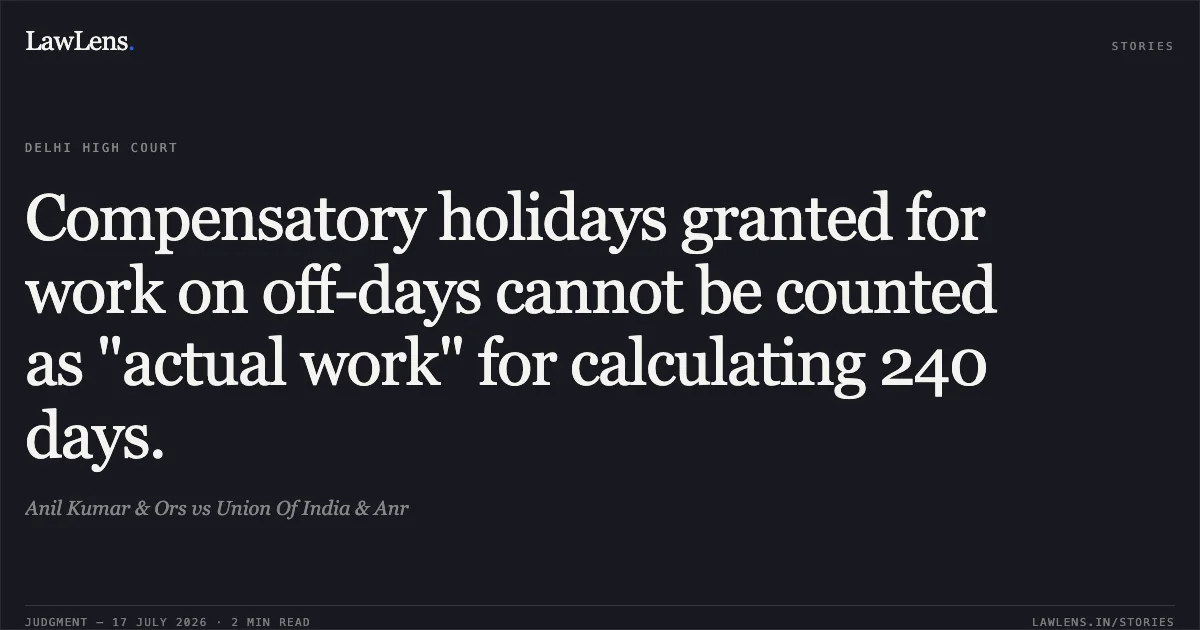
1. Whether compensatory holidays granted under Section 53 of the Factories Act, 1948, should be counted as "actual working days" for the purpose of calculating the 240-day threshold for regularization
Source reference: p. 6 / para. 102. Whether a worker can simultaneously claim the benefit of both weekly holidays (Section 52) and compensatory holidays (Section 53) in the computation of working days
Source reference: p. 6 / para. 11Law Applied
Proviso to Para 4 (iii) of the Certified Standing Orders, which requires a worker to have "actually worked" for 240 days
Source reference: p. 2Sections 52 and 53 of the Factories Act, 1948, which govern weekly holidays and compensatory holidays respectively
Source reference: p. 7-10Rule 77 and Form 9 of the Delhi Factory Rules, 1950, which provide the mechanism for recording such holidays
Source reference: p. 7-10Precedent in UOI & Anr. v. Shishpal & Ors. (W.P.(C) 77/2007), which established that while weekly offs and national holidays are counted, a worker cannot receive a "double benefit" by counting both the day they worked (for which they were paid) and the compensatory holiday given in its place as extra working days
Source reference: p. 4, 5Reasoning
The court reasoned that the use of the word "actually" in the Standing Orders specifically excludes non-working days like compensatory holidays from the computation
Source reference: p. 10It noted that Section 52 ensures a weekly day of rest, and Section 53 provides a substitute holiday only if a worker is deprived of that rest
Source reference: p. 8The court found that if a petitioner worked on a Sunday and received both wages for that day and a compensatory holiday later, counting both as "working days" would constitute an impermissible double benefit
Source reference: p. 5-6The court clarified that the purpose of Form 9 under the Delhi Factory Rules is merely a recording mechanism for compliance and does not redefine the calculation of "working days" for regularization
Source reference: p. 10Therefore, the correct computation includes only actual working days, weekly offs, and national holidays
Source reference: p. 7Holding
The court answered the issues in the negative, holding that compensatory holidays cannot be added to the 240-day calculation if the worker has already been credited for the day they actually worked
The court upheld the CAT's order, finding that the Delhi Milk Scheme had calculated the days correctly and that the petitioners failed to meet the 240-day requirement
Source reference: p. 7, 11The writ petition was dismissed
Source reference: p. 11Acts & Sections Cited
5 provisions across 2 statutes referred to in this judgment. Linked provisions open on LawLens.
Factories Act, 19484
Certified Standing Orders for the Employees of the Delhi Milk Scheme1
Original Court PDF
Anil Kumar & OrsvsUnion Of India & Anr
Click to open original judgment
Original judgment, available to read, download and summarize on LawLens.in