Facts
The complainant and others entered into agreements for residential units but alleged that the accused failed to deliver possession despite receiving payments, leading to charges of cheating and criminal conspiracy.
Source reference: para. 2During the trial for a warrant case instituted on a police report, the complainant filed an application under Section 242(2) of the Code of Criminal Procedure (“CrPC”) to bring original documents (agreements, receipts, etc.) on record during prosecution evidence.
Source reference: para. 3The Trial Court allowed the production, noting the documents were submitted "through the prosecution".
Source reference: para. 3The Petitioner/accused challenged this, arguing that a complainant/witness cannot independently introduce documents not part of the original charge-sheet.
Source reference: para. 4The Revisional Court affirmed the Trial Court's order, prompting this petition.
Source reference: para. 1Issues
1. Whether a document originating from the complainant can be taken on record at the stage of prosecution evidence in a warrant case upon an application moved through the prosecution under Section 242(2) of the CrPC.
Source reference: para. 11Law Applied
The court primarily applied Section 242 of the CrPC (corresponding to Section 265 of the BNSS, 2023), which mandates the Magistrate to take all evidence produced in support of the prosecution.
Source reference: paras. 12-13Manoj Patel v. State of Madhya Pradesh established that a witness may produce relevant documents in their possession during trial.
Source reference: para. 10Dhariwal Industries Ltd. v. Kishore Wadhwani, affirming that while a complainant must act under the Prosecutor’s direction, the prosecution may adopt documents supplied by them.
Source reference: para. 15Rajendra Prasad v. Narcotic Cell, holding that oversight in producing evidence does not constitute an "irreparable lacuna" and Courts should facilitate the discovery of truth.
Source reference: para. 18Reasoning
The Court clarified that Section 242(2) CrPC empowers a Magistrate to summon documents upon a prosecution application, while Section 242(3) mandates the receipt of all evidence produced in support of the prosecution.
Source reference: para. 13The Court distinguished between the origin of a document and its mode of production; it held that if the prosecution adopts a document and moves the application, the statutory requirement is satisfied regardless of whether the document originated from the investigating agency or the complainant.
Source reference: para. 14In this case, the Trial Court explicitly recorded that the documents were routed "through the prosecution," a finding the Petitioner failed to challenge in revision.
Source reference: para. 16Furthermore, since the documents were original versions of photocopies already in the charge-sheet, no "surprise" or prejudice was caused to the accused.
Source reference: para. 17The Court emphasized that procedural technicalities must not obstruct the quest for truth.
Source reference: para. 19Holding
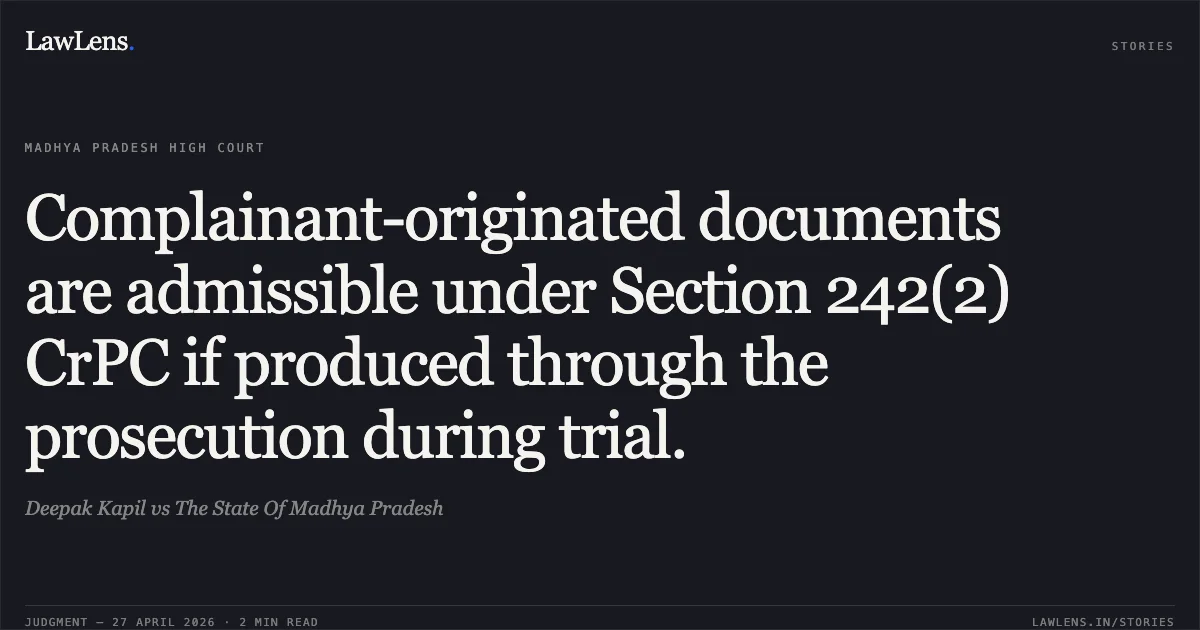
The Court answered the issue in the affirmative, holding that documents originating from a complainant are admissible under Section 242(2) CrPC if produced through the prosecution.
The Court held that the source of the document is irrelevant as long as the mode of production follows the legal channel and the accused retains the right to cross-examine and challenge admissibility.
Source reference: para. 20Finding no jurisdictional error or perversity in the lower courts' orders, the petition was dismissed.
Source reference: paras. 21-22Acts & Sections Cited
4 provisions across 2 statutes referred to in this judgment. Each provision opens on LawLens.
Bharatiya Nagarik Suraksha Sanhita, 20231
Code of Criminal Procedure, 19733
Original Court PDF
Deepak KapilvsThe State Of Madhya Pradesh
Click to open original judgment
Original judgment, available to read, download and summarize on LawLens.in