Facts
The petitioner filed an application under Section 251A of the Rajasthan Tenancy Act, 1955, seeking a 30-foot wide permanent way through the respondents' khatedari land in Khasra No. 1053/1009
Source reference: para 2On 27.02.2024, the Sub-Divisional Officer (SDO), Aau, allowed the application on the same day the Tehsildar submitted a site inspection report, which claimed the respondents were present but refused to sign
Source reference: para 2.1, 6The Revenue Appellate Authority (RAA) upheld this order
Source reference: para 2.2However, the Board of Revenue (BoR) set aside these orders and remanded the matter, finding that Rule 69 of the Rajasthan Tenancy (Government) Rules, 1955, regarding the invitation of objections to the inspection report, was not followed
Source reference: para 2.3The petitioner challenged the BoR’s remand order in the High Court
Source reference: para 1Issues
1. Whether the issuance of a notice for the conduct of a site inspection by the Tehsildar constitutes sufficient compliance with the requirement to "invite objections" under Rule 69
Source reference: para 6.1, 8.12. Whether the SDO’s failure to invite objections specifically against the site inspection report before passing a final order violates the principles of natural justice and statutory procedure
Source reference: para 9, 113. Whether the Board of Revenue exceeded its revisional jurisdiction under Section 230 of the Act by interfering with concurrent findings of fact
Source reference: para 3.3, 13Law Applied
The court applied Section 251A of the Rajasthan Tenancy Act, 1955, which grants the SDO power to allow a new way based on "absolute necessity" and absence of alternative access after a "summary inquiry"
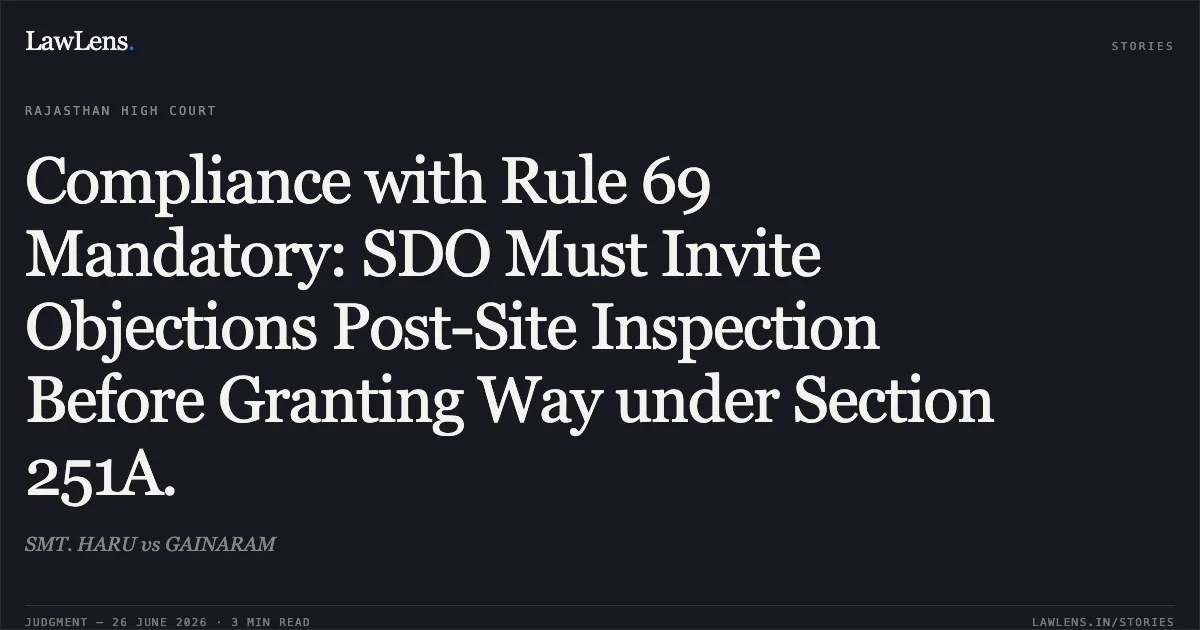
Source reference: para 6.2Rule 69 of the Rajasthan Tenancy (Government) Rules, 1955, which mandates that the SDO must either inspect the site or get it inspected and then "invite objections from the affected persons" and afford an "opportunity of being heard"
Source reference: para 6.2The court relied on Rampyari v. Board of Revenue (2019) and LRs of Rawata Ram v. BoR, establishing that statutory procedures for site inspection reports are mandatory
Source reference: para 10, 10.1The principle from Nareshbhai Bhagubhai v. Union of India (2019) that the right to file objections cannot be reduced to an empty formality
Source reference: para 12.1Reasoning
The Court reasoned that Section 251A and Rule 69 create a mandatory sequential procedure: application, site inspection, invitation of objections to the report, and then a reasoned decision
Source reference: para 7.1-7.3The Court rejected the petitioner's argument that a notice of the intent to inspect site (issued by the Tehsildar) satisfied Rule 69, noting that the Tehsildar cannot delegate the SDO's adjudicatory duty to invite and consider objections
Source reference: para 8.1Because the SDO passed the final order on the very day the report was received without sharing it with the respondents or seeking their specific objections to its findings, the procedure was a "material irregularity"
Source reference: para 9, 13.2The Court emphasized that since Section 251A(2) results in the permanent extinguishment of tenancy rights (as the land becomes a "rasta"), strict adherence to natural justice is indispensable
Source reference: para 13.5Holding
The Court held that inviting objections under Rule 69 is a substantive safeguard, not an empty formality, and the SDO's failure to do so after receiving the inspection report vitiated the proceedings
The High Court dismissed the writ petition and upheld the Board of Revenue's order of remand. The matter was remanded to the SDO, Aau, to reconsider the application afresh by following the mandate of Rule 69 and providing an effective opportunity of hearing to the affected parties
Source reference: para 14, 15Acts & Sections Cited
1 provisions across 1 statute referred to in this judgment. Each provision opens on LawLens.
Code of Civil Procedure, 19081
Original Court PDF
SMT. HARUvsGAINARAM
Click to open original judgment
Original judgment, available to read, download and summarize on LawLens.in