Facts
In February 2012, an FIR was registered alleging the gang-rape of a victim at gunpoint by five individuals
Source reference: p. 2Three accused were apprehended, while the Respondent (Kader Khan) and one other were declared absconding. A proclamation was issued against the Respondent in April 2012
Source reference: p. 3The trial was split, and during the proceedings against the apprehended accused, the victim’s deposition was recorded and cross-examined between March and July 2013
Source reference: p. 3-4The victim passed away on March 13, 2015
Source reference: p. 4Following the Respondent's arrest in September 2016, the prosecution moved an application under Section 299 of the CrPC to admit the deceased victim’s earlier testimony as evidence in the Respondent’s trial
Source reference: p. 4-5The Trial Court allowed the application, but the High Court at Calcutta set it aside, ruling that Section 299 requires a prior specific direction from the court to record evidence against an absconder at the time of the original deposition
Source reference: p. 5Issues
1. Whether the deposition of a witness recorded in a prior trial can be used against an absconding accused in a subsequent trial under Section 299 of the CrPC if the witness is deceased
Source reference: p. 6 / para. 122. Whether Section 299(1) of the CrPC requires a formal order or specific direction by the Magistrate at the time of recording evidence to make it admissible against an absconder later
Source reference: p. 9 / para. 14Law Applied
The Court interpreted Section 299 of the Code of Criminal Procedure, 1973 (CrPC), which serves as an exception to Section 33 of the Indian Evidence Act, 1872
Source reference: p. 6-7Section 299(1) permits the use of a deposition against an accused if two conditions are met at the time of recording: (i) the accused has absconded, and (ii) there is no immediate prospect of arresting him
Source reference: para. 14The court relied on Nirmal Singh v. State of Haryana (2000), which mandates strict compliance with these preconditions
Source reference: p. 7-9CBI v. Abu Salem Ansari (2011), which allows relying on earlier evidence in the absence of an absconding accused if the deponent is dead
Source reference: p. 10-11Reasoning
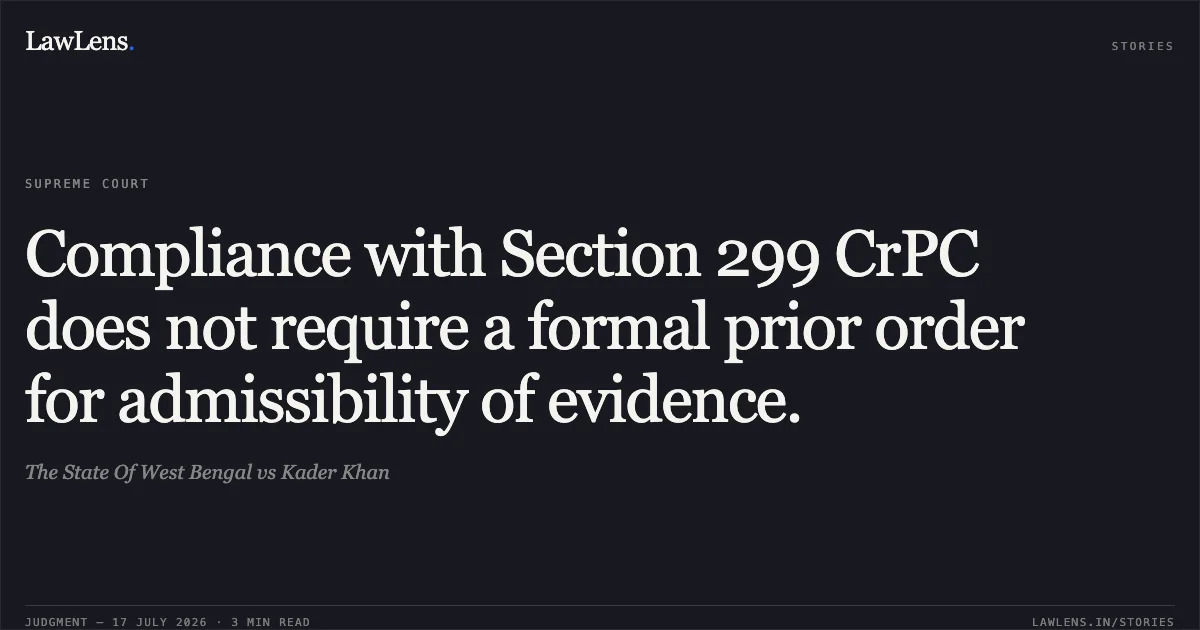
The Supreme Court held that the High Court’s restrictive interpretation was erroneous. It clarified that Section 299 CrPC does not mandate a formal "order" by a Magistrate declaring the existence of the preconditions before the witness deposes; rather, the facts of abscondance and lack of immediate arrest must simply be established as existing at that time
Source reference: para. 14Here, the Respondent was a proclaimed offender and the chargesheet listed him as absconding prior to the victim's 2013 deposition
Source reference: p. 16The Court reasoned that requiring a "direction" in the first trial would be impractical, as the prosecution cannot always foresee a witness's future unavailability
Source reference: para. 20Furthermore, a restrictive view would offer a "premium" to accused persons who deliberately abscond, waiting for witnesses to die to escape justice
Source reference: para. 16, 21The Court noted that since the Respondent remained at large for three years after the victim's testimony, the statutory conditions for "no immediate prospect of arrest" were clearly met
Source reference: para. 22Holding
The Court allowed the appeals and set aside the High Court’s order
It held that the requirements of Section 299(1) were satisfied because the Respondent was proven to be absconding at the time of the victim's deposition, and the victim is now deceased
Source reference: para. 22-23The statement of the deceased victim rendered in the earlier trial is admissible in the subsequent trial against the Respondent
Source reference: p. 17Acts & Sections Cited
9 provisions across 4 statutes referred to in this judgment. Each provision opens on LawLens.
Indian Penal Code, 18604
Arms Act, 19592
Code of Criminal Procedure, 19732
Bharatiya Nagarik Suraksha Sanhita, 20231
Original Court PDF
The State Of West BengalvsKader Khan
Click to open original judgment
Original judgment, available to read, download and summarize on LawLens.in