Facts
The plaintiff challenged a registered sale deed dated 26 November 2010 by which her father-in-law transferred the suit property to the defendant, his daughter.
Source reference: pp. 2–5, paras. 4.1–4.6She sought cancellation of the deed and protection of her possession, alleging that the property was ancestral and that the transaction was a camouflage.
Source reference: pp. 2–5, paras. 4.1–4.6The Trial Court dismissed her suit, allowed the defendant’s counterclaim in part, declared the defendant sole owner, and directed the plaintiff to hand over possession.
Source reference: pp. 2–5, paras. 4.1–4.6The First Appellate Court affirmed.
Source reference: pp. 2–5, paras. 4.1–4.6In the second appeal, the defendant’s counsel stated that possession had been obtained through execution proceedings.
Source reference: pp. 2–5, para. 6.3Issues
1. Whether the concurrent findings against the plaintiff disclosed perversity, gross error, or another basis for interference under Section 100 CPC.
Source reference: pp. 6–7, paras. 7–92. Whether the plaintiff established a right to have the registered sale deed set aside or to protect her possession against the defendant, the deed-holder.
Source reference: p. 7, paras. 8–9Law Applied
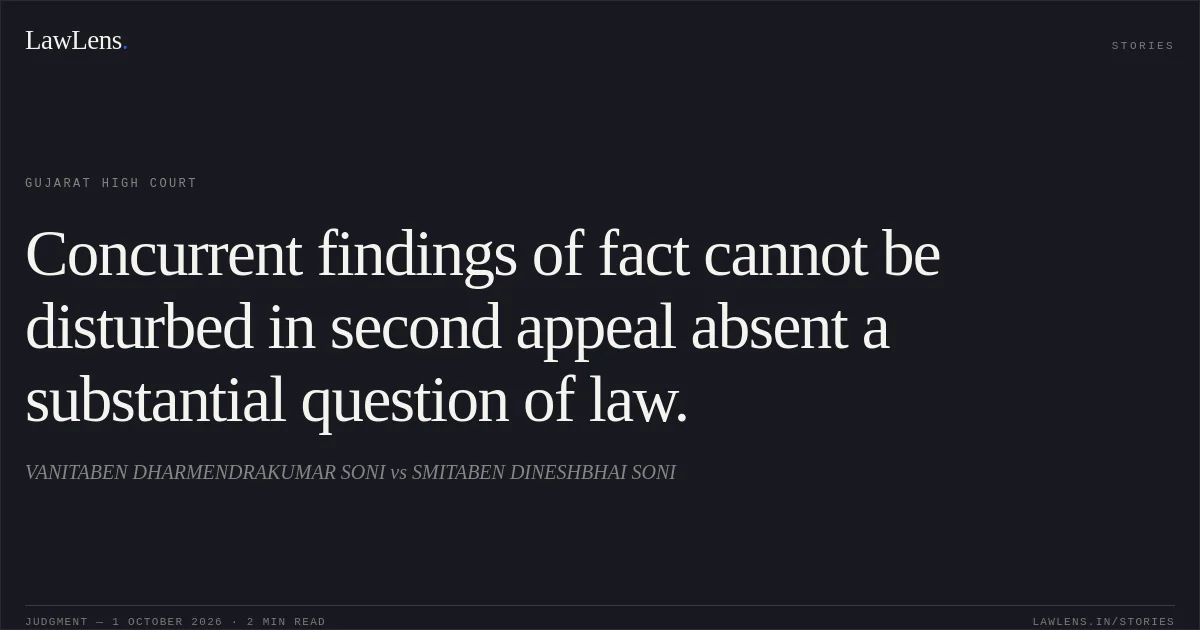
Section 100 of the Code of Civil Procedure, 1908 confines second appeals to cases involving a substantial question of law; the High Court cannot reappreciate evidence or disturb factual findings merely because they are alleged to be erroneous.
Source reference: pp. 8–9, paras. 10.1–10.2Interference may be warranted where findings are, for example, contrary to mandatory law or based on inadmissible evidence or no evidence.
Source reference: pp. 8–9, paras. 10.1–10.2The Court relied on Russi Fisheries (P) Ltd. v. Bhavna Seth, 2026 SCC OnLine SC 555, and Jaichand (Dead) through LRs v. Sahnulal, 2024 SCC OnLine SC 3864, among other precedents, on the limits of second-appellate review.
Source reference: pp. 8–9, paras. 10.1–10.2It also applied the principles that a registered document carries presumptive value and that a challenge based on fraud or forgery requires proof.
Source reference: p. 7, para. 8Reasoning
The Court found no perversity or gross irregularity in the concurrent findings.
Source reference: pp. 6–7, paras. 7–8The plaintiff had not proved that the property was ancestral; the property stood in the father-in-law’s name, and the record disclosed no proved fraud or forgery in the registered sale deed in favour of the defendant.
Source reference: pp. 6–7, paras. 7–8As the defendant held title and the plaintiff established no direct right, title, or interest in the property, the Court found no legal basis to protect the plaintiff’s possession against her.
Source reference: p. 7, para. 9The proposed questions did not meet the threshold for substantial questions of law under Section 100 CPC.
Source reference: p. 10, para. 11Holding
The High Court held that no substantial question of law arose and dismissed the second appeal in limine.
It confirmed the judgments and decrees of the courts below, disposed of the connected stay application, directed that a decree be drawn, and made no order as to costs.
Source reference: p. 10, paras. 11–12Acts & Sections Cited
1 provisions across 1 statute referred to in this judgment. Each provision opens on LawLens.
Code of Civil Procedure, 19081
Original Court PDF
VANITABEN DHARMENDRAKUMAR SONIvsSMITABEN DINESHBHAI SONI
Click to open original judgment
Original judgment, available to read, download and summarize on LawLens.in