Facts
The plaintiff (appellant) instituted a civil suit for declaration of title and permanent injunction regarding 2½ dismil of abadi land in Village Bhanwarmara
Source reference: para 2He claimed possession since 2000 and title via an abadi patta granted on 12.11.2009 pursuant to a Gram Panchayat resolution
Source reference: para 2The defendants contested the suit, asserting the patta was forged and had been cancelled by a Gram Sabha resolution dated 25.06.2014
Source reference: para 3Revenue authorities (Sub-Divisional Officer) upheld the cancellation and directed encroachment proceedings against the plaintiff
Source reference: para 3-4The Trial Court dismissed the suit, finding the patta fraudulent
Source reference: para 4The First Appellate Court affirmed this dismissal upon re-appreciation of evidence
Source reference: para 8Issues
1. Whether the concurrent findings of fact regarding the fraudulent nature and cancellation of the abadi patta were perverse or contrary to the material on record
Source reference: para 6, 92. Whether the appeal involves any "substantial question of law" as required under Section 100 of the Code of Civil Procedure, 1908
Source reference: para 9, 14Law Applied
Section 100 of the Code of Civil Procedure (CPC), 1908, which limits the jurisdiction of the High Court in Second Appeals to cases involving a "substantial question of law"
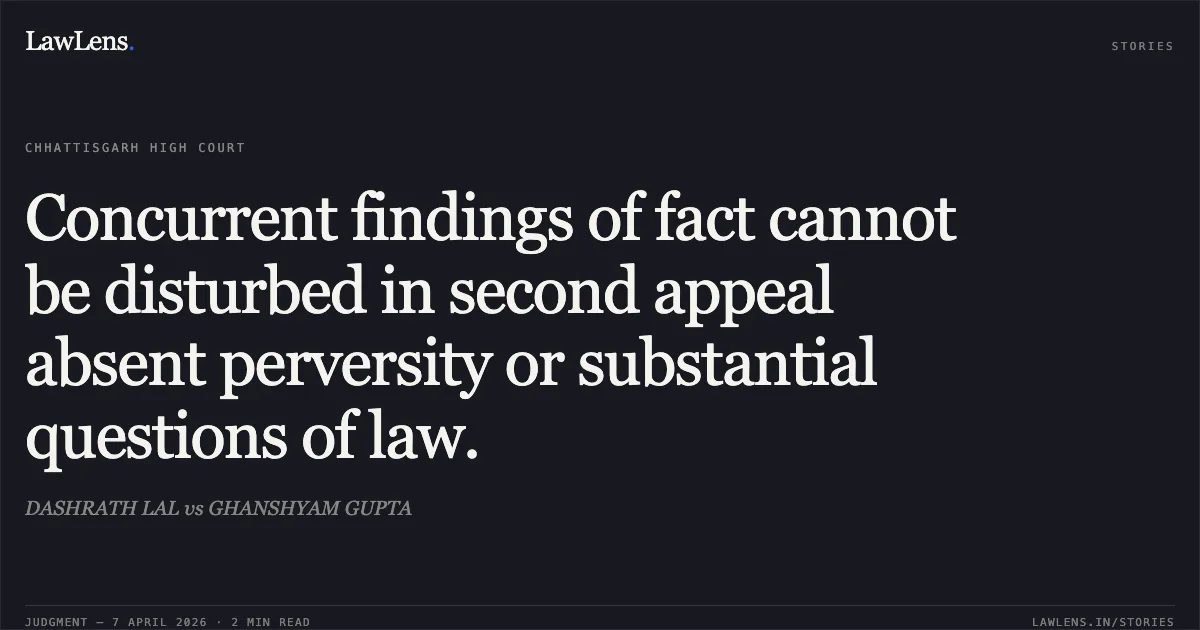
Source reference: para 1, 9The court followed the established principle that concurrent findings of fact are binding unless they are perverse, based on no evidence, or contrary to settled law
Source reference: para 9, 12The court relied on the precedent State of Rajasthan and others v. Shiv Dayal and another (2019) 8 SCC 637, which mandates that concurrent findings may only be assailed if they are recorded de hors the pleadings, based on misreading of material evidence, or are judicially unreasonable
Source reference: para 13Reasoning
The High Court examined the records and noted that the lower courts’ findings were rooted in substantial evidence, including Gram Sabha resolutions, encroachment reports, panchanamas, and eviction warrants
Source reference: para 8A critical factor was the plaintiff’s own admission during cross-examination that encroachment proceedings had been initiated and an eviction warrant issued against him regarding the suit land
Source reference: para 8The court found that because the patta (the sole basis of the plaintiff’s title claim) was proven to be fraudulently entered in the register and subsequently cancelled, the plaintiff failed to establish any lawful right or interest
Source reference: para 4, 8The High Court reasoned that the appellant’s arguments were essentially requests for the re-appreciation of evidence, which does not constitute a "substantial question of law"
Source reference: para 11, 14In the absence of any perversity or misapplication of law in the lower courts' concurrent findings, the court determined there was no merit for interference
Source reference: para 15Holding
The Court held that the appeal failed to raise any substantial question of law as contemplated under Section 100 CPC
The High Court dismissed the Second Appeal and upheld the judgment and decree passed by the First Appellate Court, confirming the dismissal of the plaintiff’s suit
Source reference: para 16Acts & Sections Cited
2 provisions across 1 statute referred to in this judgment. Each provision opens on LawLens.
Code of Civil Procedure, 19082
Original Court PDF
DASHRATH LALvsGHANSHYAM GUPTA
Click to open original judgment
Original judgment, available to read, download and summarize on LawLens.in