Facts
The petitioner challenged the order dated 15 June 2023 passed by the Collector, Datia, dismissing his revision and affirming the order dated 1 October 2022 of the Sub-Divisional Officer, Seondha, which had upheld the Naib Tehsildar’s order dated 31 January 2022 under Section 131 of the Madhya Pradesh Land Revenue Code, 1959.
Source reference: p.1The dispute concerned an alleged customary approach way over Survey No. 1808, claimed by the petitioner to be his exclusive property.
Source reference: p.1He contended that respondents Nos. 1 and 2 had no customary right over the land, possessed an alternative approach road, and that the Naib Tehsildar had impermissibly created a new road rather than recognised an existing customary way.
Source reference: pp.1–3The respondents maintained that the Revenue Authorities had conducted an enquiry, recorded evidence, and concurrently found the existence of the customary way.
Source reference: pp.4–5They also relied on the pendency of Civil Suit No. 14-A/2020 and the petitioner’s earlier proceedings under Article 227 in M.P. No. 4751/2019.
Source reference: pp.4–5Issues
1. Whether the Revenue Authorities acted without jurisdiction under Section 131 of the Madhya Pradesh Land Revenue Code by creating a new approach road over Survey No. 1808 instead of adjudicating an existing customary way.
Source reference: pp.1–3, 7–82. Whether the High Court should interfere under Article 226 with concurrent factual findings of the Naib Tehsildar, Sub-Divisional Officer and Collector concerning the existence and location of the customary way.
Source reference: pp.6–83. Whether the pendency of Civil Suit No. 14-A/2020 and the petitioner’s pursuit of substantially parallel relief affected the maintainability or propriety of the writ petition.
Source reference: pp.4–5, 7–8Law Applied
The Court applied Article 226 of the Constitution, under which writ interference is ordinarily not warranted for mere re-appreciation of evidence or an alternative possible factual view.
Source reference: pp.6–8Section 131 of the Madhya Pradesh Land Revenue Code, 1959 governs proceedings concerning customary approach ways; however, a challenge based on alleged excess of jurisdiction must disclose a patent jurisdictional error, perversity, or violation of natural justice.
Source reference: pp.1–3, 7–8The Court also applied the principle that revenue authorities should ordinarily defer to civil-court adjudication where the same property dispute is directly pending before the civil court, while recognising that the effect of such parallel proceedings depends on the facts and procedural context.
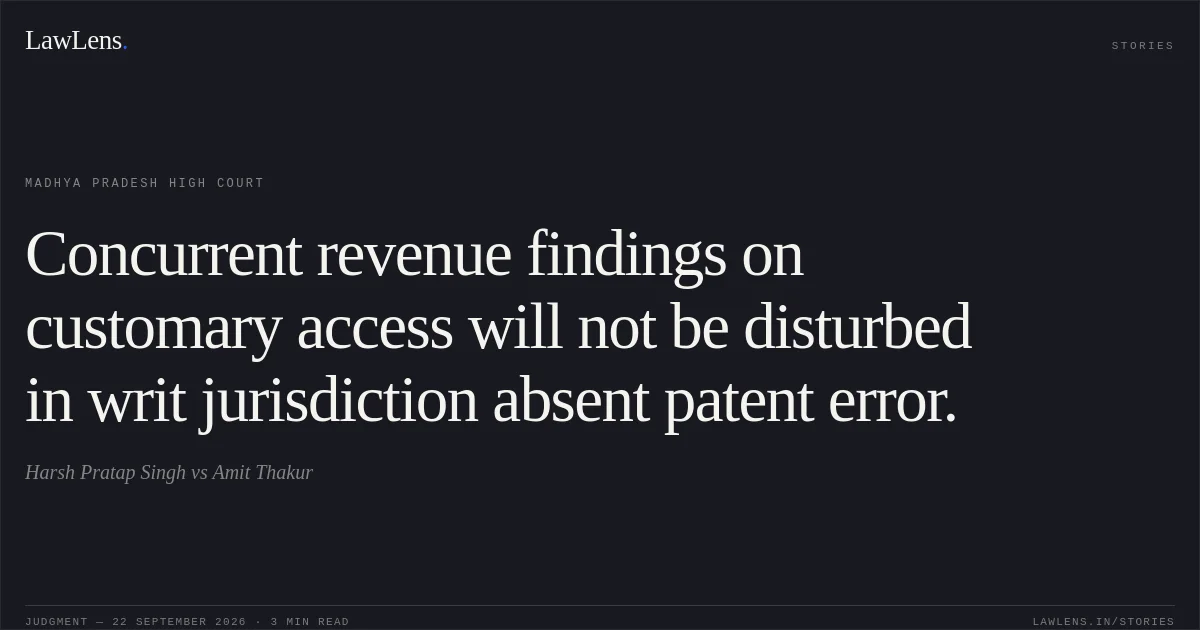
Source reference: p.3, pp.7–8Concurrent findings of fact by competent statutory authorities are not ordinarily disturbed in writ jurisdiction absent exceptional grounds.
Source reference: pp.6–8Reasoning
The Court held that the existence and nature of the disputed passage had been examined by the Naib Tehsildar after enquiry and had thereafter been reviewed by the Sub-Divisional Officer and the Collector, resulting in concurrent findings that a customary way existed.
Source reference: pp.6–7The petitioner’s reliance on Khasra entries, maps, Panchnamas and an alleged alternative access raised factual disputes regarding the location and availability of the passage; these matters did not establish perversity merely because the petitioner sought a different appreciation of the evidence.
Source reference: p.6The allegation that a new road had been created was not accepted as conclusive because the Revenue Authorities had factually found an existing customary way, and no patent lack of jurisdiction, breach of natural justice or perversity was demonstrated.
Source reference: p.7The Court further found that the petitioner’s pending civil suit and earlier Article 227 proceedings reinforced the impropriety of converting the writ petition into another forum for factual re-examination.
Source reference: p.8The reliance on the Coordinate Bench’s order in W.P. No. 29150/2025 was misplaced because that case arose in a different procedural context and did not support interference here.
Source reference: p.7Holding
The Court answered the jurisdictional and writ-interference issues against the petitioner.
It held that no patent jurisdictional error, violation of natural justice or perversity was established in the concurrent orders of the Revenue Authorities, and that the disputed questions concerning the existence, location and nature of the customary way were essentially factual.
Source reference: pp.7–8In view of the concurrent findings and the parallel civil proceedings, the writ petition was dismissed, and the orders dated 31 January 2022, 1 October 2022 and 15 June 2023 were left undisturbed.
Source reference: p.8Acts & Sections Cited
1 provisions across 1 statute referred to in this judgment. Each provision opens on LawLens.
MP Land Revenue Code 19591
Original Court PDF
Harsh Pratap SinghvsAmit Thakur
Click to open original judgment
Original judgment, available to read, download and summarize on LawLens.in