01Facts
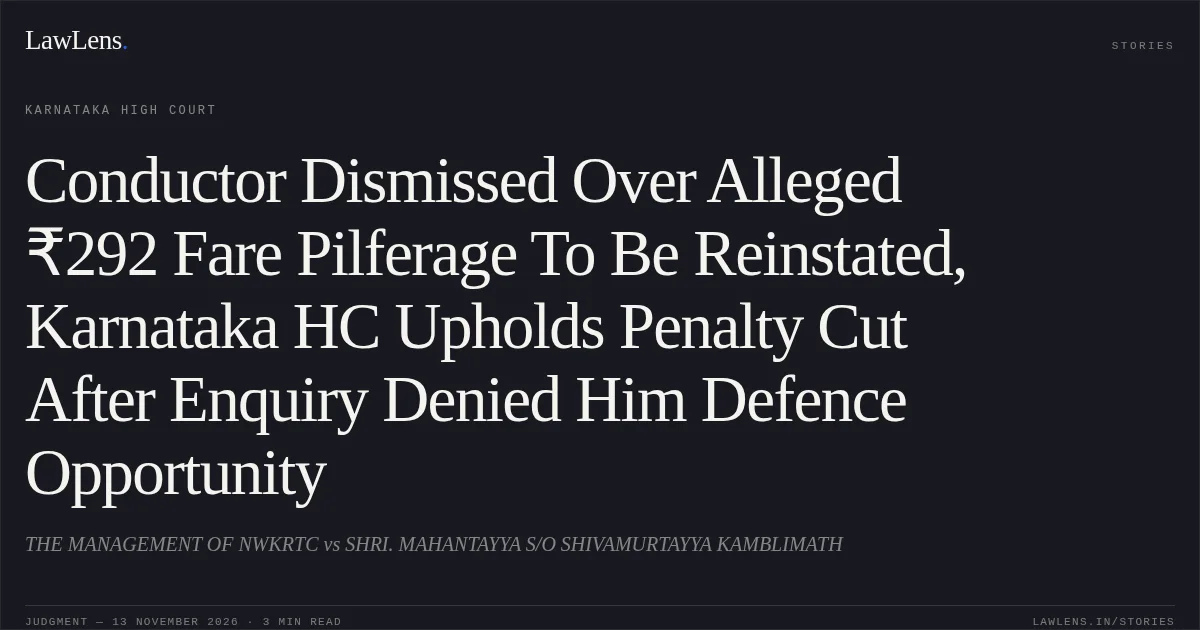
The respondent, a conductor with approximately 11 years’ service, was accused of failing to collect ₹146 from each of two passengers, causing an alleged revenue loss of ₹292.
¶ 3Following a departmental enquiry, he was dismissed. The Labour Court rejected his challenge under Section 10(4-A) of the Industrial Disputes Act, 1947.
¶ 3In a writ petition, the Single Judge found that the enquiry had proceeded without granting the respondent an opportunity to lead defence evidence or complying with Regulation 23(18) of the Karnataka State Road Transport Corporation Servants (Conduct and Discipline) Regulations, 1971.
¶ 8–9The Judge set aside the dismissal and Labour Court award, directed reinstatement with notional continuity and no back wages or monetary benefits, and substituted withholding of two increments with cumulative effect for dismissal.
¶ 8–9The Corporation appealed.
¶ 1, 402Issues
i.Whether the Enquiry Officer’s failure to question the respondent as required by Regulation 23(18), when the respondent had not examined himself, vitiated the departmental enquiry.
¶ 10ii.Whether the procedural breach occasioned prejudice to the respondent and warranted upholding the Single Judge’s order substituting the penalty and directing reinstatement.
¶ 10, 26–2703Law Applied
Regulation 23(1) of the 1971 Regulations requires an enquiry, conducted as far as may be in accordance with Regulation 23, before specified major penalties may be imposed.
¶ 12Under Regulation 23(18), the Enquiry Officer may question a Corporation servant after the servant closes his case; however, where the servant has not examined himself, the Officer shall generally question him about circumstances appearing against him in the evidence so that he may explain them.
¶ 11, 13–15Relying on K. Prabhakar Hegde v. Bank of Baroda, which considered a pari materia disciplinary regulation, the Court held that this duty is mandatory and is not satisfied by merely giving the employee a general opportunity to make submissions; the adverse circumstances must be brought to his attention.
¶ 22–24The Court further applied the principle that denial of this mandatory opportunity, in the circumstances of the case, constitutes prejudice.
¶ 19, 24Provisions in the judgment · 1 · Linked ones open on LawLens
KARNATAKA HIGH COURT ACT, 1961 Section 4
04Reasoning
The respondent had not examined himself, so the mandatory limb of Regulation 23(18) applied.
¶ 18, 25After the Management closed its evidence, he sought time to lead defence evidence, but time was not granted; nor did the Enquiry Officer question him about the adverse circumstances in the evidence.
¶ 18, 25The Court held that the combined denial of an opportunity to present a defence and the required questioning deprived him of a meaningful opportunity to respond, thereby vitiating the enquiry.
¶ 19, 21In light of the procedural defect, the passage of time, the nature of the allegation and the respondent’s service, the Court found no compelling reason to disturb the Single Judge’s choice not to remit the matter for a fresh enquiry and to substitute a lesser penalty.
¶ 2605Holding
The Court held that the Enquiry Officer’s non-compliance with Regulation 23(18) was a breach of a mandatory procedural safeguard that occasioned prejudice to the respondent.
¶ 27–28Finding no merit in the Corporation’s appeal, it rejected the appeal and left undisturbed the Single Judge’s order setting aside the dismissal and Labour Court award, directing reinstatement with notional continuity but without back wages or monetary benefits, and imposing withholding of two increments with cumulative effect.
¶ 27–28Original Court PDF
THE MANAGEMENT OF NWKRTCvsSHRI. MAHANTAYYA S/O SHIVAMURTAYYA KAMBLIMATH
Click to open original judgment
Original judgment, available to read, download and summarize on LawLens.in