Facts
The Appellant was convicted by the Trial Court under Sections 376(1) and 450 of the IPC and sentenced to 10 years of rigorous imprisonment
Source reference: p. 1-2The prosecution alleged that on May 21, 2022, while the informant’s husband was away, the Appellant broke into the house at 2:00 A.M. and raped the informant
Source reference: p. 2The Appellant fled when the husband returned at 3:00 A.M.
Source reference: p. 2The Appellant challenged the conviction, contending that the medical evidence showed no signs of struggle or intercourse
Source reference: p. 4The Appellant contended there was an unexplained delay in filing the FIR
Source reference: p. 4The Appellant contended that the relationship, if any, was consensual between two competent adults
Source reference: p. 6Issues
1. Whether the prosecution proved the charges of house-trespass and non-consensual sexual intercourse beyond a reasonable doubt given the lack of medical evidence and delayed FIR
Source reference: p. 9, 122. Whether the acts of the parties constituted an offence under Section 376 IPC or a consensual relationship between two adults
Source reference: p. 10Law Applied
Section 376(1) (punishment for rape) and Section 450 of the IPC (house-trespass to commit an offence punishable with life imprisonment)
Source reference: p. 1, 9The legal maxim volenti non fit injuria (to one who consents, no injury is done) regarding adult autonomy
Source reference: p. 10The fundamental maxim actus non facit reum nisi mens sit rea (an act does not make a person guilty unless the mind is also guilty)
Source reference: p. 11Section 90 of the IPC regarding the validity of consent
Source reference: p. 13Pankaj Singh v. State of Haryana (2024), which held that the burden of proof remains on the prosecution to prove lack of consent in the absence of a fiduciary relationship
Source reference: p. 12-13Reasoning
The Court observed that since both parties were discerning adults, they possessed the legal and mental capacity to provide autonomous consent
Source reference: p. 10-11It found the prosecution's narrative improbable, noting that the informant raised no alarm during the alleged trespass into a bolted house
Source reference: p. 9The Court scrutinized the medical report of P.W.5, which found no internal or external injuries or signs of recent intercourse, contradicting the claim of forcible assault
Source reference: p. 12The court found the delay in filing the FIR, despite the husband’s immediate presence, cast doubt on the veracity of the allegations
Source reference: p. 11-12The Court reasoned that the evidence pointed toward a consensual relationship that later turned sour, rather than a criminal act, noting that the criminal justice system should not be a tool for personal leverage in failed adult relationships
Source reference: p. 14-15Holding
The High Court answered the issues in the negative, holding that the prosecution failed to establish the foundational elements of criminal intent and lack of consent
The Court set aside the Judgment dated 10.07.2025 passed by the Trial Court, Jeypore. The Appellant was acquitted of all charges under Sections 376(1) and 450 IPC, and the CRLA was allowed
Source reference: p. 15-16Acts & Sections Cited
7 provisions across 3 statutes referred to in this judgment. Each provision opens on LawLens.
Bharatiya Nagarik Suraksha Sanhita, 20231
Code of Criminal Procedure, 19732
Indian Penal Code, 18604
Original Court PDF
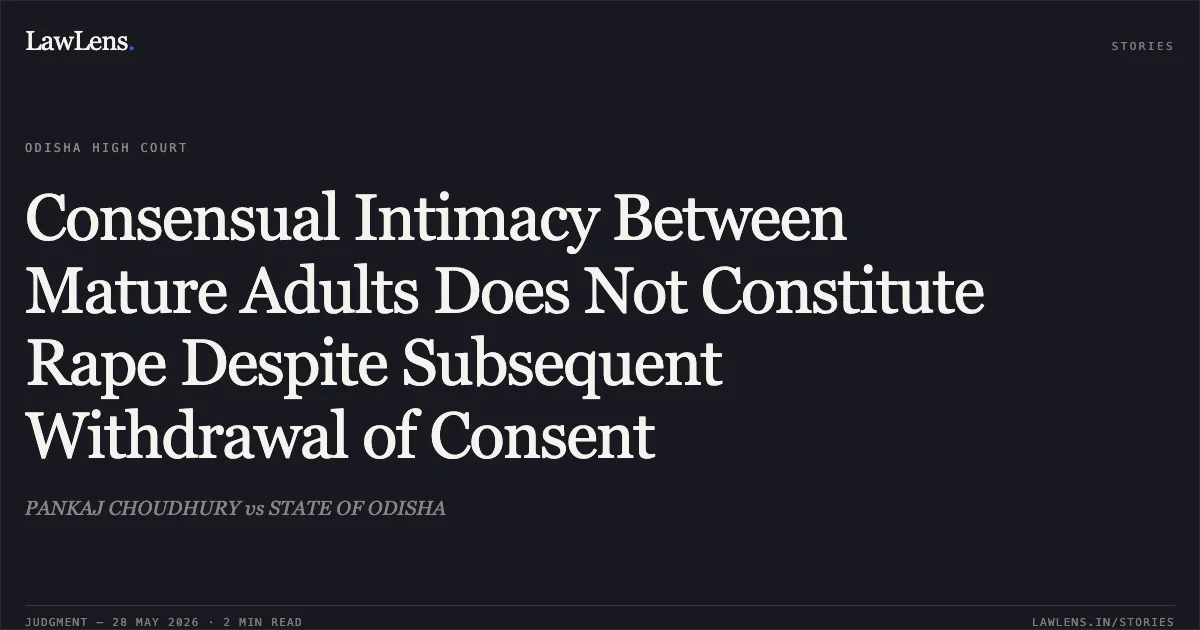
PANKAJ CHOUDHURYvsSTATE OF ODISHA
Click to open original judgment
Original judgment, available to read, download and summarize on LawLens.in