Facts
The appellant was convicted by the Trial Court under Sections 376 and 417 of the IPC for allegedly committing rape on the pretext of marriage.
Source reference: p. 1-2The prosecutrix (P.W.-9) alleged that the appellant, who is her brother-in-law (saali), eloped with her on 04.01.2014 and kept her in various locations, maintaining a physical relationship on the assurance of marriage.
Source reference: p. 2-3She further alleged that the appellant’s family took her ornaments and ₹60,000.
Source reference: p. 3The Trial Court sentenced the appellant to seven years of rigorous imprisonment.
Source reference: p. 1-2The appellant challenged this, arguing that the relationship was consensual and that the prosecutrix was aware of his existing marriage to her own sister.
Source reference: p. 7Issues
1. Whether a conviction under Section 376 IPC can be sustained when the physical relationship was consensual and the prosecutrix was aware of the appellant's subsisting marriage?
Source reference: p. 82. Whether the conviction under Section 417 IPC (Cheating) was sustainable regarding the misappropriation of property?
Source reference: p. 8Law Applied
The court applied Section 376 of the IPC regarding rape and Section 417 of the IPC regarding punishment for cheating.
Source reference: p. 1-2The court relied on the doctrine of "Consent," establishing that where two major individuals enter into a long-term relationship with full knowledge of existing legal impediments (such as a prior marriage), the "false pretext of marriage" does not vitiate consent for the purpose of a rape charge.
Source reference: p. 8Reasoning
The High Court observed that both parties were adults and the relationship was long-standing and consensual.
Source reference: p. 8The court specifically noted that the prosecutrix was the appellant’s sister-in-law and was fully aware that the appellant was already married to her own sister and had three children.
Source reference: p. 7This knowledge rendered the claim of "false pretext of marriage" legally unsustainable, as there could be no misconception of fact under Section 90 IPC regarding a promise of marriage that the prosecutrix knew could not be legally fulfilled.
Source reference: p. 8The court found that the criminal case was initiated only after maltreatment occurred during their cohabitation as "husband and wife".
Source reference: p. 8However, concerning Section 417 IPC, the court found that valuable securities and money were taken by making false promises, justifying the conviction for cheating.
Source reference: p. 8Holding
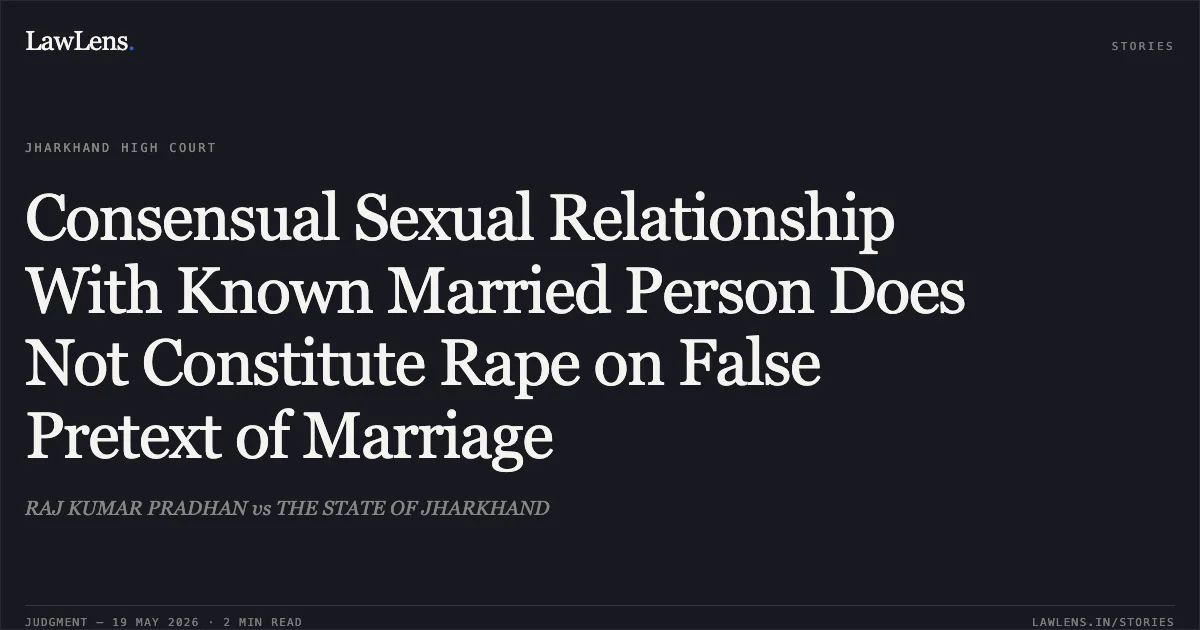
The High Court allowed the appeal in part. It quashed and set aside the conviction under Section 376 IPC, holding that the relationship was consensual and not based on a fraudulent promise of marriage.
The conviction under Section 417 IPC was sustained. Since the appellant had already served four years and six months in custody—exceeding the one-year maximum punishment prescribed for Section 417 IPC—the court ordered his immediate discharge.
Source reference: p. 8-9Acts & Sections Cited
2 provisions across 1 statute referred to in this judgment. Each provision opens on LawLens.
Indian Penal Code, 18602
Original Court PDF
RAJ KUMAR PRADHANvsTHE STATE OF JHARKHAND
Click to open original judgment
Original judgment, available to read, download and summarize on LawLens.in