Facts
The petitioner, Defendant No. 2 in Civil Suit No. 43 of 2023, sought a direction requiring the trial court to conclude the suit within a specified period.
Source reference: no citationHis written statement and applications under Order IX Rule 7 and Order VIII Rule 9 CPC had been filed on 18 July 2025; the applications remained pending while the matter was repeatedly listed for the plaintiffs’ objections.
Source reference: p. 3, para. 5; p. 4, para. 7The record also showed repeated adjournments concerning fresh steps against Defendant No. 5, with no recorded filing of those steps by 20 June 2026.
Source reference: p. 2, para. 4The High Court considered the request under Article 227 of the Constitution.
Source reference: p. 2, para. 1Issues
1. Whether the High Court should direct the trial court to dispose of the suit within a specified time.
Source reference: p. 5, paras. 9–10; p. 6, para. 112. Whether directions should be issued to address the prolonged pendency of the petitioner’s applications and the conduct of the proceedings.
Source reference: p. 6, para. 12; p. 7, para. 13Law Applied
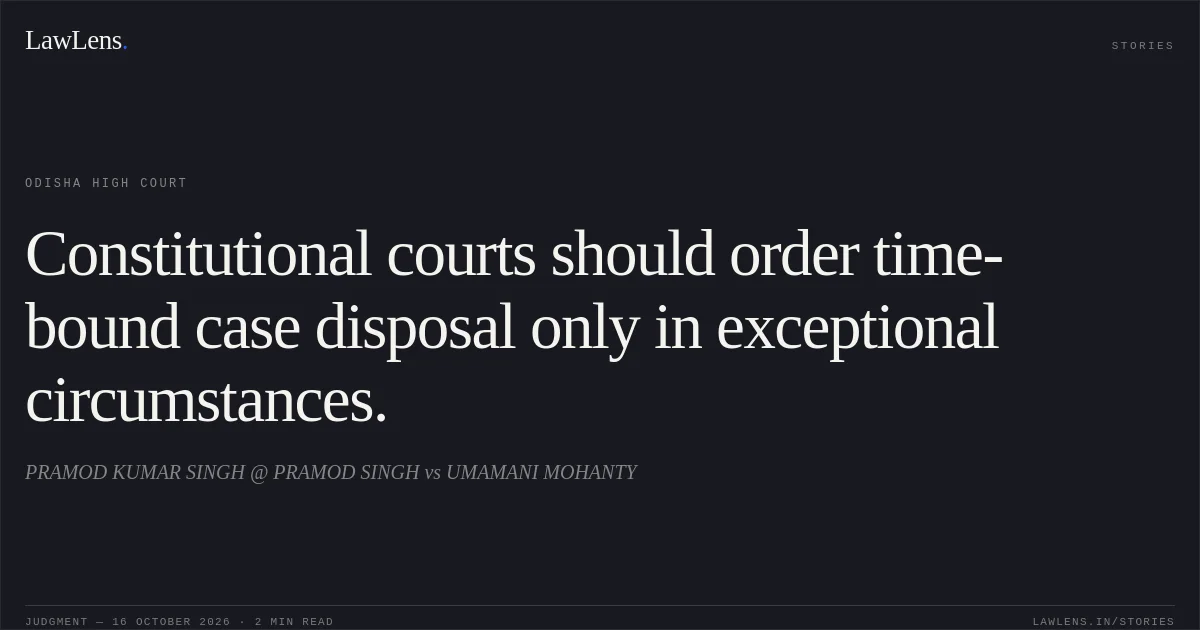
Under Article 227 of the Constitution, a constitutional court should ordinarily refrain from fixing a time-bound schedule for disposal of cases pending before another court; such directions are appropriate only in exceptional circumstances, and prioritisation is generally for the court where the case is pending.
Source reference: p. 5, para. 9The High Court applied the principle stated in Sangram Sadashiv Suryavanshi v. State of Maharashtra, 2024 INSC 899, which quotes paragraph 47.3 of the Constitution Bench decision in High Court Bar Association, Allahabad v. State of Uttar Pradesh, (2024) 6 SCC 267.
Source reference: p. 5, para. 9The applications in the suit were made under Order IX Rule 7 and Order VIII Rule 9 CPC.
Source reference: pp. 3–4, paras. 5, 7Reasoning
The Court found no sufficient basis to direct disposal of the entire suit within a fixed period, consistent with the rule that such time-bound directions should not issue routinely.
Source reference: p. 6, paras. 10–11However, the petitioner’s two applications had remained pending for more than a year, and the record showed repeated adjournments for objections.
Source reference: p. 6, para. 12The Court therefore ordered a limited procedural remedy: the trial court was to give the plaintiffs only one further opportunity to file objections, then dispose of the applications, and proceed with the suit without unnecessary adjournments.
Source reference: p. 6, para. 12Holding
The High Court declined to direct disposal of the suit within a specified period.
It directed the trial court to dispose of the petitioner’s applications under Order IX Rule 7 and Order VIII Rule 9 CPC after allowing the plaintiffs one further opportunity to object, to avoid unnecessary adjournments, and to pass appropriate orders if fresh steps against Defendant No. 5 had not been filed.
Source reference: pp. 6–7, paras. 12–14The CMP was disposed of, and the Registry was directed to communicate the order to the trial court forthwith.
Source reference: p. 7, paras. 14–15Original Court PDF
PRAMOD KUMAR SINGH @ PRAMOD SINGHvsUMAMANI MOHANTY
Click to open original judgment
Original judgment, available to read, download and summarize on LawLens.in