Facts
The petitioners filed a Contempt Petition (C.P.) alleging non-compliance with the Tribunal’s order dated 19.12.2023, which directed the respondents to convene a Departmental Promotion Committee (DPC) and grant promotions to SSO (Grade-I) with consequential benefits.
Source reference: p. 9On 09.12.2025, the Tribunal noted that the respondents sought clarifications from the DoP&T regarding consequential benefits rather than implementing the order or challenging it.
Source reference: p. 9The respondents subsequently challenged this interim contempt order and the original order before the Delhi High Court in W.P.(C) No. 1117/2026.
Source reference: p. 10The High Court observed that since a DPC had been held and a promotion list issued on 08.03.2024, the directions were substantially complied with, and any dispute regarding the extent of consequential benefits required a fresh Original Application (O.A.) rather than contempt proceedings.
Source reference: p. 10-11The Supreme Court upheld this view in S.L.P. (C) No. 7094/2026, granting liberty to the petitioners to seek appropriate legal remedies.
Source reference: p. 11Issues
1. Whether the contempt proceedings should be continued when the respondents have partially complied with the directions and the High Court has ruled that the remaining grievance requires fresh adjudication.
Source reference: p. 11-122. Whether the principle of res judicata bars a fresh petition regarding the denial of consequential benefits after the disposal of the contempt petition.
Source reference: p. 12Law Applied
The court applied the principle that the jurisdiction to initiate contempt proceedings arises only in cases of "willful disobedience of clear and categoric directions".
Source reference: p. 10, para 14Once an order is passed in purported compliance, the correctness of that subsequent action (right or wrong) must be tested through a fresh O.A. and not through the "surrogate vehicle" of contempt jurisdiction.
Source reference: p. 10-11, para 14-15The doctrine of "fresh cause of action" arising from new compliance orders, which supersedes the bar of res judicata when express liberty is granted by higher courts.
Source reference: p. 12Reasoning
The Tribunal analyzed the current status of the dispute in light of the High Court and Supreme Court orders. It found that the respondents had indeed convened the DPC and issued a promotion list, albeit without the full consequential benefits sought by the petitioners.
Source reference: p. 10Following the Delhi High Court's reasoning, the Tribunal held that it cannot relitigate the merits of the "consequential benefits" in a contempt proceeding because such an action would distort the purpose of contempt jurisdiction.
Source reference: p. 11Regarding the petitioners' fear of res judicata, the Tribunal reasoned that since the High Court and Supreme Court explicitly granted liberty to file a fresh O.A., and since the respondents' new promotion order dated 08.03.2024 constitutes a fresh cause of action, the legal bar does not apply.
Source reference: p. 12Holding
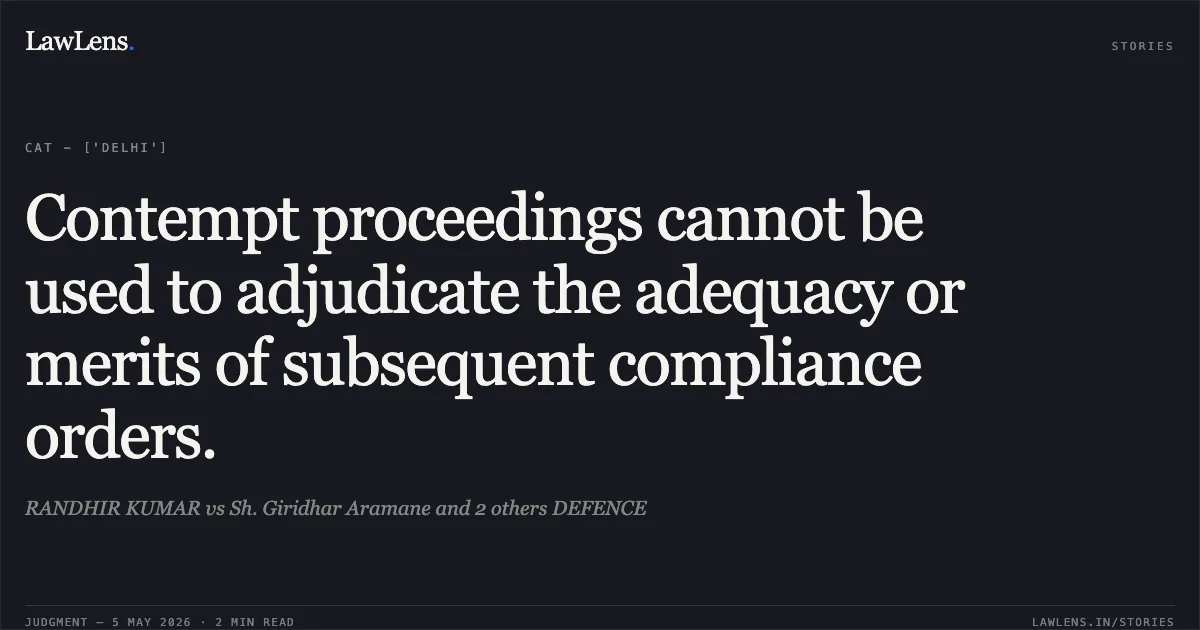
The Tribunal closed the Contempt Petition, holding that nothing survived for consideration in the contempt jurisdiction.
It directed that if the applicants are aggrieved by the non-grant of specific consequential reliefs, the appropriate remedy is to file a fresh O.A. as permitted by the Delhi High Court and the Supreme Court. The Tribunal clarified that the merits of the case, including precedents like GNCTD v. Rakesh Beniwal, remain open for adjudication in such fresh proceedings.
Source reference: p. 12Acts & Sections Cited
5 provisions across 3 statutes referred to in this judgment. Each provision opens on LawLens.
Administrative Tribunals Act, 19852
Contempt of Courts Act, 19712
Code of Civil Procedure, 19081
Original Court PDF
RANDHIR KUMARvsSh. Giridhar Aramane and 2 others DEFENCE
Click to open original judgment
Original judgment, available to read, download and summarize on LawLens.in