Facts
The petitioners were appointed as teachers (PRT, TGT, and PGT) by the Damodar Valley Corporation (DVC) on a contractual basis between 2002 and 2005 following various advertisements and selection processes
Source reference: p. 6Despite serving for over 20 years on sanctioned and vacant posts, their services remained contractual
Source reference: p. 7, 9The Corporation periodically issued technical breaks in service, such as during summer vacations, and subsequently re-engaged them
Source reference: p. 7, 16Several petitioners sought regularization following a 2016 Division Bench order in LPA No. 216 of 2008, which modified a previous restriction on regularization
Source reference: p. 7the respondent-Corporation rejected their representations via impugned orders dated 27.09.2016 and 10.01.2017, arguing that the engagement was day-to-day and that vacancies would now be filled via outsourcing or open advertisement
Source reference: p. 8Issues
1. Whether the petitioners, having completed over 20 years of continuous service on sanctioned posts, are entitled to regularization of their services
Source reference: p. 52. Whether the technical breaks in service (e.g., summer vacations) and the label of "contractual employee" preclude a claim for regularization under the Constitution
Source reference: p. 163. Whether the writ petitions are barred by the principle of delay and laches given the impugned orders were passed in 2016/2017
Source reference: p. 10, 17Law Applied
The Court primarily applied the constitutional principles of Articles 14, 16, and 21 regarding fair employment and the duty of the State as a "Constitutional Employer"
Source reference: para. 18(b)Dharam Singh v. State of U.P. (2025), which held that long-term extraction of regular labor under temporary labels offends the promise of equal protection
Source reference: para. 18(b)Jaggo v. Union of India (2024), establishing that perennial work cannot be brushed aside by labeling it contractual
Source reference: para. 18(c)Bhola Nath v. State of Jharkhand (2026), which characterized the power imbalance between the State and a contractual employee as an "unconscionable agreement between a Lion and a Lamb"
Source reference: para. 18(e)Prem Chand v. State of Punjab (2025) regarding the legal insignificance of "artificial breaks" in service
Source reference: para. 18(f)Reasoning
The Court reasoned that the petitioners' 20-year tenure proves the work is permanent and perennial in nature, making them the "backbone" of the institution
Source reference: para. 18(a)The Court dismissed the Corporation’s defense regarding "technical breaks" (summer vacations), classifying them as "artificial and engineered" to prevent the accrual of legal rights, which does not constitute a genuine cessation of employment
Source reference: para. 18(f)Applying the "Constitutional Employer" doctrine, the Court held that the DVC, as a statutory body, cannot balance budgets by exploiting workers on a long-term contractual basis while the work remains perennial
Source reference: para. 18(b)Regarding the Corporation's intent to move to "outsourcing," the Court noted that replacing long-serving employees with outsourced labor for permanent work is not permissible in law
Source reference: p. 10the Court rejected the plea of "delay and laches," stating such technicalities cannot be used to deny regularization to employees who have rendered decades of service
Source reference: para. 18(i)Holding
The High Court allowed all writ petitions and quashed the impugned orders dated 27.09.2016 and 10.01.2017
The Court issued a Writ of Mandamus directing the respondents to regularize the services of the petitioners with effect from the date they completed ten years of service, along with all consequential service benefits
Source reference: p. 19The Court held that the Division Bench's earlier observations in LPA No. 216 of 2008 were misconstrued by the Corporation to deny legitimate claims
Source reference: para. 18(g)Acts & Sections Cited
1 provisions across 1 statute referred to in this judgment. Linked provisions open on LawLens.
Damodar Valley Corporation Act, 19481
Original Court PDF
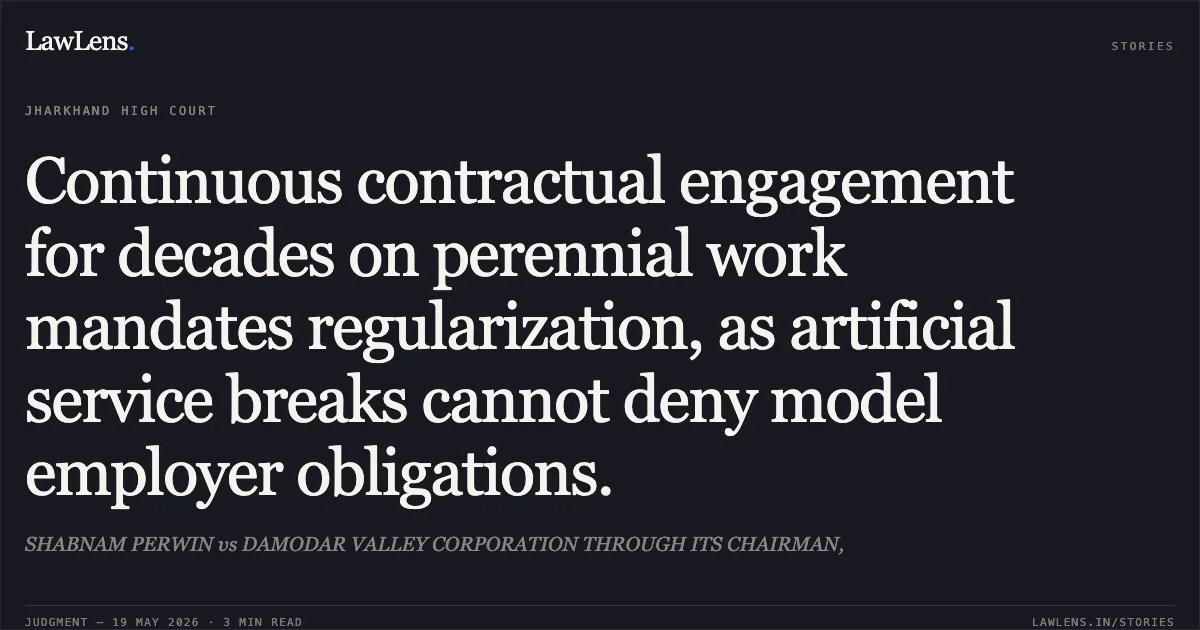
SHABNAM PERWINvsDAMODAR VALLEY CORPORATION THROUGH ITS CHAIRMAN,
Click to open original judgment
Original judgment, available to read, download and summarize on LawLens.in