Facts
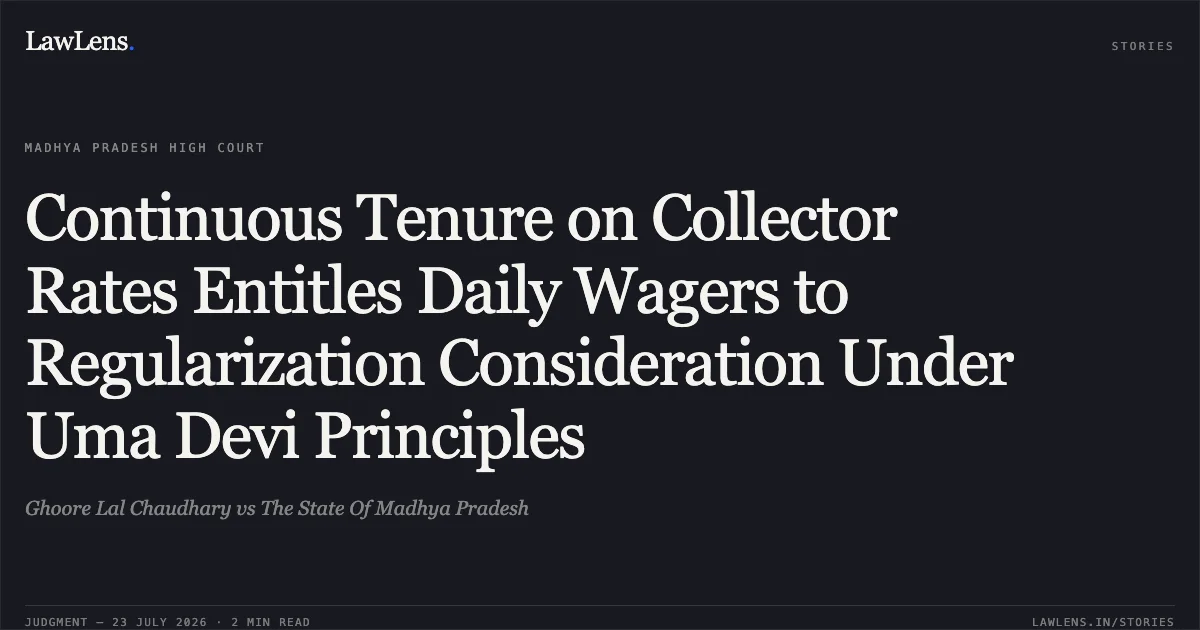
The petitioner, who has worked uninterruptedly for a government department since 1997, sought regularization and a regular pay scale.
Source reference: para. 3He previously filed a writ petition in 2016, where the court directed the respondents to consider his representation.
Source reference: para. 2The respondents subsequently rejected his claim on March 24, 2016, asserting that as a part-time employee, he was ineligible for regularization under existing rules.
Source reference: para. 2The petitioner challenged this rejection, providing evidence of continuous service at Collector rates and noting that similarly situated individuals had been regularized.
Source reference: para. 3Issues
1. Whether the respondent's rejection of the petitioner’s claim for regularization was valid given his long-term, continuous service and the treatment of similarly situated employees.
Source reference: para. 32. Whether the principles regarding the regularization of long-serving temporary or irregular employees established by the Supreme Court apply to the petitioner's circumstances.
Source reference: para. 4-5Law Applied
Article 226 of the Constitution of India regarding the High Court's discretionary power to issue writs.
Source reference: para. 1Precedent established by the Hon'ble Apex Court in Jaggu v. Union of India (2024) and Pawan Kumar v. Union of India, which interpret the landmark Uma Devi judgment.
Source reference: para. 4Doctrine that while "backdoor entries" are prohibited, employees in "irregular" rather than "illegal" appointments who have served for over ten years in sanctioned roles should be considered for regularization as a one-time measure to prevent the "weaponizing" of legal technicalities against long-term workers.
Source reference: para. 4Reasoning
The court found that the petitioner’s status as a "part-time" worker was contradicted by the administrative record, which showed he had been re-engaged at Collector rates and worked continuously for decades.
Source reference: para. 3The court observed that the department had previously regularized others in the same position, suggesting a discriminatory application of rules.
Source reference: para. 3By applying the Supreme Court’s reasoning in Jaggu, the court determined that government departments must act as model employers; it reasoned that denying regularization solely on procedural labels (like "part-time") after decades of indispensable service contradicts international labor standards and the spirit of Indian constitutional law.
Source reference: para. 4-5Holding
The court set aside the previous rejection and remitted the matter back to the respondent authorities for fresh consideration, holding that the petitioner’s long-term service and payment at Collector rates necessitated a review in light of modern Supreme Court precedents.
The court directed the petitioner to submit a fresh representation within 15 days, which the respondents must decide upon within two months from the date of receipt, and the writ petition was disposed of accordingly.
Source reference: para. 6-7Original Court PDF
Ghoore Lal ChaudharyvsThe State Of Madhya Pradesh
Click to open original judgment
Original judgment, available to read, download and summarize on LawLens.in