Facts
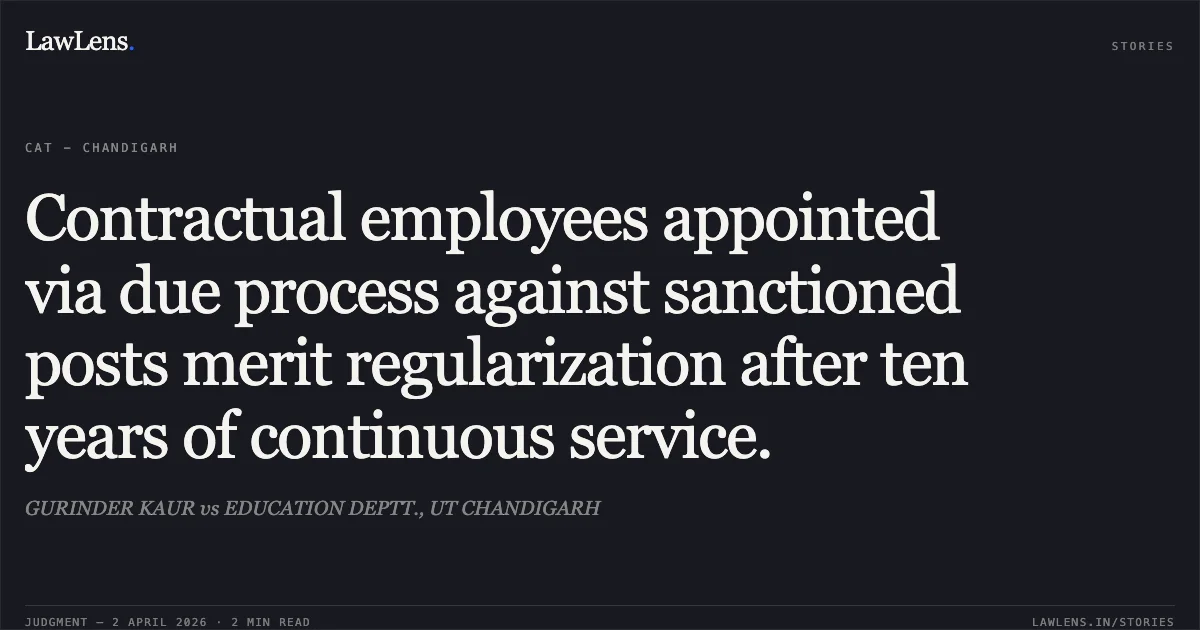
The applicants were appointed as teachers (JBT/TGT/PGT/Lecturers) by the Department of Education, Chandigarh Administration, on a contract basis following advertisements issued in 1997 and 2002
Source reference: p. 5-6At the time of the application, most applicants had served continuously for over 16 years (with one applicant exceeding 10 years) against sanctioned and vacant posts
Source reference: p. 6The applicants approached the Tribunal seeking a direction for the respondents to frame a comprehensive policy for their regularization and to absorb them into service, citing a lack of action by the Union Territory of Chandigarh despite similar policies being implemented in neighboring states
Source reference: p. 6-7Issues
1. Whether the applicants are entitled to the regularization of their services based on their long-term continuous employment against sanctioned posts
Source reference: p. 52. Whether the respondents are mandated to frame a regularization policy in light of the evolving jurisprudence regarding contractual employees
Source reference: p. 6Law Applied
The court primarily relied on the landmark judgment in Secretary, State of Karnataka v. Uma Devi (2006) 4 SCC 1, which directed governments to frame one-time policies for regularizing "irregular" (but not illegal) appointments of employees who served for over ten years.
Source reference: p. 6It further integrated the principles from Jaggo v. Union of India (2024) SCC OnLine SC 3826, which cautioned against the "weaponization" of the Uma Devi ruling to deny legitimate claims of long-serving employees.
Source reference: p. 7The Tribunal also relied on Shripal and Another v. Nagar Nigam, Ghaziabad (2025) and Dharam Singh v. State of UP (2025), alongside the Punjab and Haryana High Court’s decision in CWP No. 20096/2021 (2025), which held that qualified personnel appointed via due procedure against sanctioned posts cannot be denied regularization due to the absence of a policy.
Source reference: p. 8-10Reasoning
The Tribunal noted that the applicants were not "backdoor entrants" because they were appointed through a formal selection process involving advertisements and were working against sanctioned posts.
Source reference: p. 6, 9Applying the reasoning from Jaggo, the court observed that when roles are integral to an organization's functioning and employees have served for decades, continuous contractual engagement contravenes fair labour standards.
Source reference: p. 7-8The Tribunal emphasized the High Court's finding that teachers performing the same duties as regular staff for nearly 20 years should not be kept on contract by misapplying the Uma Devi dicta.
Source reference: p. 9Since the respondents had not yet taken a final decision regarding the applicants' regularization, the Tribunal determined that the claims must be re-evaluated under the refined legal standards established by the Supreme Court in 2024 and 2025, which favor regularization for long-term "irregular" appointees.
Source reference: p. 10Holding
The Tribunal disposed of the Original Applications with a direction to the respondents' Competent Authority to consider the applicants' claims for regularization.
The respondents must evaluate the claims in light of the ratios established in Jaggo, Shripal, and Dharam Singh within a period of three months from the receipt of the certified order.
Source reference: p. 10No order was made as to costs.
Source reference: p. 10Original Court PDF
GURINDER KAURvsEDUCATION DEPTT., UT CHANDIGARH
Click to open original judgment
Original judgment, available to read, download and summarize on LawLens.in