Facts
The petitioners, 24 retired teachers under the age of 65, were engaged as Block Resource Persons (BRPs) on a contractual basis in Gaya district under the Sarv Shiksha Abhiyan (SSA)
Source reference: p. 3-5Their primary responsibility was school monitoring and inspection
Source reference: p. 5-6Following a review by the Education Department, it was discovery that inspection reports submitted by BRPs and other outsourced agencies contained "fake and concocted data" that significantly differed from ground realities
Source reference: p. 6, 11-12Consequently, the District Programme Officer issued Memo No. 902 dated 11.03.2025, directing that BRP services be discontinued after 31.03.2025
Source reference: p. 3, 7The petitioners challenged this order, seeking to continue until they reached 65 years of age or until regular appointments were made
Source reference: p. 3Issues
1. Whether the termination of the petitioners' contractual engagement as BRPs was arbitrary, illegal, or in violation of the principles of natural justice
Source reference: p. 7, 92. Whether the petitioners, as retired teachers on contract, are entitled to protections under Article 311 of the Constitution of India
Source reference: p. 7, 123. Whether a contractual employee can be replaced by another set of employees or if the state is bound by "legitimate expectation" to continue the contract until age 65
Source reference: p. 7, 14Law Applied
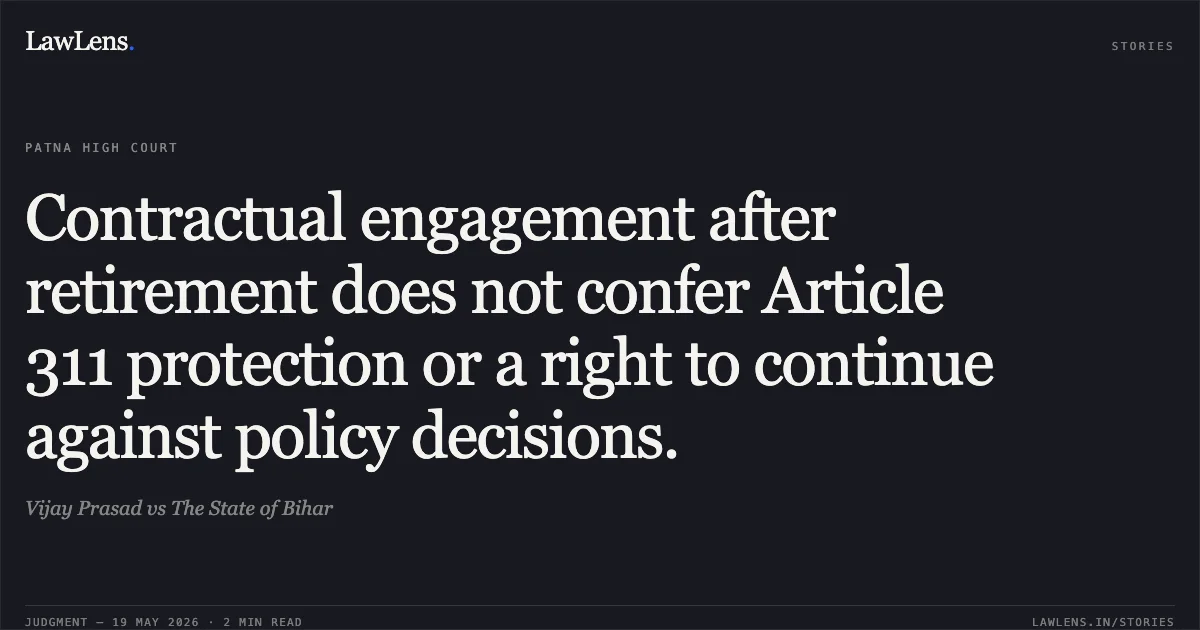
Statement identifying that contractual employees do not hold a "civil post" and thus cannot claim protection under Article 311 of the Constitution of India
Source reference: p. 12, 13The court distinguished the precedents of State of Haryana v. Piara Singh (1992) 4 SCC 118 (regarding Ad-hoc employees) and Ramana Dayaram Shetty v. IAAI (1979) 3 SCC 489, noting they are inapplicable to retired personnel re-engaged on a contractual basis
Source reference: p. 9, 14The court upheld the State’s right to make policy decisions regarding the restructuring of inspection mechanisms and the judicious use of the public exchequer
Source reference: p. 13, 15Reasoning
The court reasoned that the petitioners' engagement was strictly contractual and governed by specific terms, including Clause 7, which allowed for immediate termination if services were found unsatisfactory
Source reference: p. 10, 15The court found that the State's decision was a matter of policy necessitated by the "futile exercise" of collecting contradictory and unreliable data, which resulted in a loss to the public money
Source reference: p. 13, 15Since the State decided to transfer inspection duties to its own departmental officials rather than replacing one set of contractual workers with another, the rule against replacing one ad-hoc worker with another was not violated
Source reference: p. 14The court emphasized that judicial interference in policy decisions is limited, especially when the decision aims to strengthen the administrative mechanism and safeguard public funds
Source reference: p. 13-14Holding
The court answered the issues in the negative and held that the petitioners have no vested right to continue until age 65 as they were not regular employees and their performance was found lacking
The court concluded that the impugned order was a valid policy decision by the Bihar Education Project Council to prevent the waste of public exchequer on unreliable monitoring; consequently, the writ petition was dismissed and no relief was granted
Source reference: p. 15, 16Original Court PDF
Vijay PrasadvsThe State of Bihar
Click to open original judgment
Original judgment, available to read, download and summarize on LawLens.in