Facts
The appellant, Rajesh, was allegedly employed as a driver by RTS Transport Company. On January 24, 2001, he and a helper, Dilbagh Singh (deceased), left Delhi for Agra in a truck
Source reference: p. 2On January 27, 2001, an unidentified body (later identified as Dilbagh via photographs) was recovered near Agra; the cause of death was determined to be asphyxia due to strangulation
Source reference: p. 3Following a Habeas Corpus petition by the deceased's wife, the appellant was arrested on October 10, 2001
Source reference: p. 3The prosecution relied on an extra-judicial confession made to PW-14, the "last seen" theory, and the recovery of the deceased's blanket from the appellant's home
Source reference: p. 3-4The Trial Court convicted the appellant under Section 302 of the IPC
Source reference: p. 1Issues
1. Whether the prosecution established a complete and unbroken chain of circumstantial evidence sufficient to prove the appellant's guilt beyond reasonable doubt
Source reference: p. 4 / para. 102. Whether the extra-judicial confession made to PW-14 was voluntary, truthful, and reliable given the alleged political and financial rivalry between the parties
Source reference: p. 5 / para. 123. Whether the prosecution proved the foundational facts of employment and the "last seen together" circumstance in the absence of documentary evidence
Source reference: p. 15 / para. 28-29Law Applied
The court primarily applied Section 302 and Section 201 of the IPC
Source reference: p. 1-2It relied on the "Five Golden Principles" of circumstantial evidence established in Sharad Birdhichand Sarda v. State of Maharashtra, requiring a chain of evidence so complete as to exclude any hypothesis of innocence
Source reference: p. 18 / para. 32The court applied Section 106 of the Evidence Act regarding the burden of proof for facts within special knowledge, noting it only shifts after the prosecution proves foundational facts
Source reference: p. 16 / para. 30Regarding extra-judicial confessions, the court followed Sahadevan v. State of Tamil Nadu, treating them as "weak evidence" requiring independent corroboration
Source reference: p. 21-22 / para. 35It also applied the principle from Ramkishan Mithanlal Sharma v. State of Bombay regarding the necessity of Test Identification Parades (TIP) for recovered articles
Source reference: p. 20 / para. 34Reasoning
The court found the prosecution's case fundamentally flawed as it failed to produce any documentary evidence (attendance registers, freight receipts, or call records) to prove the appellant was actually driving the truck or left with the deceased
Source reference: p. 15-16This failure prevented the "last seen" theory from being established, thus Section 106 of the Evidence Act did not apply
Source reference: p. 16-17The court dismissed the extra-judicial confession, noting PW-14 admitteed to a financial dispute and political rivalry with the appellant’s family, making the confession improbable
Source reference: p. 22the recovery of the blanket was deemed unreliable because no TIP was conducted, and the item was common
Source reference: p. 19-20The court also highlighted contradictions regarding the place of arrest (Kanpur vs. Agra) and noted that the deceased’s family initially suspected the transport company owners, not the appellant
Source reference: p. 17-18Holding
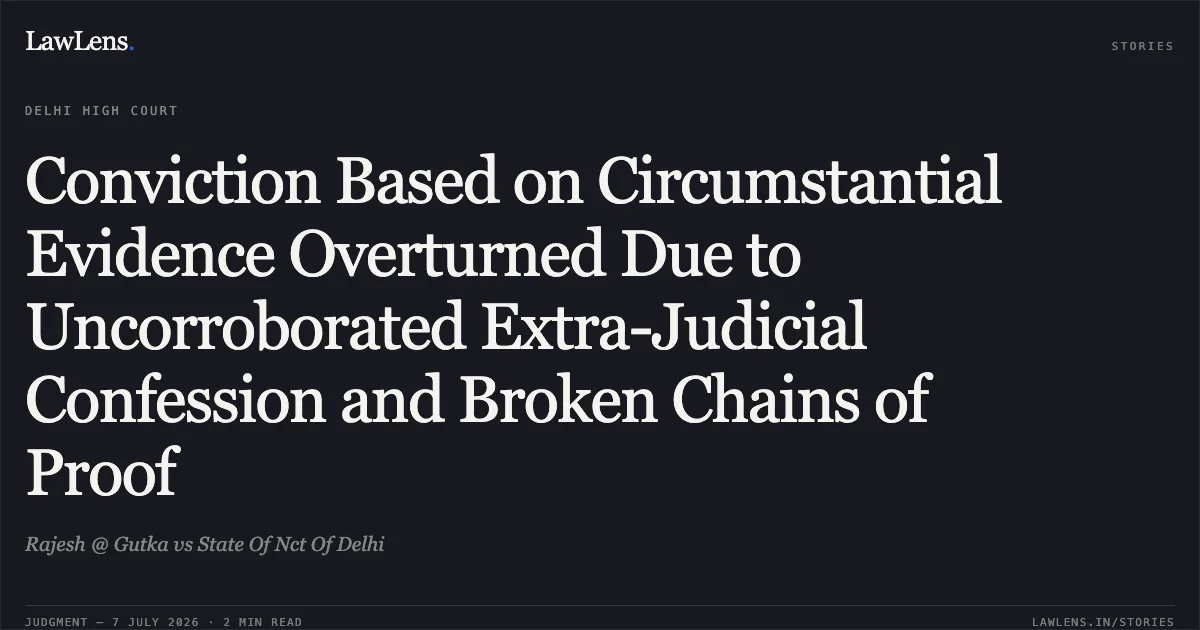
The court answered the issues in the negative, holding that the prosecution failed to bridge the gap between "may be true" and "must be true"
The court held that suspicion, however grave, cannot replace legal proof
Source reference: p. 27Consequently, the High Court set aside the Judgment of Conviction and Order on Sentence dated September 12, 2003, and acquitted the appellant of all charges. His bail bond was cancelled and the surety discharged.
Source reference: p. 28Acts & Sections Cited
5 provisions across 2 statutes referred to in this judgment. Each provision opens on LawLens.
Indian Penal Code, 18604
Code of Criminal Procedure, 19731
Original Court PDF
Rajesh @ GutkavsState Of Nct Of Delhi
Click to open original judgment
Original judgment, available to read, download and summarize on LawLens.in