Facts
On 14 May 2001, accused Narendra allegedly threatened to kill Dhruba Pradhan, the deceased.
Source reference: no citationLater that evening, a group of accused persons allegedly armed with weapons searched for the deceased, intercepted him at Agi Chhak while he was travelling by motorcycle, forcibly took him to a paddy field, assaulted him, and caused his death.
Source reference: no citationHis motorcycle was thrown into a pond.
Source reference: no citationThe FIR was lodged by PW-3 at 2:00 a.m. on 15 May 2001, and the investigation resulted in a chargesheet against 18 persons.
Source reference: no citationFourteen accused were tried; the Trial Court convicted six persons under Sections 148, 506 and 302 read with Section 149 IPC and acquitted eight.
Source reference: no citationThe High Court rejected the alleged eyewitness account on the ground that identification in the pitch-dark night was improbable, but nevertheless affirmed the convictions on circumstantial evidence.
Source reference: no citationDuring the pendency of the appeals before the Supreme Court, two convicted appellants died, leaving four appellants before the Court
Source reference: paras. 2–10Issues
Whether the prosecution witnesses could reliably identify the appellants or witness the assault in a pitch-dark night from a distance of approximately 60 cubits, particularly when the alleged source of light was the assailants’ torchlight?
Source reference: paras. 17–21Whether, after discarding the alleged eyewitness testimony, the remaining circumstances established an unbroken chain proving the appellants’ guilt beyond reasonable doubt under Sections 302/149 IPC?
Source reference: paras. 22–33Whether the concurrent findings of conviction by the Trial Court and the High Court warranted interference by the Supreme Court?
Source reference: paras. 14, 34–35Law Applied
The Court applied Sections 148, 506 and 302 read with Section 149 of the Indian Penal Code, 1860, concerning rioting with deadly weapons, criminal intimidation, and murder by members of an unlawful assembly.
Source reference: no citationFor circumstantial evidence, it applied the five principles in Sharad Birdhichand Sarda v. State of Maharashtra, requiring every circumstance to be fully established, consistent only with guilt, conclusive, exclusive of reasonable alternative hypotheses, and collectively forming a complete chain
Source reference: para. 23It also relied on Kamal v. State (NCT of Delhi) for the rule that circumstances “must or should” be proved and that strong suspicion cannot substitute proof beyond reasonable doubt
Source reference: para. 24Abdul Nassar v. State of Kerala for the requirement that each link of circumstantial evidence be individually proved and collectively form an unbroken chain
Source reference: para. 31State of U.P. v. Ashok Kumar and Tamilselvan v. State for the principle that identification of assailants in darkness, particularly where the light is directed from the assailants toward the witnesses, may be unreliable
Source reference: paras. 18–20Reasoning
The Court found material inconsistencies among the alleged eyewitnesses.
Source reference: no citationPW-3’s FIR indicated that only PW-17 and PW-26 had witnessed the occurrence, whereas PW-4 later claimed that PW-3 and several other witnesses were also present
Source reference: para. 17The incident allegedly occurred on a pitch-dark night at a distance of about 60 cubits, and the witnesses’ identification was based principally on sound and torchlight carried by the accused.
Source reference: no citationApplying Ashok Kumar and Tamilselvan, the Court held that light emanating from the assailants’ torches would not safely permit the witnesses to identify them
Source reference: paras. 18–21Once the ocular evidence was rejected, the remaining circumstances—prior threats, the accused’s presence near the deceased’s house, alleged identification, witness recognition by voice, and recovery of articles—were found either dependent on the unreliable testimony or insufficiently proved.
Source reference: paras. 26–30The Court also noted inconsistencies in witness conduct and the absence of reliable evidence connecting the appellants to the alleged 53-kilogram laterite stone
Source reference: paras. 26–30Applying the principles governing circumstantial evidence, the Court concluded that the circumstances did not exclude reasonable hypotheses consistent with innocence and did not form a complete chain proving guilt beyond reasonable doubt
Source reference: paras. 31–33Holding
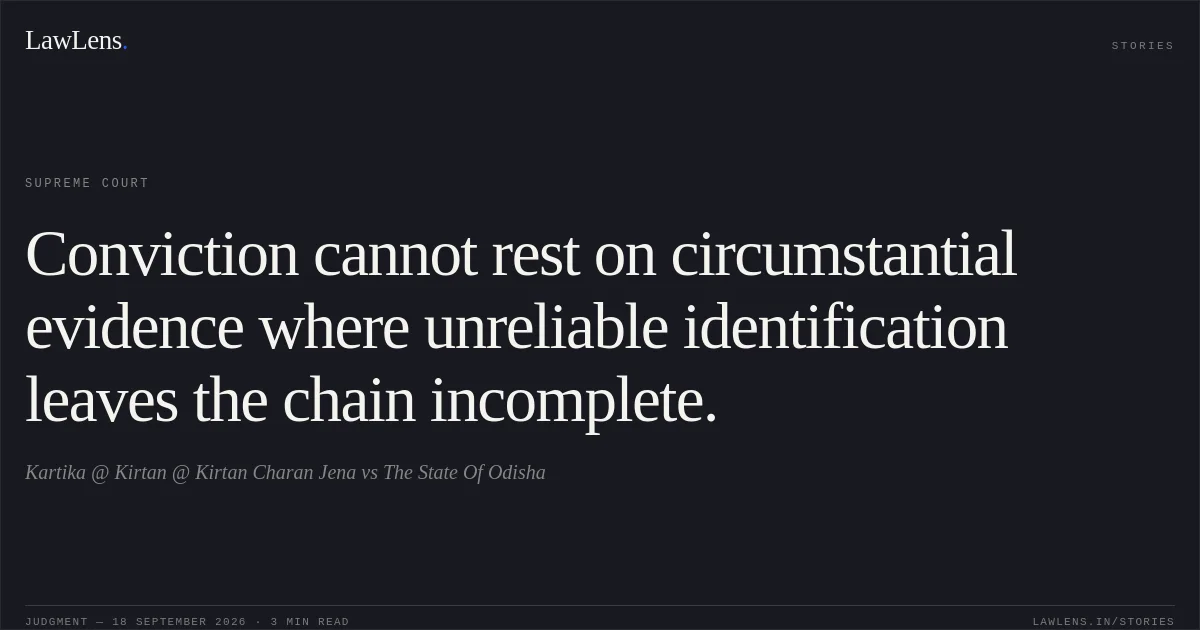
The Supreme Court held that the prosecution failed to establish the appellants’ authorship of the murder.
The alleged eyewitness testimony was unreliable, and the circumstantial evidence did not form a complete and conclusive chain pointing only to the appellants’ guilt.
Source reference: paras. 33–35Giving the appellants the benefit of doubt, the Court allowed the appeals, quashed the High Court judgment dated 6 May 2009 and the Trial Court judgment dated 28 January 2004, and set aside the appellants’ convictions and sentences
Source reference: paras. 33–35Acts & Sections Cited
4 provisions across 1 statute referred to in this judgment. Each provision opens on LawLens.
Indian Penal Code, 18604
Original Court PDF
Kartika @ Kirtan @ Kirtan Charan JenavsThe State Of Odisha
Click to open original judgment
Original judgment, available to read, download and summarize on LawLens.in