Facts
On 19 July 2020, Manjhariya Devi allegedly left her home with her daughter, Neha Kumari (PW-7), to attend nature’s call. The prosecution alleged that seven or eight persons intercepted Manjhariya Devi near a canal, compelled Neha to leave, and subsequently murdered Manjhariya Devi by firearm. Her body, bearing a gunshot injury, was found near a pond the following morning.
Source reference: paras. 3–4; p. 2–3The FIR was based on the fardbeyan of Surendra Ram (PW-1), who was not an eyewitness and claimed to have learnt of the incident from Neha.
Source reference: paras. 3–4; p. 2–3The appellant was charge-sheeted under Sections 302/34 IPC and Section 27 of the Arms Act. The trial court convicted him under Sections 302 IPC and 27 of the Arms Act and imposed life imprisonment for murder and three years’ rigorous imprisonment for the Arms Act offence, with the sentences to run concurrently.
Source reference: paras. 5–7; p. 3–4The prosecution principally relied upon Neha Kumari’s testimony, the medical evidence, alleged recovery of a country-made pistol, and recovery of cartridges and an empty shell.
Source reference: paras. 11–14; p. 5–7In appeal, the appellant challenged the credibility of PW-7, the timing and place of the fardbeyan, the non-examination of material witnesses, the alleged suppression of the deceased’s husband’s first statement, and the failure to prove the firearm recovery.
Source reference: paras. 15–20; p. 7–9Issues
Whether the testimony of Neha Kumari (PW-7), allegedly the sole eyewitness, was sufficiently reliable to sustain the appellant’s conviction for murder despite material contradictions and doubts regarding her presence and identification of the assailants?
Source reference: paras. 27–34; p. 11–19Whether the prosecution proved the alleged recovery of the firearm and cartridges in accordance with law so as to support the conviction under Section 27 of the Arms Act and corroborate the murder charge?
Source reference: paras. 25–26, 34; p. 10–11, 19Whether inconsistencies concerning the recording of the fardbeyan, the alleged suppression of the deceased’s husband’s first version, and the non-examination of the chowkidar created reasonable doubt regarding the prosecution case?
Source reference: paras. 29–33; p. 13–19Law Applied
The Court applied Section 302 IPC, which requires the prosecution to prove the accused’s intentional participation in murder beyond reasonable doubt, and Section 27 of the Arms Act concerning the use of a firearm in the commission of an offence.
Source reference: paras. 2, 7; p. 1–4The Court also considered Section 34 IPC, under which liability depends upon proof of participation pursuant to a common intention, and Section 27 of the Indian Evidence Act, now corresponding to Section 23 of the Bharatiya Sakshya Adhiniyam, 2023, under which only that portion of an accused’s disclosure statement distinctly relating to a fact discovered is admissible.
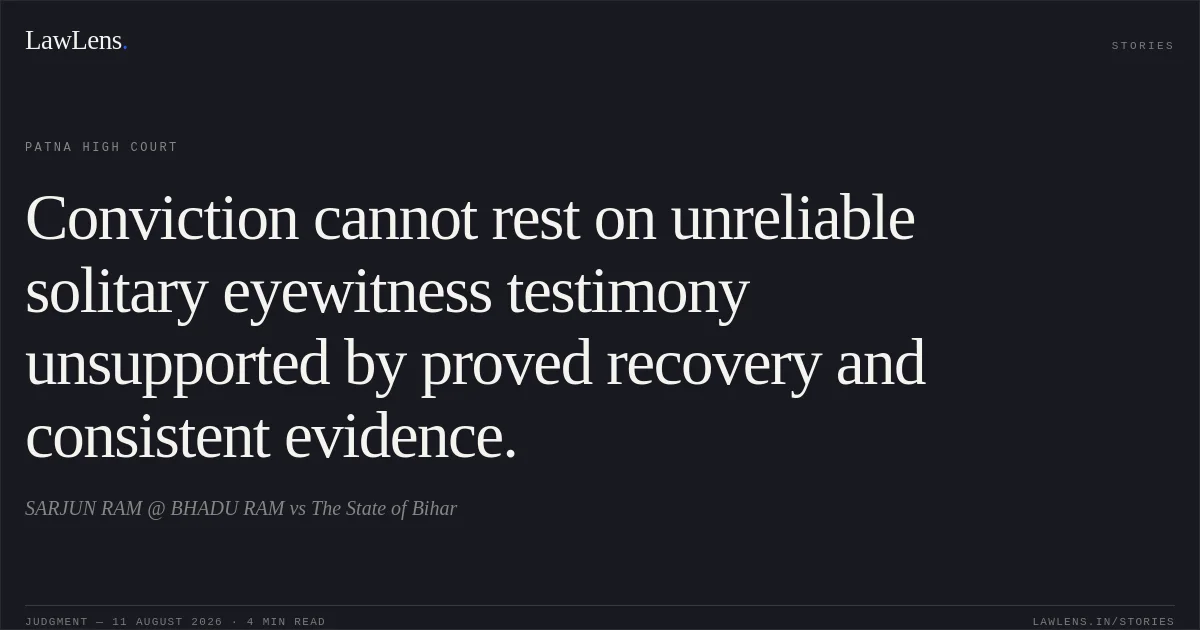
Source reference: paras. 5–7, 26; p. 3–4, 11The governing criminal-law principle was that conviction can be based on the testimony of a solitary eyewitness only where that testimony is wholly reliable and inspires confidence; where material contradictions, doubtful identification, investigative irregularities, and unreliable recoveries create reasonable doubt, the accused must receive the benefit of that doubt.
Source reference: paras. 26–27, 33–35; p. 11–19Reasoning
The Court found that the alleged firearm recovery was not legally proved: the firearm’s seizure list and disclosure statement were not exhibited, the country-made pistol was not produced before the trial court, and the recovery witnesses were not examined.
Source reference: para. 26; p. 11The recovery of two live cartridges and an empty shell was also considered doubtful because the articles were produced in court only on 26 July 2020, although allegedly seized near the body on 20 July 2020.
Source reference: para. 25; p. 10–11The Court further held that PW-7’s evidence was not wholly reliable. Her account conflicted with PW-2 regarding the events after the occurrence, the reporting of the incident, and the recording of the fardbeyan.
Source reference: paras. 29–31; p. 13–16PW-2’s testimony suggested that the deceased’s husband had given an earlier statement, which was not brought on record, raising the possibility that the prosecution’s first version had been suppressed.
Source reference: paras. 29–31; p. 13–16The non-examination of the chowkidar, who allegedly first informed the police and had discussed the incident with the informant, further weakened the prosecution case.
Source reference: para. 30; p. 14–15The Court also considered it improbable that the deceased and PW-7 would travel approximately one kilometre in a dark, rainy night to attend nature’s call.
Source reference: paras. 32–34; p. 16–19Since PW-7 stated that the appellant’s face was partly covered with a black towel, his identification was itself doubtful.
Source reference: paras. 32–34; p. 16–19These circumstances, coupled with the Investigating Officer’s evidence that PW-7 had not stated several material facts during investigation and that no person claimed to have witnessed the occurrence, made her presence and testimony unsafe for sustaining a conviction.
Source reference: paras. 32–34; p. 16–19The prosecution therefore failed to establish guilt beyond reasonable doubt.
Source reference: para. 35; p. 19Holding
The High Court held that the prosecution failed to prove the appellant’s guilt under Section 302 IPC and Section 27 of the Arms Act beyond reasonable doubt.
The alleged eyewitness testimony was unreliable, the firearm recovery was not proved in accordance with law, and the inconsistencies regarding the FIR and the suppressed first version materially weakened the prosecution case.
Source reference: paras. 34–35; p. 19The judgment of conviction dated 23 January 2023 and order of sentence dated 27 January 2023 were set aside.
Source reference: paras. 36–38; p. 20The appellant was acquitted by giving him the benefit of doubt and was directed to be released forthwith, unless required in any other case. The appeal was allowed.
Source reference: paras. 36–38; p. 20Acts & Sections Cited
10 provisions across 4 statutes referred to in this judgment. Each provision opens on LawLens.
Indian Penal Code, 18607
Arms Act, 19591
Code of Criminal Procedure, 19731
Bharatiya Sakshya Adhiniyam, 20231
Original Court PDF
SARJUN RAM @ BHADU RAMvsThe State of Bihar
Click to open original judgment
Original judgment, available to read, download and summarize on LawLens.in