01Facts
On 06.08.2004, SI Jagjit Singh, leading a patrolling party, stopped a scooter near a culvert in village Badrukhan. The pillion rider, the appellant Gurdeep Singh, was carrying a plastic bag containing 26.150 kg of poppy husk, and both riders were arrested
¶ 4FIR No. 288 dated 06.08.2004 was registered at Police Station Kotwali, Sangrur, under Section 15 of the NDPS Act, 1985
¶ 2Investigation followed, and a final report under Section 173 CrPC was filed
¶ 5By judgment dated 31.01.2006, the Special Court, Sangrur, convicted the appellant and co-accused. By order of the same date, the appellant was sentenced to rigorous imprisonment for one and a half years and a fine of Rs. 10,000/-, with three months' further rigorous imprisonment in default, with set-off of detention undergone
¶ 3At the hearing, the appellant confined the appeal to sentence and did not challenge conviction
¶ 9The appellant stated that he had undergone three months and nine days of imprisonment, that the matter had been pending for more than 22 years, that he had not been prosecuted for any other offence in that period, and that he was 52 years old
¶ 10, 11, 16(d)–(f)The State contended that the sentence was already on the lower side
¶ 1202Issues
i.1. Whether the findings of conviction under Section 15 of the NDPS Act, which the appellant did not challenge, warrant interference on the evidence
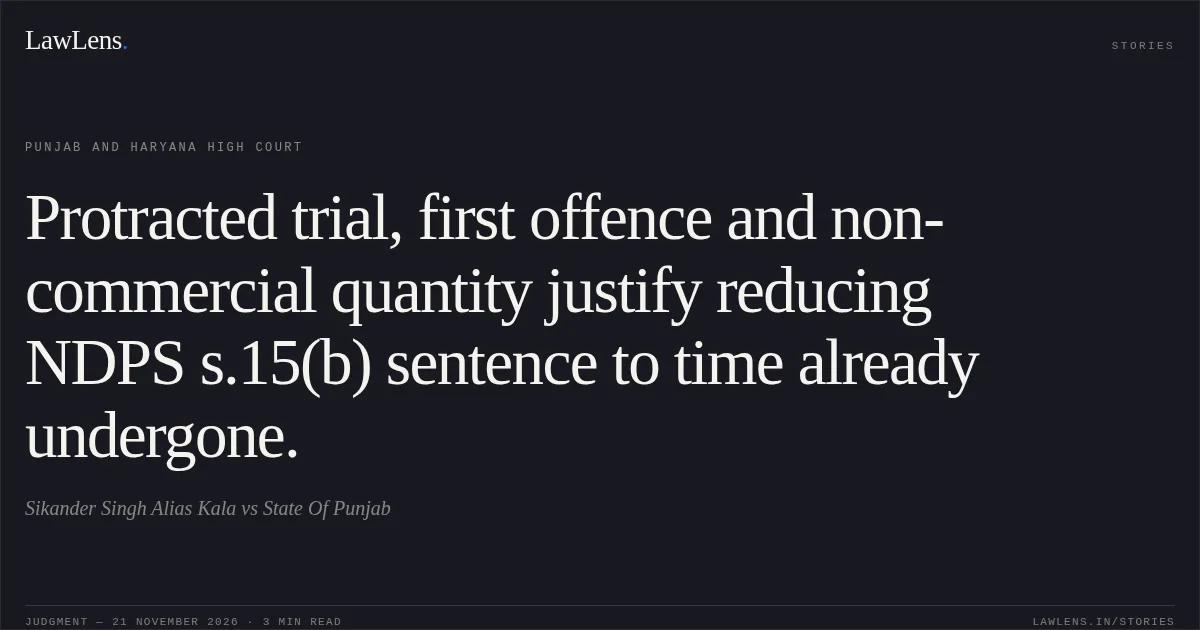
¶ 14ii.2. Whether the sentence of one and a half years' rigorous imprisonment and fine, imposed under Section 15 of the NDPS Act, is harsh and requires modification in view of the non-commercial quantity, the lapse of about 22 years, the protracted trial, the period already undergone, the absence of other offences, and the appellant's age
¶ 15–1703Law Applied
Section 15 of the NDPS Act, 1985, under which the appellant was convicted for contravention involving poppy husk
¶ 3, 12, 14On the sentencing question, the principle that the quantum of punishment must be proportionate and that a lenient view may be taken where mitigating circumstances exist
¶ 16The non-commercial quantity of contraband, for which no minimum sentence is prescribed
¶ 16(a)The lapse of about 22 years since the incident, the protracted trial and appeal, the period already undergone, the absence of any other prosecution, and the appellant's age
¶ 16(b)–(f)The judgment cites no precedents
Provisions in the judgment · 2 · Linked ones open on LawLens
Narcotic Drugs and Psychotropic Substances Act, 1985 Section 15
Code of Criminal Procedure, 1973 Section 173
04Reasoning
The court first considered the conviction, though the appellant had conceded it. On perusal of the record, it found the prosecution evidence "thoroughly consistent" and sufficient to establish guilt under Section 15, and it therefore affirmed the conviction
¶ 14On sentence, the court noted that the appellant had served three months and nine days of the one-and-a-half-year term and was entitled to a lenient view. It then weighed the mitigating factors listed in paragraph 16. Because the seized quantity was non-commercial, the statutory minimum did not apply. The prolonged litigation over more than 22 years, which caused the appellant considerable hardship, and his clean record during that period weighed in his favour. The court held the sentence "harsh" in these circumstances and concluded that it required interference in the appellate jurisdiction
¶ 15, 16(a), 16(c), 16(e), 1705Holding
The conviction under Section 15 of the NDPS Act is upheld
¶ 14, 19The period already undergone by the appellant was held adequate to meet the ends of justice, and the sentence is modified and reduced to the period already undergone by the appellant, namely three months and nine days
¶ 18, 19The judgment does not expressly address the Rs. 10,000/- fine or the default sentence, and it is silent on whether the fine remains payable
The appeal is partly allowed. Miscellaneous applications, if any, stand disposed of
¶ 20Original Court PDF
Gurdeep SinghvsState Of Pb .
Click to open original judgment
Original judgment, available to read, download and summarize on LawLens.in