01Facts
On 13.09.2004, ASI Kundan Lal, leading a patrol, spotted the appellant and co-accused Tarsem Singh sitting near a bag under a kikkar tree at the Kot Shamir crossing. They attempted to leave on noticing the police party and were apprehended.
¶ 4The bag contained 15 kg of poppy husk, and Rs. 50 and Rs. 30 were recovered from the appellant and co-accused respectively.
¶ 4FIR No. 96 dated 13.09.2004 was registered at PS Sadar Bathinda under Section 15 of the NDPS Act, 1985.
¶ 2Following investigation, the appellant was tried by the Special Court, Bathinda. By judgment and order dated 04.02.2006, he was convicted under Section 15(b) and sentenced to one year's rigorous imprisonment and a fine of Rs. 2,000, with two months' further rigorous imprisonment in default.
¶ 3, 4In appeal, the appellant did not challenge conviction and confined his challenge to the quantum of sentence.
¶ 9The appellant contended that the contraband was of non-commercial quantity, that the incident occurred about 22 years earlier, that he had undergone four months and thirteen days of imprisonment, that it was his first offence, and that he had not been prosecuted for any other offence in the interim.
¶ 10, 11, 16The State argued the sentence was already on the lower side and the appeal lacked merit.
¶ 1202Issues
i.1. Whether the appellant's conviction under Section 15(b) of the NDPS Act should be interfered with, where the appellant does not challenge conviction and the evidence is examined only to test the findings.
¶ 9, 14ii.2. Whether the one-year rigorous imprisonment sentence should be modified, given the non-commercial quantity, the lapse of about 22 years, the protracted trial, the period already undergone, the first-offence status, and the absence of any subsequent prosecution.
¶ 15, 16, 1703Law Applied
Section 15(b) of the NDPS Act, under which the appellant was convicted and sentenced.
¶ 3, 14No minimum sentence is prescribed for the offence, and the quantity recovered was non-commercial.
¶ 11, 16(a)The prosecution must prove its case beyond reasonable doubt, applied as the standard against which the trial record was re-examined.
¶ 8, 14The appellate jurisdiction of the Court may be exercised to modify an order on quantum of sentence, and a harsh sentence may be rationalised and reduced where mitigating circumstances exist.
¶ 17The judgment cites no precedents and no specific sentencing statute or provision for the appellate power; the governing authority is stated as the appellate jurisdiction vested in the Court.
¶ 17, no citationProvisions in the judgment · 2 · Linked ones open on LawLens
Narcotic Drugs and Psychotropic Substances Act, 1985 Section 15
Code of Criminal Procedure, 1973 Section 173
04Reasoning
On conviction, the court examined the trial record despite the appellant's concession and found the prosecution evidence thoroughly consistent and sufficient to establish guilt under Section 15(b). The conviction was therefore affirmed.
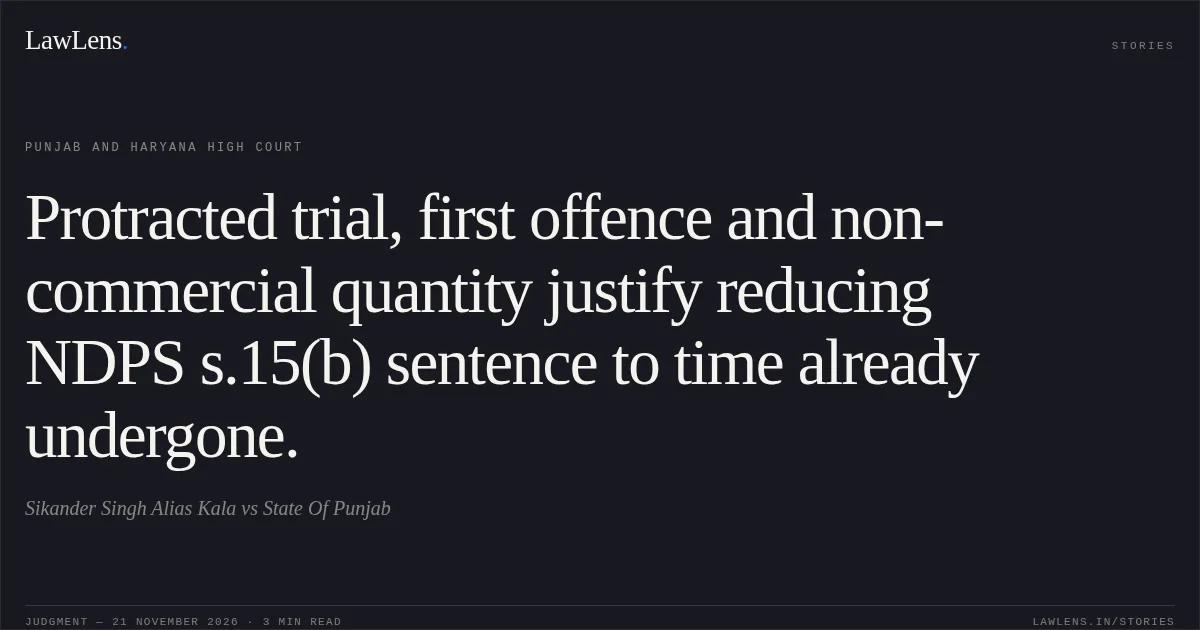
¶ 14On sentence, the court weighed the non-commercial quantity, the absence of a prescribed minimum sentence, the 22-year delay, the protracted trial, the first-offence status, and the absence of any subsequent prosecution.
¶ 16(a)–(f)The appellant had already served four months and thirteen days of a one-year term. Given this combination, the court held the sentence harsh and found interference warranted.
¶ 15, 16(d), 17The judgment does not expressly address the Rs. 2,000 fine or the default sentence.
05Holding
The conviction under Section 15(b) NDPS Act is upheld, and the appeal against conviction is dismissed.
¶ 14, 19The court concluded that the period already undergone was adequate to meet the ends of justice. The one-year rigorous imprisonment is reduced to the period already undergone by the appellant, i.e., four months and thirteen days.
¶ 18, 19The judgment does not specify any modification of the fine or default sentence.
The appeal against sentence is allowed in part. Pending miscellaneous applications, if any, stand disposed of.
¶ 20Original Court PDF
Sikander Singh Alias KalavsState Of Punjab
Click to open original judgment
Original judgment, available to read, download and summarize on LawLens.in