01Facts
The petitioner (complainant) alleged that her husband bought part of a Housing Board property in Faridabad from the respondent in June 2002 through a sale agreement, GPA, SPA, and related documents, and that the respondent later sold the entire property to her son Rajan for Rs. 10,00,000 while receiving Rs. 8,00,000.
¶ 2She alleged that the respondent then cheated her family by obtaining certified copies of the sale deed, denying the sale, extracting a fresh sale deed consideration of Rs. 9,46,500 in 2007, and forging a Rs. 4,46,500 underpayment entry on the sale deed.
¶ 2–4She filed a private complaint under Sections 420, 467, 468, 471, 120-B and 506 IPC.
¶ 2After preliminary evidence (five prosecution witnesses) and a Section 202 Cr.P.C. report finding no cognizable offence, the JMIC, Faridabad dismissed the complaint on 26.07.2019 because no documents were tendered in evidence and no dishonest intention at inception was proved.
¶ 3–4The Additional Sessions Judge, Faridabad dismissed the revision (CRR-458 of 2019) on 21.05.2025, finding no prima facie case.
¶ 5The petitioner then sought quashing of both orders under Section 528 BNSS (Section 482 Cr.P.C.).
¶ 1, 602Issues
i.1. Whether the orders of the JMIC (26.07.2019) and the Additional Sessions Judge (21.05.2025) dismissing the complaint under the IPC offences were illegal or passed without application of mind, so as to warrant quashing under Section 528 BNSS.
¶ 1, 7ii.2. Whether the dismissal of the complaint without summoning the accused was contrary to Section 203 Cr.P.C., given the material the petitioner alleged existed.
¶ 703Law Applied
The Court relied on its inherent power under Section 528 BNSS (Section 482 Cr.P.C.) to quash orders.
¶ 1At the summoning stage the Magistrate must determine whether a prima facie case exists, without detailed scrutiny of evidence, and must dismiss the complaint under Section 203 Cr.P.C. where no sufficient ground for proceeding exists.
¶ 5 (ASJ ¶11–12)The ASJ applied Pepsi Foods Ltd. v. Special Judicial Magistrate (1997), holding that summoning is a serious matter, the Magistrate must apply his mind to the facts, and oral and documentary evidence must be examined.
¶ 5 (ASJ ¶11)The ASJ also relied on Arun Jha v. State of Haryana (2006) to the same effect.
¶ 5 (ASJ ¶11)The JMIC applied the Indian Evidence Act, holding that documents not tendered in evidence cannot be read into evidence, and that cheating requires proof of dishonest intention at inception.
¶ 4 (quoting JMIC ¶10)The Section 202 report was relied upon as finding no cognizable offence.
¶ 4Provisions in the judgment · 9 · Linked ones open on LawLens
Bharatiya Nagarik Suraksha Sanhita, 2023 Section 528
Code of Criminal Procedure, 1973 Section 482Section 202Section 203
Indian Penal Code, 1860 Section 420Section 467Section 468Section 471Section 506
04Reasoning
The petitioner's counsel argued that the orders were illegal, lacked application of mind, and contravened Section 203 Cr.P.C., and that the record showed intent to cheat from inception.
¶ 7The Court examined the impugned orders and found that the petitioner had not produced any forged document in evidence and that there was scant evidence of cheating by the respondent.
¶ 9Because the allegations of forgery rested on documents never tendered, the trial court's finding that oral testimony alone could not establish forgery was accepted.
¶ 4, 9The Court characterised the dispute as a financial dispute within the two families and held that no criminality was established.
¶ 9The Court did not separately address the Section 203 contention.
¶ 7, 905Holding
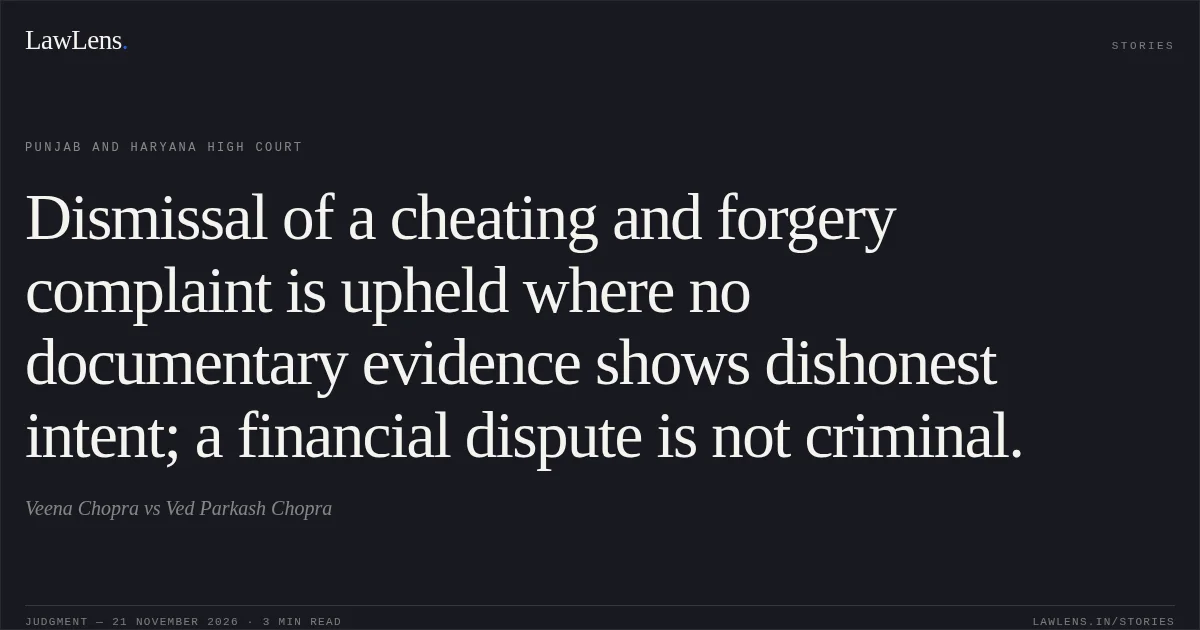
The Court held that no criminality had been established and that the impugned orders did not warrant interference.
¶ 9The petition seeking quashing of the orders dated 26.07.2019 and 21.05.2025 is dismissed, and pending applications are disposed of. Application CRM-17399-2026 for placing on record the petitioner's evidence (Annexure P-6) was allowed subject to all just exceptions.
¶ 10–11 · no citation (preamble)Original Court PDF
Veena ChopravsVed Parkash Chopra
Click to open original judgment
Original judgment, available to read, download and summarize on LawLens.in