Facts
On 26 August 1999, SI Naseeb Singh received secret information regarding a proposed dacoity and formed a police raiding party at Roshnara Park, Delhi. Five persons allegedly assembled there, including the three appellants, Shyam Kishore and one Raju. The police apprehended the appellants and Shyam Kishore, while Raju allegedly escaped. A button-actuated knife was allegedly recovered from Maharam Singh, a dagger from Tulsi and a kirpan from Shyam Kumar. FIR proceedings were initiated under Sections 399 and 402 IPC and Section 25 of the Arms Act.
Source reference: paras. 1–4; pp. 2–4The Trial Court convicted the three appellants under Sections 399/402 IPC and convicted Maharam Singh additionally under Section 25 of the Arms Act, sentencing each to five years’ rigorous imprisonment and fine under Sections 399/402 IPC.
Source reference: para. 5; p. 4In appeal, the appellants challenged the prosecution evidence, the alleged recoveries, the absence of five persons necessary for the application of Sections 399/402 IPC, and the failure to prove any concrete preparation for dacoity.
Source reference: paras. 6–10; pp. 4–6Issues
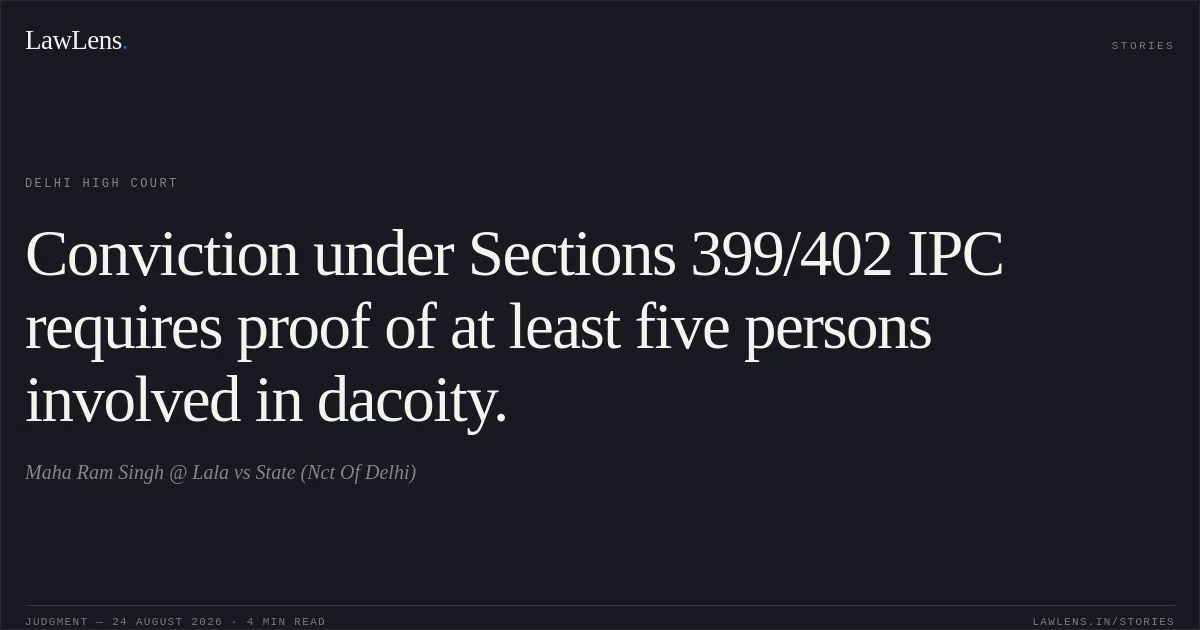
Whether the appellants could be convicted under Sections 399 and 402 IPC when the prosecution had not established the presence and participation of at least five persons in the alleged assembly for committing dacoity.
Source reference: paras. 14–17, 23–25; pp. 7–12Whether the prosecution proved, beyond reasonable doubt, that the appellants had made preparation for committing dacoity, as required under Section 399 IPC.
Source reference: paras. 15–20; pp. 7–10Whether the alleged recovery of the knife, dagger and kirpan, particularly the knife allegedly recovered from Maharam Singh, was reliable enough to sustain conviction under Section 25 of the Arms Act.
Source reference: paras. 18–22, 28–30; pp. 9–15Law Applied
The Court applied Section 391 IPC, which defines dacoity as robbery or attempted robbery committed or aided conjointly by five or more persons; Section 399 IPC, which criminalises preparation for committing dacoity; and Section 402 IPC, which criminalises being one of five or more persons assembled for the purpose of committing dacoity.
Source reference: para. 14; p. 7The statutory requirement of five or more persons is an essential ingredient of the offences under Sections 399 and 402 IPC.
Source reference: paras. 15, 17; pp. 7–9The Court relied on Raj Kumar @ Raju v. State of Uttaranchal, (2008) 11 SCC 709, holding that fewer than five persons cannot be convicted for a dacoity-related offence unless the Court finds that five or more persons participated but the identity of some could not be established; mere proof of fewer than five participants is insufficient.
Source reference: paras. 23–24; pp. 11–12It also referred to Yog Raj v. State, 1985 SCC OnLine Del 278, and Hari v. State, 2026 SCC OnLine Ker 856, concerning the requirement of five persons and proof of something more than mere assembly to establish preparation for dacoity.
Source reference: paras. 7–9; pp. 5–6Conviction under Section 25 of the Arms Act requires reliable proof of conscious possession of a prohibited weapon; although independent public witnesses are not legally mandatory, their absence may assume significance where the official evidence regarding recovery is doubtful.
Source reference: paras. 10, 22, 28–30; pp. 6, 10–15Reasoning
The Court found that the prosecution’s case regarding the presence of five persons was inherently doubtful. Although the police witnesses claimed that five persons were present and that Raju escaped, Constable Arjun Singh—allegedly the officer who chased Raju—testified that he was not part of the raiding party on 26 August 1999 and joined the investigation only on the following day. This contradicted the evidence of PW-1, PW-3 and PW-6 and undermined the existence of the alleged fifth participant.
Source reference: paras. 25–27; pp. 12–14Since fewer than five persons were actually charged, the Court held that the prosecution could not invoke the exception recognised in Raj Kumar concerning unidentified participants where the presence of five or more offenders is otherwise established.
Source reference: para. 24; p. 12The prosecution also failed to place on record the substance of the alleged conversation or any specific conduct demonstrating preparation for dacoity. The claimed surveillance by the police witnesses in a public park was considered improbable, particularly as no explanation was given as to how they could secretly overhear and decipher the alleged discussion.
Source reference: paras. 15–20; pp. 7–10The same contradictions affected the credibility of the alleged weapon recoveries. In the absence of independent corroboration and in view of the unreliable testimony of the principal police witnesses, the recovery evidence was not treated as above board.
Source reference: paras. 22, 28–30; pp. 10–15Holding
The Delhi High Court allowed all three appeals and acquitted Tulsi, Shyam Kumar and Maharam Singh @ Lala of the charges under Sections 399 and 402 IPC. Maharam Singh was also acquitted of the charge under Section 25 of the Arms Act, as the alleged recovery was found unreliable.
Their bail bonds were ordered to stand discharged. The seized weapons were directed to be destroyed after expiry of the period for filing an appeal, and pending applications, if any, were disposed of.
Source reference: paras. 32–34; p. 15Acts & Sections Cited
6 provisions across 3 statutes referred to in this judgment. Each provision opens on LawLens.
Indian Penal Code, 18604
Arms Act, 19591
Code of Criminal Procedure, 19731
Original Court PDF
Maha Ram Singh @ LalavsState (Nct Of Delhi)
Click to open original judgment
Original judgment, available to read, download and summarize on LawLens.in