Facts
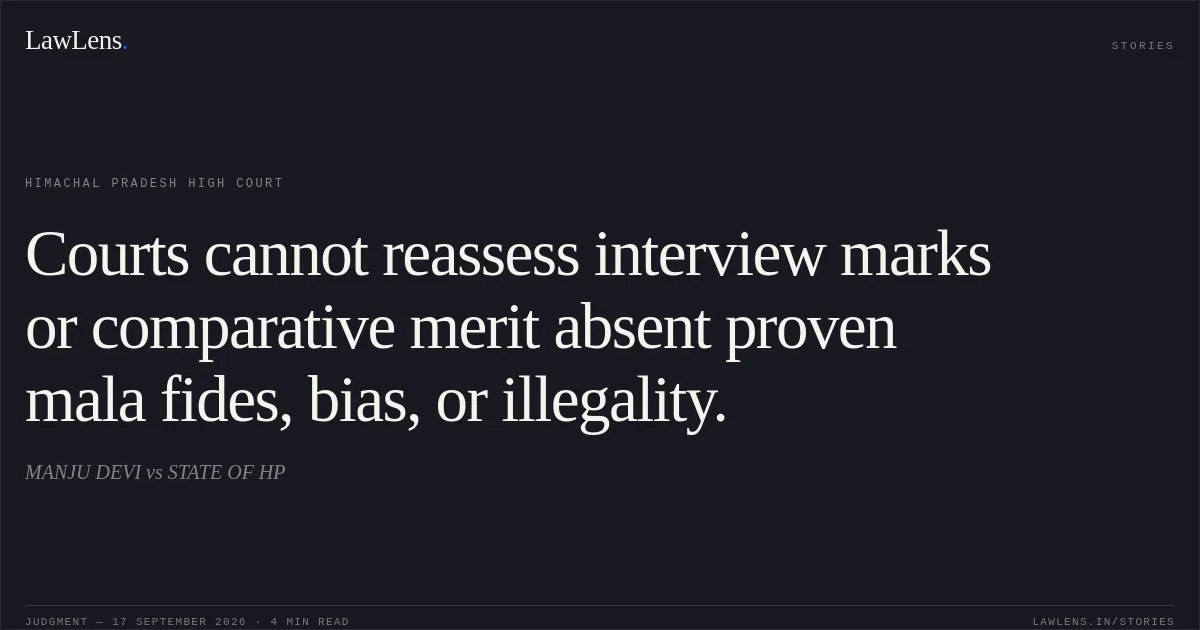
The petitioner, Manju Devi, challenged the selection and appointment of respondent No. 6, Gitanjali, as Post-Graduate Teacher in Political Science at Government Senior Secondary School, Gai Ghat, under the School Management Committee (SMC) Policy.
Source reference: p. 2Applications were invited for the post and interviews were conducted on 31 October 2014 before a three-member Selection Committee comprising the Sub-Divisional Magistrate as Chairman, the President of the concerned SMC as Member, and the Head of the Institution/Secretary of the SMC as the third Member.
Source reference: p. 2; p. 18The petitioner alleged that, despite being a local candidate belonging to the concerned Patwar Circle, she was not given due preference and was awarded only 2.33 marks out of 10 in the interview, whereas respondent No. 6 received 9.5 marks.
Source reference: p. 3; p. 6The State contended that the selection was made according to the prescribed SMC criteria and that respondent No. 6 secured higher overall merit—30.52 marks as against the petitioner’s 30.33 marks—after consideration of educational qualifications, local-area status and interview performance.
Source reference: pp. 4–5The petitioner sought quashing of respondent No. 6’s selection and a direction for her own engagement.
Source reference: p. 2Issues
Whether the High Court could reassess or redetermine the comparative merit of the candidates, particularly the interview marks awarded by the duly constituted Selection Committee?
Source reference: pp. 6–18Whether the award of 9.5 interview marks to respondent No. 6 and 2.33 marks to the petitioner was arbitrary, biased, mala fide or otherwise contrary to the SMC Policy?
Source reference: pp. 11–12, 18–21Whether the petitioner, as a local candidate belonging to the concerned Patwar Circle, was entitled to preference over respondent No. 6 despite having lower overall merit?
Source reference: pp. 22–25Whether the petitioner, having participated in the selection process without establishing violation of statutory rules, the SMC Policy, bias or mala fides, could challenge the selection after remaining unsuccessful?
Source reference: pp. 21–22Law Applied
The Court applied the principle that judicial review of selections made by an expert or duly constituted Selection Committee is limited and does not permit courts to sit as appellate authorities or reassess comparative merit.
Source reference: pp. 7–18Relying on Durga Devi v. State of Himachal Pradesh, Dalpat Abasaheb Solunke v. Dr. B.S. Mahajan, Madan Lal v. State of Jammu & Kashmir, Union Public Service Commission v. M. Sathiya Priya and Mohd. Mustafa v. Union of India, the Court held that interference is justified only where the selection is vitiated by illegality, patent material irregularity, bias, mala fides, arbitrariness or violation of statutory rules or governing policy.
Source reference: pp. 7–18The Court further applied the SMC Policy dated 17 July 2012, as amended on 16 August 2014, including the criteria for allocation of marks and the provision that preference would be given to local eligible candidates.
Source reference: pp. 2, 22–24It also applied the principle that a preference is ordinarily relevant where competing candidates are otherwise equal in merit, and cannot override superior overall merit.
Source reference: pp. 23–25Finally, relying on Tajvir Singh Sodhi v. State of Jammu & Kashmir and State of Uttar Pradesh v. Karunesh Kumar, the Court held that a candidate who participates in a selection process and remains unsuccessful cannot subsequently challenge the assessment merely because the result is adverse, absent proof of legal or procedural infirmity.
Source reference: pp. 21–22Reasoning
The Court found that the selection was conducted by a duly constituted three-member committee in accordance with the SMC Policy and that the petitioner had not produced any cogent material demonstrating bias, mala fides, favouritism, arbitrariness or violation of the governing rules.
Source reference: pp. 9–12, 18The difference in interview marks, by itself, did not justify judicial reassessment because evaluation of suitability and comparative performance was within the Selection Committee’s specialised domain.
Source reference: pp. 11–18The marks chart also showed that respondent No. 6 had higher marks in Graduation, B.Ed. and Post-Graduation, while the petitioner received 10 marks for belonging to the concerned Patwar Circle; respondent No. 6 nevertheless secured a marginally higher aggregate of 30.52 marks compared with the petitioner’s 30.33 marks.
Source reference: pp. 19–21The Court therefore held that the petitioner’s local status had already been accounted for under the prescribed criteria and could not operate as an overriding preference in her favour despite her lower overall merit.
Source reference: pp. 22–25Her participation in the selection process without protest, followed by a challenge after non-selection, further weakened her claim.
Source reference: pp. 21–22The earlier decision in Santosh v. State of Himachal Pradesh was distinguished because it involved specific allegations of bias and alteration of marks, circumstances absent in the present case.
Source reference: pp. 25–26Holding
The High Court dismissed the writ petition.
It upheld respondent No. 6 Gitanjali’s selection as Post-Graduate Teacher in Political Science pursuant to the interview held on 31 October 2014 and affirmed her appointment and continuance in service.
Source reference: pp. 27–28The Court held that the petitioner’s non-selection, including the lower interview marks and lower overall merit, was neither illegal nor perverse; her claim to local preference could not displace respondent No. 6’s superior overall merit.
Source reference: pp. 27–28The parties were directed to bear their own costs, and all pending miscellaneous applications were disposed of.
Source reference: p. 28Original Court PDF
MANJU DEVIvsSTATE OF HP
Click to open original judgment
Original judgment, available to read, download and summarize on LawLens.in