Facts
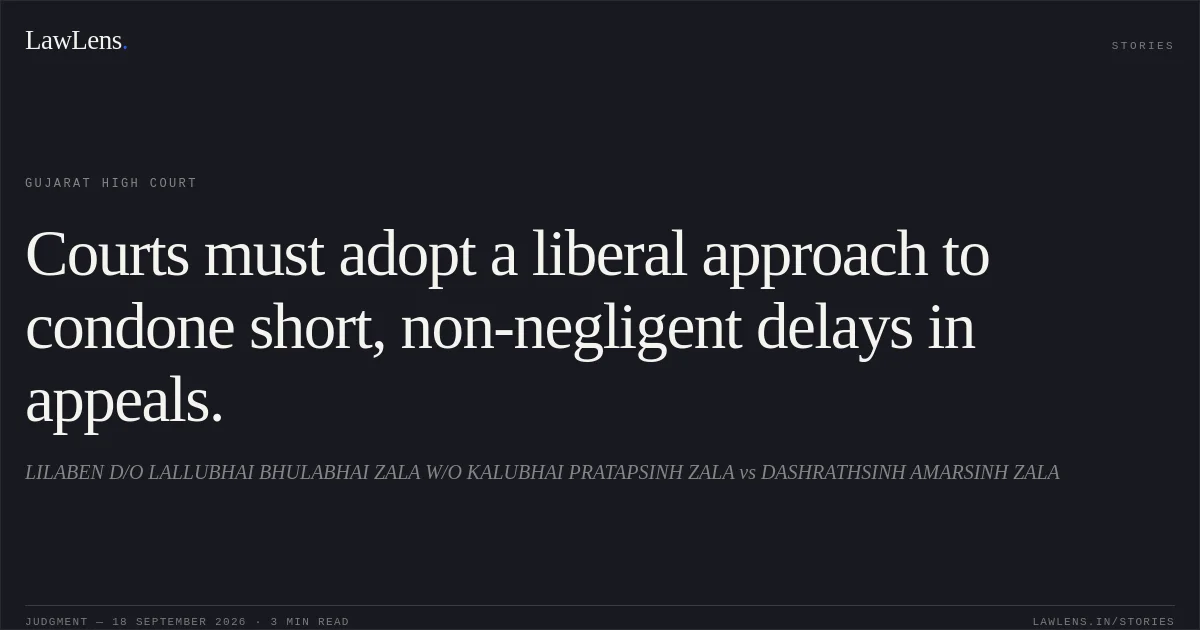
The petitioner sought condonation of a 27-day delay in filing a Regular First Appeal against the judgment and order dated 28 February 2026 passed in Regular Civil Suit No. 64 of 2021 by the Additional Civil Judge, Umreth.
Source reference: pp. 1–4, paras. 2–5The 4th Additional District Judge, Anand, rejected the delay-condonation application, Civil Misc. Application No. 51 of 2026, by order dated 29 June 2026.
Source reference: pp. 1–4, paras. 2–5The petitioner contended that the delay was neither intentional nor mala fide and occurred because the advocate had not communicated the trial court’s judgment in time.
Source reference: pp. 1–4, paras. 2–5The respondent did not file a written reply to the delay application, though an oral objection was raised.
Source reference: pp. 1–4, paras. 2–5The petitioner therefore invoked the High Court’s jurisdiction under Article 227 of the Constitution of India challenging the rejection of the delay application.
Source reference: pp. 1–4, paras. 2–5Issues
Whether the Appellate Court erred in adopting a hyper-technical approach and refusing to condone the petitioner’s 27-day delay in filing the Regular First Appeal.
Source reference: pp. 2–4, paras. 3–6Whether the High Court, in exercise of its supervisory jurisdiction under Article 227, could set aside the order refusing condonation and direct registration and adjudication of the appeal on merits.
Source reference: pp. 7–9, paras. 7–10Law Applied
The Court applied the principles governing condonation of delay under Section 5 of the Limitation Act, 1963, under which an appeal may be admitted after limitation if the appellant establishes “sufficient cause.”
Source reference: pp. 5–7, para. 6.2It held that “sufficient cause” must receive a liberal, pragmatic and justice-oriented interpretation where the delay is neither deliberate nor attributable to culpable negligence.
Source reference: pp. 5–7, para. 6.2The Court relied principally on Collector, Land Acquisition, Anantnag v. Mst. Katiji, (1987) 2 SCC 107, which held that refusing to condone delay may defeat adjudication on merits, that “every day’s delay” should not be applied pedantically, and that substantial justice should ordinarily prevail over technical objections.
Source reference: pp. 5–7, para. 6.2The Court also exercised its supervisory jurisdiction under Article 227 to correct the Appellate Court’s legally inappropriate approach.
Source reference: pp. 1–2, para. 2Reasoning
The High Court found that a 27-day delay was neither gross nor inordinate and that the petitioner had asserted that the judgment was not communicated by the advocate in time.
Source reference: pp. 3–4, paras. 5–6This explanation remained substantively uncontroverted because the respondent had not filed a reply to the delay application.
Source reference: pp. 3–4, paras. 5–6The Appellate Court had treated the fact that the same advocate later filed the appeal as undermining the petitioner’s explanation.
Source reference: p. 4, para. 6.1The High Court rejected that reasoning, observing that the advocate’s subsequent filing of the appeal did not make it impossible that the judgment had not been timely communicated to the petitioner.
Source reference: p. 4, para. 6.1Applying the liberal approach mandated by Katiji, the Court held that refusing condonation would improperly deprive the petitioner of a statutory appellate remedy and prevent consideration of the dispute on merits.
Source reference: pp. 5–8, paras. 6.2–8Since the delay was short and no prejudice arising from condonation was demonstrated, the Court considered it appropriate to grant relief without issuing prior notice, while preserving the respondent’s right to seek recall or modification.
Source reference: p. 8, paras. 8–9Holding
The High Court allowed the petition, quashed and set aside the order dated 29 June 2026 passed in Civil Misc. Application No. 51 of 2026, and condoned the 27-day delay in filing the Regular First Appeal.
The Appellate Court was directed to register the appeal and decide it on its own merits after hearing the parties, uninfluenced by the High Court’s observations.
Source reference: pp. 8–9, paras. 9–11The respondent was permitted to file an application for recall or modification within one month of receiving the order.
Source reference: pp. 8–9, paras. 9–11Original Court PDF
LILABEN D/O LALLUBHAI BHULABHAI ZALA W/O KALUBHAI PRATAPSINH ZALAvsDASHRATHSINH AMARSINH ZALA
Click to open original judgment
Original judgment, available to read, download and summarize on LawLens.in