Facts
The appellant was tried for multiple offences under the Indian Penal Code and the Arms Act. The trial court acquitted him of all charges except the offence under Section 3/25 of the Arms Act, for which it convicted and sentenced him.
Source reference: paras. 1, 3His appeal was confined to sentence; he did not challenge the conviction. The trial court had declined his request for probation without giving specific reasons.
Source reference: paras. 4, 6.1During the appeal, the High Court received confirmation that he had completed the entire sentence, including the default sentence for non-payment of fine.
Source reference: paras. 6.7, 6.10Issues
1. Whether the conviction under Section 3/25 of the Arms Act warranted interference, notwithstanding that the appellant did not challenge it
Source reference: paras. 4–5.32. Whether the trial court’s refusal to grant probation, without recording reasons, complied with the statutory sentencing requirements
Source reference: paras. 6.1–6.93. Whether any further sentencing order was warranted after the appellant had served the entire sentence
Source reference: paras. 6.10–6.11Law Applied
Section 3/25 of the Arms Act was the basis of the appellant’s conviction.
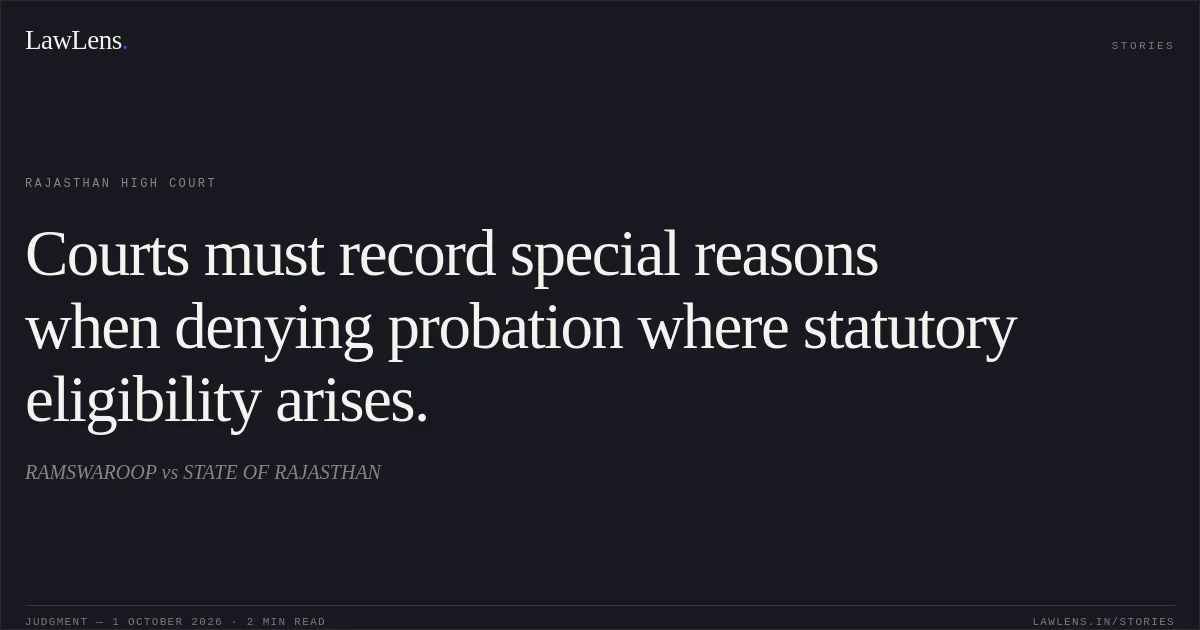
Source reference: para. 3Sections 360 and 361 of the Code of Criminal Procedure govern consideration of release on probation: Section 360 requires consideration of relevant matters, including the offender’s age, character, antecedents and the circumstances of the offence; under Section 361, where a court could have dealt with an accused under Section 360 or the Probation of Offenders Act but chooses not to, it must record special reasons.
Source reference: paras. 6.4–6.8Probation is not automatic merely because the offender has no prior conviction, but a specifically raised plea must be considered and refused on relevant, reasoned grounds.
Source reference: paras. 6.4–6.8Reasoning
The High Court independently reviewed the record and found no patent illegality, perversity or material infirmity in the conviction; it therefore affirmed the finding of guilt under Section 3/25 of the Arms Act.
Source reference: paras. 5–5.3On sentence, the appellant’s lack of prior convictions or known criminal antecedents, the lengthy proceedings, and his acquittal of the other charges were relevant considerations. Because the trial court gave no specific reasons for rejecting probation, its sentencing determination fell short of the statutory requirement.
Source reference: paras. 6.6–6.9However, as the appellant had already completed the entire sentence, remand or a further substantive sentencing order had no practical significance.
Source reference: paras. 6.10–6.11Holding
The appeal was partly allowed. The conviction under Section 3/25 of the Arms Act was affirmed, while the High Court held that the trial court had declined probation without the required special and cogent reasons.
As the appellant had served the entire sentence, no further sentencing order was made; if he remained in custody pursuant to the impugned judgment and was not required in another case, he was to be released forthwith.
Source reference: paras. 7–7.1Acts & Sections Cited
15 provisions across 3 statutes referred to in this judgment. Each provision opens on LawLens.
Indian Penal Code, 1860
Arms Act, 19593
Code of Criminal Procedure, 19732
Original Court PDF
RAMSWAROOPvsSTATE OF RAJASTHAN
Click to open original judgment
Original judgment, available to read, download and summarize on LawLens.in