Facts
Raj Narain Yadav, a police constable, was convicted in Sessions Trial No. 202 of 1999 under Sections 304-B, 201 and 498-A of the Indian Penal Code and Sections 3/4 of the Dowry Prohibition Act, and was sentenced to a maximum term of ten years’ rigorous imprisonment.
Source reference: para. 2Relying on Rule 8(2)(a) of the U.P. Police Officers of the Subordinate Ranks (Punishment and Appeal) Rules, 1991, the disciplinary authority dismissed him from service by order dated 25 July 2006, without conducting a disciplinary inquiry.
Source reference: paras. 2, 15The respondent challenged the dismissal after approximately seven years, explaining that he had remained incarcerated throughout the period and approached the Court immediately after his release.
Source reference: paras. 5–6, 13The learned Single Judge condoned the delay, quashed the dismissal order, directed reinstatement with consequential benefits, and granted liberty to the authorities to pass a fresh order in accordance with law.
Source reference: para. 1The State preferred the present intra-court special appeal.
Source reference: no citationIssues
Whether the writ petition was liable to be rejected on the ground of delay and laches, despite the respondent’s incarceration during the relevant period?
Source reference: paras. 5–14Whether dismissal under Rule 8(2)(a) of the 1991 Rules could be imposed solely on the basis of the respondent’s criminal conviction, without the disciplinary authority independently considering the conduct that led to the conviction and the proportionality of the penalty?
Source reference: paras. 15–20Whether the Division Bench, in intra-court appellate jurisdiction, was justified in interfering with the learned Single Judge’s decision?
Source reference: paras. 21–22Law Applied
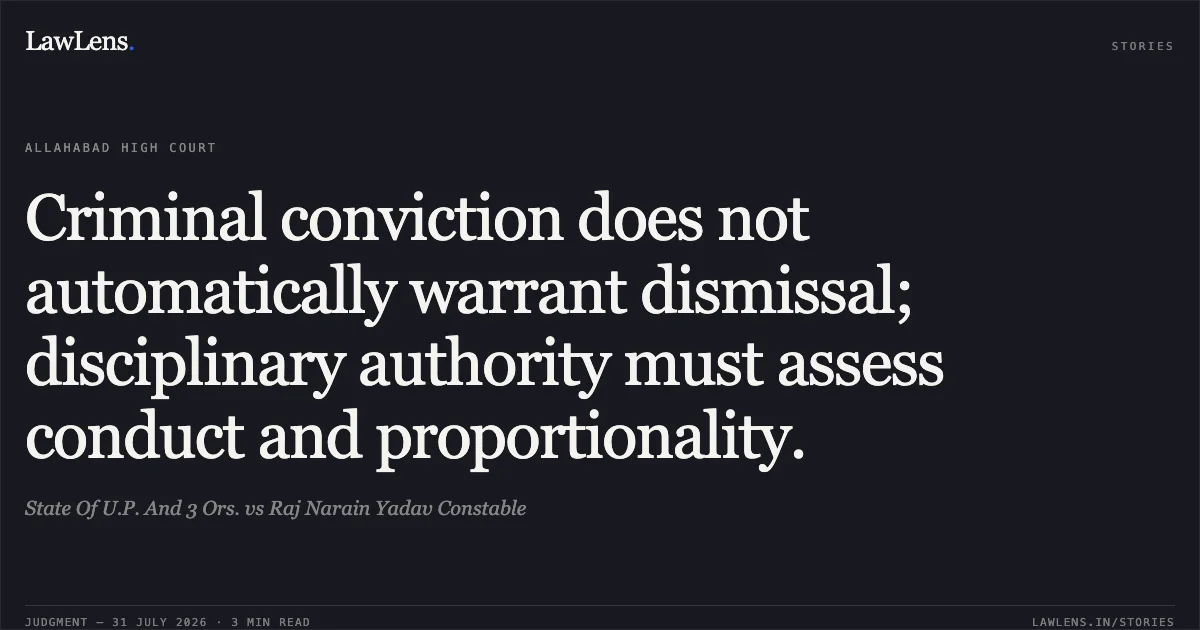
Rule 8(2)(a) of the U.P. Police Officers of the Subordinate Ranks (Punishment and Appeal) Rules, 1991, which is pari materia with the second proviso to Article 311(2)(a) of the Constitution, permits dismissal, removal or reduction in rank without a disciplinary inquiry where the penalty is imposed on the ground of conduct leading to conviction on a criminal charge; however, conviction does not automatically entail dismissal.
Source reference: paras. 15–17Under Union of India v. Tulsiram Patel, the disciplinary authority must independently examine the criminal judgment, the facts and circumstances of the case, the conduct underlying the conviction, and the appropriate penalty before exercising the power under Article 311(2)(a).
Source reference: para. 17T.R. Chellappan and Shankar Dass v. Union of India establish that the power must be exercised fairly, justly, reasonably and proportionately.
Source reference: paras. 17–19On delay, the Court applied the principle that the sufficiency of the explanation, rather than the length of delay, is determinative; delay may be condoned where the litigant was prevented by circumstances beyond his control.
Source reference: paras. 7–13In an intra-court appeal, interference is warranted only where the Single Judge’s view is demonstrably erroneous, perverse or legally unsustainable, and not merely because another view is possible.
Source reference: paras. 21–22Reasoning
The Court held that the respondent’s incarceration constituted sufficient cause for the delay, since he was prevented from approaching the Court during the period of imprisonment and filed the writ petition promptly after release.
Source reference: paras. 6, 13–14On the merits, Rule 8(2)(a) dispensed only with the requirement of a regular disciplinary inquiry; it did not dispense with the disciplinary authority’s duty to consider the conduct that resulted in the conviction.
Source reference: paras. 17–20The dismissal order merely relied on the conviction and did not disclose any consideration of the respondent’s underlying conduct, the seriousness of the offence in the context of service, or the choice between the available major penalties of dismissal, removal and reduction in rank.
Source reference: paras. 17–20Since such consideration was a condition precedent to the lawful exercise of power under Rule 8(2)(a), the dismissal order was legally unsustainable.
Source reference: paras. 17–20The learned Single Judge’s decision represented a plausible and correct application of the governing law, and therefore did not warrant appellate interference.
Source reference: paras. 19, 21–22Holding
The Special Appeal was dismissed for want of merit.
The Court affirmed the order quashing the dismissal dated 25 July 2006 and the direction for reinstatement with consequential benefits, while preserving the authorities’ liberty to pass a fresh order after properly considering the conduct that led to the respondent’s conviction and determining the appropriate punishment in accordance with law.
Source reference: paras. 20, 23–24The consequential benefits were made subject to the outcome of that fresh decision.
Source reference: para. 24Acts & Sections Cited
3 provisions across 2 statutes referred to in this judgment. Each provision opens on LawLens.
Indian Penal Code, 18601
Original Court PDF
State Of U.P. And 3 Ors.vsRaj Narain Yadav Constable
Click to open original judgment
Original judgment, available to read, download and summarize on LawLens.in