Facts
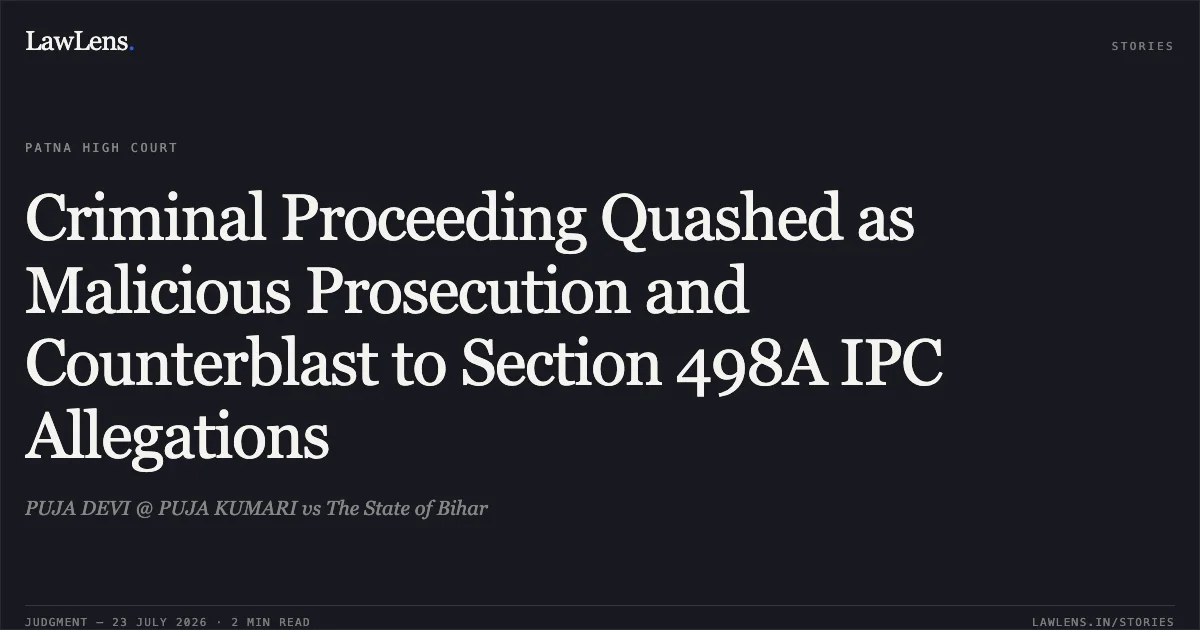
The petitioners sought to quash an order dated 24.01.2022 passed by the Judicial Magistrate 1st Class, Rohtas, taking cognizance under Section 379 IPC in Complaint Case No. 609 of 2021.
Source reference: para. 2The complainant (Opposite Party No. 2) alleged that Petitioner No. 1 (his daughter-in-law), accompanied by her brothers (Petitioners No. 2 & 3), stole cash and jewellery at gunpoint from his house.
Source reference: para. 3, 7Petitioner No. 1 contended that the complaint was a malicious counterblast to a dowry harassment case (Section 498A IPC) she had previously filed against the complainant’s family on 23.05.2021.
Source reference: para. 5-6The Magistrate had taken cognizance despite the complainant admitting Petitioner No. 1 was on visiting terms at the house.
Source reference: para. 7Issues
1. Whether the criminal proceedings against the petitioners constitute malicious prosecution and an abuse of the process of law.
Source reference: para. 8, 132. Whether the allegations in the complaint meet the threshold of being "absurd and inherently improbable" to warrant quashing under Section 482 Cr.P.C.
Source reference: para. 8, 10Law Applied
The court primarily relied on the landmark precedent of State of Haryana v. Bhajan Lal, which established categories (specifically 5 and 7) for quashing proceedings where allegations are absurd or the prosecution is malicious.
Source reference: para. 9, 13It applied Section 482 of the Cr.P.C. regarding the inherent powers of the High Court to prevent abuse of the process of any court.
Source reference: para. 10The court further cited Manoj Mahavir Prasad Khaitan v. Ram Gopal Poddar, holding that the High Court has the power to quash complaints that lack bona fides or contain inherently improbable charges.
Source reference: para. 10K.K. Agrawal v. State of Bihar regarding the quashing of patently absurd allegations.
Source reference: para. 11Reasoning
The Court observed that the theft complaint was filed on 06.09.2021, nearly four months after Petitioner No. 1 filed her case under Section 498A IPC, indicating a retaliatory motive to "save their own skin".
Source reference: para. 5-6The Court found the allegations—that a daughter-in-law would commit gunpoint robbery in her own matrimonial home while visiting—to be inherently improbable and absurd.
Source reference: para. 7-8It noted that the ingredients of Section 379 IPC were not satisfied by the facts presented.
Source reference: para. 8Applying the Bhajan Lal criteria, the Court reasoned that the case was a "glaring case of malicious prosecution" filed with "oblique motives and evil design," necessitating judicial intervention to prevent a miscarriage of justice.
Source reference: para. 5, 8, 13Holding
The Court answered the issues in the affirmative, holding that continuing the trial would amount to an abuse of the process of the court.
The High Court allowed the application and quashed the cognizance order dated 24.01.2022 and the entire proceedings of Complaint Case No. 609 of 2021.
Source reference: para. 14Acts & Sections Cited
4 provisions across 3 statutes referred to in this judgment. Each provision opens on LawLens.
Indian Penal Code, 18601
Code of Criminal Procedure, 19731
Original Court PDF
PUJA DEVI @ PUJA KUMARIvsThe State of Bihar
Click to open original judgment
Original judgment, available to read, download and summarize on LawLens.in