Facts
The informant, Manisha Devi, married Pankaj Kumar Jha on 4 June 2011. She alleged that, after an initially normal relationship, her husband and relatives demanded a four-wheeler as dowry and subjected her to assault, cruelty, threats and other ill-treatment. She further alleged that on 18 January 2015, the accused persons assaulted her, poured kerosene oil on her and attempted to set her on fire, but she was rescued and taken to her maternal home; her ornaments and clothes were allegedly retained by the accused
Source reference: p. 2–3, para. 6On the basis of these allegations, Ghoghardiha P.S. Case No. 111 of 2015 was registered for offences under Sections 147, 149, 341, 323, 498A, 379, 504, 506/34 of the IPC and Sections 3/4 of the Dowry Prohibition Act. The Sub-Divisional Judicial Magistrate, Jhanjharpur, took cognizance and issued processes against the accused by order dated 14 February 2017 in G.R. No. 114 of 2015
Source reference: p. 2, para. 5The petitioners—Gopal Jha, Neeraj Kumar Jha, Munni Devi and Nandan Devi—challenged the cognizance order under the Court’s inherent jurisdiction. During the proceedings, petitioner no. 1, Gopal Jha, died; the application was therefore withdrawn and dismissed as against him
Source reference: p. 1, paras. 2–4The remaining petitioners contended that they were the informant’s brother-in-law, mother-in-law and sister-in-law, respectively, and had been implicated through general and omnibus allegations. They also relied on the pendency of a matrimonial divorce proceeding instituted by the informant’s husband before registration of the criminal case
Source reference: p. 3–4, paras. 7.1–7.4Issues
Whether the order dated 14 February 2017 taking cognizance of offences against the surviving petitioners should be quashed where the allegations against them were alleged to be general, omnibus and motivated by matrimonial discord?
Source reference: p. 5, paras. 9–10Whether continuation of the criminal proceedings against the surviving petitioners would amount to abuse of the process of the court within the principles governing exercise of inherent jurisdiction?
Source reference: p. 4–5, paras. 7.2–7.4, 9–10Law Applied
The Court considered the offences alleged under Sections 147, 149, 341, 323, 498A, 379, 504 and 506/34 of the IPC and Sections 3/4 of the Dowry Prohibition Act
Source reference: p. 2, para. 5In exercising its inherent jurisdiction to prevent abuse of process, it relied on the principles stated in State of Haryana v. Bhajan Lal, 1992 Supp (1) SCC 335, particularly the category concerning proceedings instituted maliciously or vexatiously with an ulterior motive
Source reference: p. 4–5, para. 7.4The Court also considered Preeti Gupta v. State of Jharkhand, (2010) 7 SCC 667, K. Subba Rao v. State of Telangana, (2018) 14 SCC 452, Achin Gupta v. State of Haryana, (2024) 6 SCR 129, and Nitin Ahluwalia v. State of Punjab, 2025 SCC OnLine SC 2013, for the principle that relatives of a husband should not be prosecuted on the basis of vague, general or omnibus allegations in matrimonial disputes where continuation of the proceedings would constitute abuse of the judicial process
Source reference: p. 3–5, paras. 7.2–7.4Reasoning
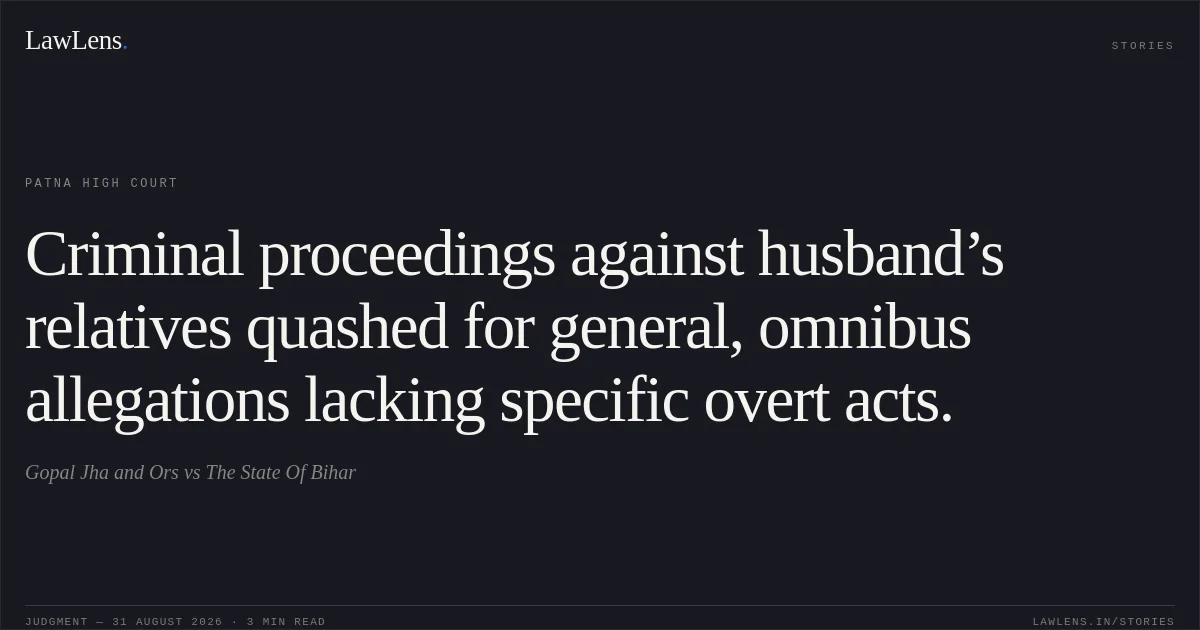
The Court accepted the petitioners’ contention that the surviving petitioners had been implicated as the husband’s relatives through general and omnibus allegations. It also took note of the matrimonial litigation initiated by the husband before registration of the criminal case, which was relied upon as indicating that the prosecution had been instituted to create a defence in the matrimonial dispute
Source reference: p. 3–4, para. 7.1Applying the principles governing quashing of vexatious proceedings and the Supreme Court’s caution against routine implication of relatives in matrimonial cases, the Court concluded that continuation of the prosecution against the surviving petitioners was unjustified and amounted to abuse of process
Source reference: p. 5, paras. 9–10Holding
The Court permitted withdrawal of the application and dismissed it as withdrawn with respect to petitioner no. 1, Gopal Jha, owing to his death
As against the surviving petitioners, the Court quashed the order dated 14 February 2017 taking cognizance in G.R. No. 114 of 2015, arising out of Ghoghardiha P.S. Case No. 111 of 2015, and consequently allowed the application
Source reference: p. 5, paras. 10–11Acts & Sections Cited
11 provisions across 3 statutes referred to in this judgment. Each provision opens on LawLens.
Indian Penal Code, 18608
Hindu Marriage Act, 19551
Original Court PDF
Gopal Jha and OrsvsThe State Of Bihar
Click to open original judgment
Original judgment, available to read, download and summarize on LawLens.in