Facts
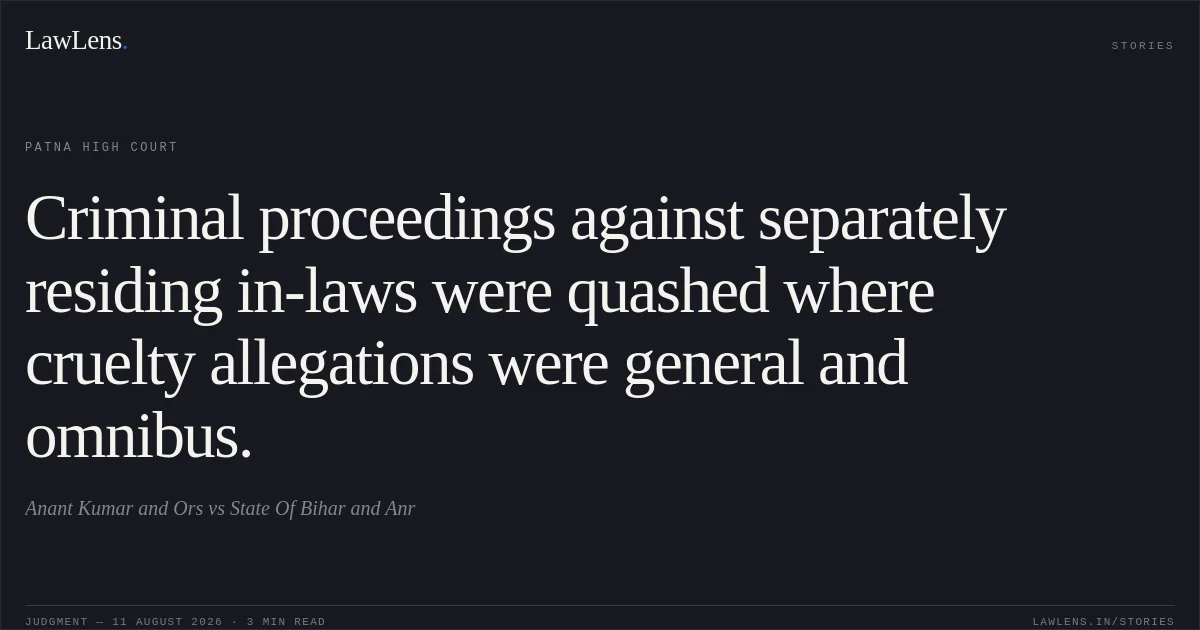
The petitioners sought quashing of the order dated 5 October 2018 passed by the learned ACJM, Naugachia, in Gopalpur P.S. Case No. 299 of 2018, whereby cognizance was taken for offences under Sections 498A, 323, 504, 506 and 34 of the Indian Penal Code and Sections 3 and 4 of the Dowry Prohibition Act.
Source reference: para. 6The complainant alleged that the petitioners subjected her to mental and physical cruelty in connection with a dowry demand for a Scorpio vehicle.
Source reference: para. 7Petitioner No. 1, Anant Kumar, the complainant’s husband, was permitted to withdraw the petition, and the proceedings against him were dismissed as withdrawn.
Source reference: paras. 2–4The petition thereafter survived only in respect of Petitioner Nos. 2 and 3, the complainant’s father-in-law and mother-in-law, and Petitioner No. 4, the husband’s uncle.
Source reference: para. 5The surviving petitioners contended that they lived separately, had no connection with the complainant’s daily domestic affairs, and had been implicated through general and omnibus allegations.
Source reference: para. 8Issues
1. Whether the criminal proceedings and order taking cognizance against the father-in-law, mother-in-law and uncle of the husband should be quashed under the High Court’s inherent jurisdiction where the allegations of cruelty and dowry demand are general and omnibus?
Source reference: paras. 8, 12–132. Whether continuation of the prosecution against the surviving petitioners would amount to an abuse of the process of court or otherwise defeat the ends of justice?
Source reference: paras. 11–13Law Applied
The Court exercised its inherent jurisdiction under Section 482 of the Code of Criminal Procedure to prevent abuse of the process of court and secure the ends of justice.
Source reference: paras. 12–13Relying on Abhishek v. State of Madhya Pradesh, 2023 SCC OnLine SC 1083, and the principles stated in V. Ravi Kumar v. State, Neeharika Infrastructure (P) Ltd. v. State of Maharashtra, Kahkashan Kausar @ Sonam v. State of Bihar, Preeti Gupta v. State of Jharkhand, Neelu Chopra v. Bharti and Mahmood Ali v. State of U.P., the Court held that quashing must be exercised sparingly and courts ordinarily should not assess the truthfulness of allegations at the threshold.
Source reference: paras. 11–12However, proceedings may be quashed where allegations, even if accepted at face value, do not disclose an offence, are absurd or inherently improbable, or are manifestly mala fide and amount to abuse of process.
Source reference: paras. 11–12In matrimonial prosecutions under Section 498A IPC, specific particulars and the individual role of each accused are necessary; general and omnibus allegations against relatives of the husband, particularly those living separately, may justify quashing.
Source reference: paras. 13–17Reasoning
The Court noted that the surviving petitioners were relatives of the husband who were living separately and were not connected with the complainant’s daily domestic affairs.
Source reference: para. 12The allegations of mental and physical cruelty and dowry demand against them were found to be general and omnibus, without sufficient particulars identifying their individual acts or roles.
Source reference: paras. 7–8, 12Applying the principles in Abhishek and the other cited authorities, the Court concluded that continuation of the prosecution against such relatives, in the absence of specific allegations, would constitute an abuse of the process of law.
Source reference: paras. 12–13The Court therefore distinguished the husband’s position—against whom the petition was withdrawn—from that of the remaining relatives.
Source reference: paras. 4–5, 12–13Holding
The petition was dismissed as withdrawn insofar as it related to Petitioner No. 1, Anant Kumar, the complainant’s husband.
In respect of Petitioner Nos. 2, 3 and 4, the Court quashed and set aside the order dated 5 October 2018 taking cognizance, along with all consequential proceedings arising therefrom.
Source reference: para. 13The application was accordingly allowed, and the trial court records were directed to be returned to the court below with a copy of the judgment.
Source reference: paras. 14–15Acts & Sections Cited
9 provisions across 3 statutes referred to in this judgment. Each provision opens on LawLens.
Indian Penal Code, 18604
Code of Criminal Procedure, 19733
Original Court PDF
Anant Kumar and OrsvsState Of Bihar and Anr
Click to open original judgment
Original judgment, available to read, download and summarize on LawLens.in