Facts
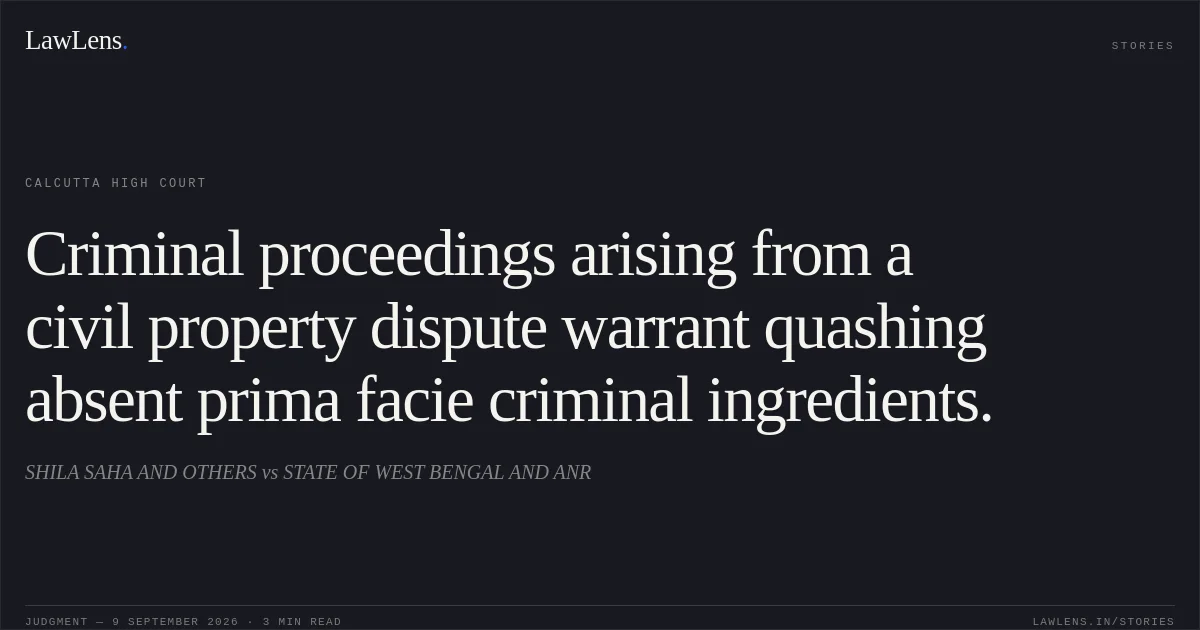
The petitioners sought quashing of G.R. No. 655 of 2024, arising from Islampur Police Station Case No. 69 of 2024, registered under Sections 341/323/325/506/34 of the Indian Penal Code, which culminated in charge-sheet No. 143 of 2024 under Sections 314/323/506/34 IPC, pending before the Chief Judicial Magistrate, Lalbagh, Murshidabad.
Source reference: para. 1The parties were relatives involved in an ancestral-property dispute. Petitioner No. 2 had instituted a pending partition suit against Opposite Party No. 2, in which an order directing maintenance of status quo had been passed.
Source reference: paras. 2–3The complaint alleged that, on 14 September 2023, the accused assaulted the complainant with fists and blows over a landed-property dispute and threatened him and his family members with dire consequences.
Source reference: para. 4The petitioners contended that the allegations were general and omnibus, that no specific overt act or criminal intent was attributed to them, and that the dispute was essentially civil in nature.
Source reference: para. 5The State produced the case diary before the High Court.
Source reference: para. 6Issues
1. Whether the FIR, investigation materials, and charge-sheet disclosed the essential ingredients of the offences alleged against the petitioners and made out a prima facie criminal case?
Source reference: paras. 8, 10–122. Whether continuation of the criminal proceeding, arising out of an ongoing family property and partition dispute, constituted an abuse of the process of law warranting exercise of the High Court’s inherent jurisdiction under Section 482 CrPC?
Source reference: paras. 8, 10–12Law Applied
The Court applied the inherent jurisdiction under Section 482 of the Code of Criminal Procedure, 1973, which may be exercised to prevent abuse of the process of court and secure the ends of justice.
Source reference: para. 7Relying on State of Haryana v. Bhajan Lal, 1992 Supp. (1) SCC 335, as reiterated in Ramesh Chandra Gupta v. State of Uttar Pradesh, 2022 LiveLaw (SC) 993, the Court recognised that quashing may be appropriate where the allegations, even if accepted at face value, do not constitute an offence; where the uncontroverted allegations and collected evidence do not disclose commission of an offence; or where the proceeding is manifestly mala fide and instituted with an ulterior motive.
Source reference: paras. 7–8The Court also relied on Vineet Kumar v. State of Uttar Pradesh, (2017) 13 SCC 369, concerning the prevention of malicious or abusive criminal prosecution.
Source reference: para. 7Randheer Singh v. State of Uttar Pradesh, (2021) 14 SCC 626, holds that a civil dispute may possess a criminal colour, but criminal proceedings should be quashed where the FIR and charge-sheet do not disclose the essential ingredients of any offence against the accused.
Source reference: para. 9The alleged offences were under Sections 341, 323, 325, 506 and 34 IPC, concerning wrongful restraint, voluntarily causing hurt or grievous hurt, criminal intimidation, and common intention.
Source reference: no citationReasoning
The Court found that the dispute arose from an ancestral-property conflict between related parties and that a partition suit concerning the same property was already pending.
Source reference: paras. 3, 11Although the complaint alleged assault and threats, the Court held that the materials in the case diary and charge-sheet did not establish any specific criminal act, overt role, or criminal intent on the part of the petitioners.
Source reference: para. 10The allegations were treated as general and omnibus, while the underlying controversy concerned property rights and transfer of property within the family.
Source reference: paras. 5, 10–11Applying the categories identified in Bhajan Lal, the Court concluded that the allegations and collected materials did not prima facie constitute the offences alleged and that the criminal proceeding had been given a criminal colour to what was essentially a civil family-property dispute.
Source reference: paras. 8, 11Continuation of the prosecution would therefore amount to abuse of the process of law.
Source reference: no citationHolding
The High Court answered both issues in favour of the petitioners. It held that no prima facie material disclosed the essential ingredients of the alleged offences against them and that the proceeding was an abuse of the process of law.
Accordingly, CRR 2428 of 2024 was allowed, and G.R. No. 655 of 2024, arising from Islampur Police Station Case No. 69 of 2024 and charge-sheet No. 143 of 2024, was quashed in respect of Shila Saha, Bibhash Kumar Das, Binit Kumar Das, Shampa Das, Anukana Das and Souradip Saha.
Source reference: paras. 12–14Connected applications were disposed of, any interim order was vacated, and a copy of the judgment was directed to be sent to the trial court for necessary compliance.
Source reference: paras. 15–17Acts & Sections Cited
10 provisions across 3 statutes referred to in this judgment. Each provision opens on LawLens.
Indian Penal Code, 18606
Code of Civil Procedure, 19081
Code of Criminal Procedure, 19733
Original Court PDF
SHILA SAHA AND OTHERSvsSTATE OF WEST BENGAL AND ANR
Click to open original judgment
Original judgment, available to read, download and summarize on LawLens.in