Facts
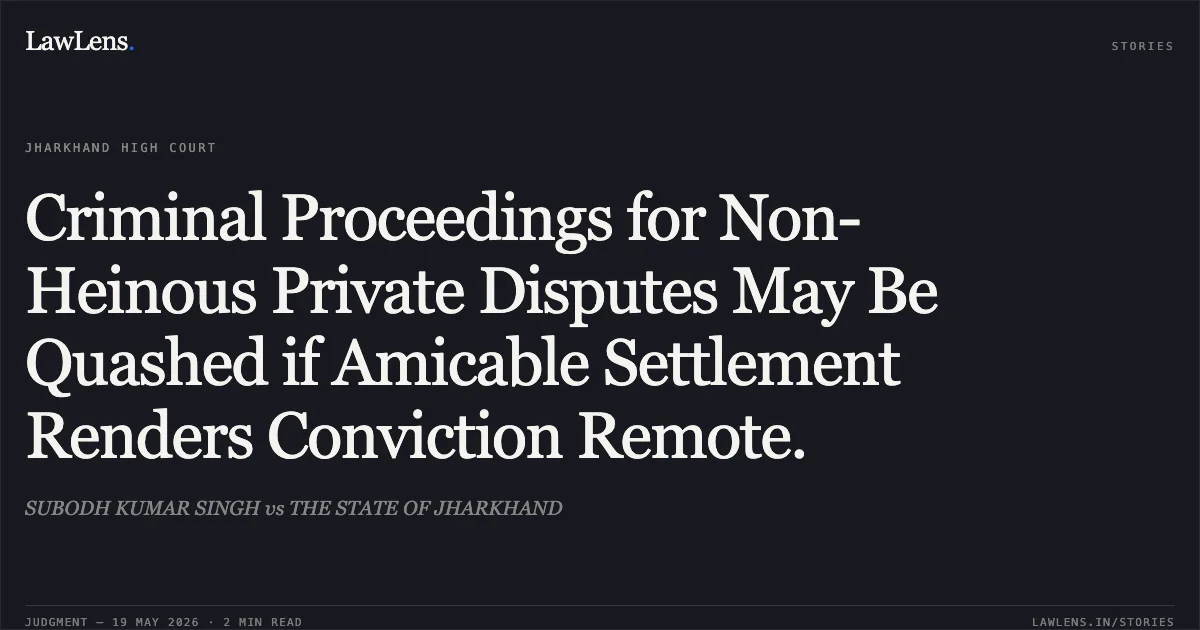
The petitioners sought the quashing of criminal proceedings and an order dated 11.11.2022 passed by the CJM, Bokaro, in connection with Sector 4 P.S. Case No. 99 of 2020 (G.R. Case No. 1179 of 2022)
Source reference: para. 2The petitioners were charged under Sections 406, 409, 420, 120B, and 34 of the Indian Penal Code (IPC)
Source reference: para. 2During the pendency of the case, the petitioners and the victim (Opposite Party No. 2) filed an interlocutory application (I.A. No. 6605 of 2026) supported by affidavits, stating that the dispute had been settled through the intervention of well-wishers and was primarily civil in nature
Source reference: para. 4Issues
1. Whether the High Court should exercise its inherent power to quash criminal proceedings in non-compoundable offences on the basis of a private settlement between the parties
Source reference: para. 2, 62. Whether the continuation of the criminal proceeding would amount to an abuse of the process of law given the bleak chances of conviction following the compromise
Source reference: para. 4, 7Law Applied
The Court applied Section 528 of the Bharatiya Nagarik Suraksha Sanhita (BNSS), 2023 (formerly Section 482 Cr.P.C.), which saves the inherent power of the High Court to prevent abuse of the process of any court or to secure the ends of justice
Source reference: para. 2, 6It relied heavily on the precedent established in Parbatbhai Aahir @ Parbatbhai Bhimsinhbhai Karmur and Others v. State of Gujarat and Another (2017), which categorized cases with "overwhelmingly and predominatingly civil flavour"—such as commercial, financial, or mercantile disputes—as fit for quashing if a settlement is reached and the wrong is private in nature
Source reference: para. 6Reasoning
The Court noted that the dispute between the parties was essentially a civil matter to which a "cloak of criminal case" had been given
Source reference: para. 4Applying the guidelines from Parbatbhai Aahir, the Court observed that the offences alleged were private in nature and did not involve public policy or serious "mental depravity" like murder or rape, which would otherwise preclude quashing
Source reference: para. 6Since the informant (O.P. No. 2) explicitly stated a lack of interest in pursuing the case due to the settlement, the Court reasoned that the possibility of conviction had become "remote and bleak"
Source reference: para. 4, 6Consequently, requiring the petitioners to face trial would result in "great oppression and prejudice," constituting an abuse of the judicial process
Source reference: para. 6, 7Holding
The Court answered the issues in the affirmative, holding that it is appropriate to terminate proceedings when parties resolve a private dispute to secure the ends of justice
The High Court allowed the petition and quashed the entire criminal proceeding, including the cognizance order dated 11.11.2022 passed by the CJM, Bokaro, against the petitioners. All pending interlocutory applications were disposed of accordingly
Source reference: para. 8, 9Acts & Sections Cited
7 provisions across 3 statutes referred to in this judgment. Each provision opens on LawLens.
Bharatiya Nagarik Suraksha Sanhita, 20231
Indian Penal Code, 18604
Code of Criminal Procedure, 19732
Original Court PDF
SUBODH KUMAR SINGHvsTHE STATE OF JHARKHAND
Click to open original judgment
Original judgment, available to read, download and summarize on LawLens.in