Facts
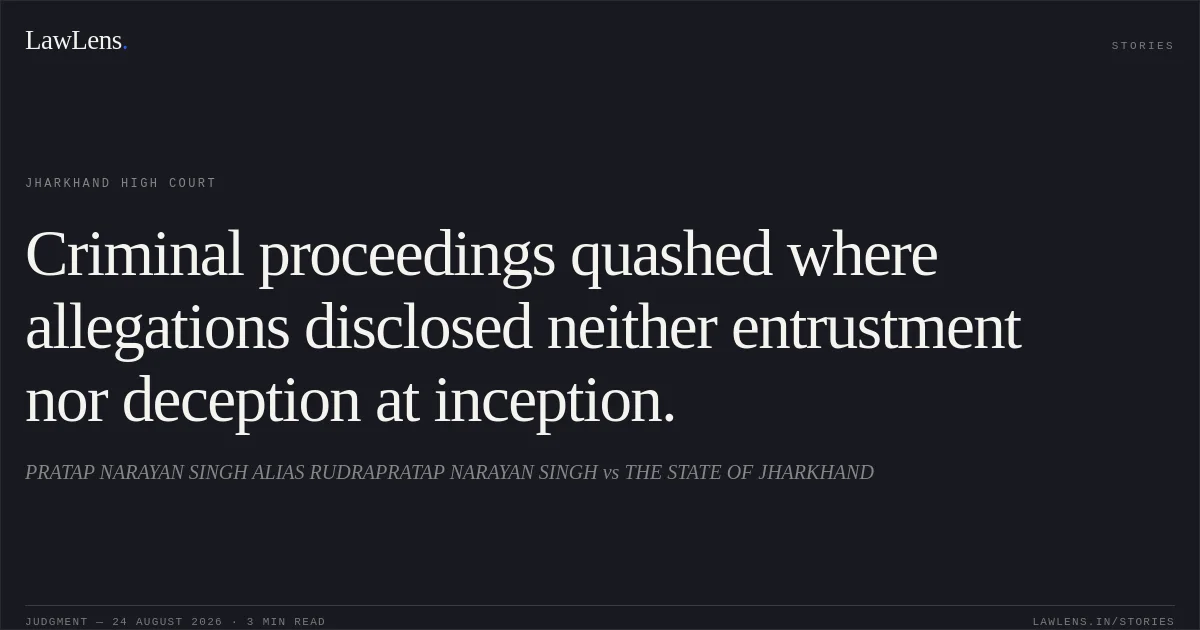
The petitioners, alleged to be the Chairman and Secretary to the Chairman of S.S.R. Medical College, Mauritius, sought quashing under Section 528 of the Bharatiya Nagarik Suraksha Sanhita, 2023, of the proceedings arising from Argora P.S. Case No. 199 of 2024, registered under Sections 406, 420 and 120B of the Indian Penal Code and pending before the Judicial Magistrate, XIII, Ranchi.
Source reference: para. 2The informant alleged that his son, Kairav Kirtne, was induced through advertisements to enrol in the college’s MBBS course for the 2019–2024 session, was humiliated and unfairly treated by the college staff, was prevented from appearing in examinations despite payment of fees, and that the family was financially exploited to the extent of approximately Rs. 49,63,141.
Source reference: paras. 4–5The petitioners denied the allegations, asserting that the student had voluntarily discontinued the course after approximately 4.5 years, had poor attendance and internal assessment results, and that the payments were made to the college trust in Mauritius rather than to the petitioners personally.
Source reference: paras. 6–8Investigation was ongoing and no charge-sheet had yet been filed.
Source reference: para. 3Issues
Whether the allegations, taken at their face value, disclosed the essential ingredients of cheating under Section 420 IPC, particularly deception and dishonest inducement from the inception of the transaction.
Source reference: paras. 10–12Whether payment of medical-college fees constituted “entrustment” sufficient to attract criminal breach of trust under Sections 405–406 IPC.
Source reference: paras. 13–14Whether the allegation of criminal conspiracy under Section 120B IPC could survive in the absence of the foundational offences of cheating and criminal breach of trust.
Source reference: para. 15Whether continuation of the criminal proceedings amounted to an abuse of the process of law warranting exercise of the High Court’s inherent jurisdiction under Section 528 BNSS.
Source reference: paras. 16–18Law Applied
The Court applied Sections 405 and 406 IPC, requiring entrustment of property and dishonest misappropriation, conversion, or use contrary to a legal direction or contract; payment made pursuant to an ordinary contractual or educational transaction does not, by itself, amount to entrustment.
Source reference: paras. 13–14For Section 420 IPC, the Court relied on Ram Narayan Popli v. Central Bureau of Investigation, (2003) 3 SCC 641, holding that cheating requires deception or dishonest/fraudulent misrepresentation inducing delivery of property, and on Uma Shankar Gopalika v. State of Bihar, (2005) 10 SCC 336, holding that dishonest intention must exist at the inception of the transaction; a subsequent breach or failure of contractual performance is not, by itself, cheating.
Source reference: paras. 10–12The Court also relied on Narayana Health v. State of West Bengal, 2026 SCC OnLine SC 844, for the principles that criminal breach of trust requires entrustment, cheating requires dishonest intention from the beginning, and conspiracy requires a prior agreement or meeting of minds to commit an unlawful act.
Source reference: paras. 6, 15Section 120B IPC cannot ordinarily stand where the foundational offences are not disclosed.
Source reference: para. 15Reasoning
The Court held that the allegations did not assert that either petitioner had personally deceived or induced the informant or his son to part with property, or that deception existed from the beginning of the transaction.
Source reference: paras. 10–12The student had in fact pursued the course for approximately 4.5 years, which was inconsistent with an allegation that the petitioners had dishonestly induced his admission from the outset.
Source reference: para. 12The amounts paid were college fees arising from an ordinary educational contract and were not entrusted to the petitioners to be held in trust for a restricted purpose; consequently, the statutory requirement of entrustment and dishonest misappropriation under Sections 405–406 IPC was absent.
Source reference: paras. 13–14Since neither cheating nor criminal breach of trust was prima facie made out, there could be no sustainable allegation of a meeting of minds to commit those offences under Section 120B IPC.
Source reference: para. 15Continuing the proceedings despite the absence of these foundational ingredients would therefore constitute an abuse of process.
Source reference: para. 16Holding
The High Court answered the issues in favour of the petitioners.
It held that the allegations, even if accepted in their entirety, did not disclose offences under Sections 406, 420 or 120B IPC.
Source reference: paras. 12, 14–16Exercising jurisdiction under Section 528 BNSS, the Court quashed and set aside the entire criminal proceeding arising from Argora P.S. Case No. 199 of 2024, pending before the Judicial Magistrate, XIII, Ranchi, insofar as it concerned the petitioners.
Source reference: paras. 16–18The Criminal Miscellaneous Petition was accordingly allowed.
Source reference: para. 18Acts & Sections Cited
5 provisions across 2 statutes referred to in this judgment. Linked provisions open on LawLens.
Bharatiya Nagarik Suraksha Sanhita, 20231
Indian Penal Code, 18604
Original Court PDF
PRATAP NARAYAN SINGH ALIAS RUDRAPRATAP NARAYAN SINGHvsTHE STATE OF JHARKHAND
Click to open original judgment
Original judgment, available to read, download and summarize on LawLens.in