Facts
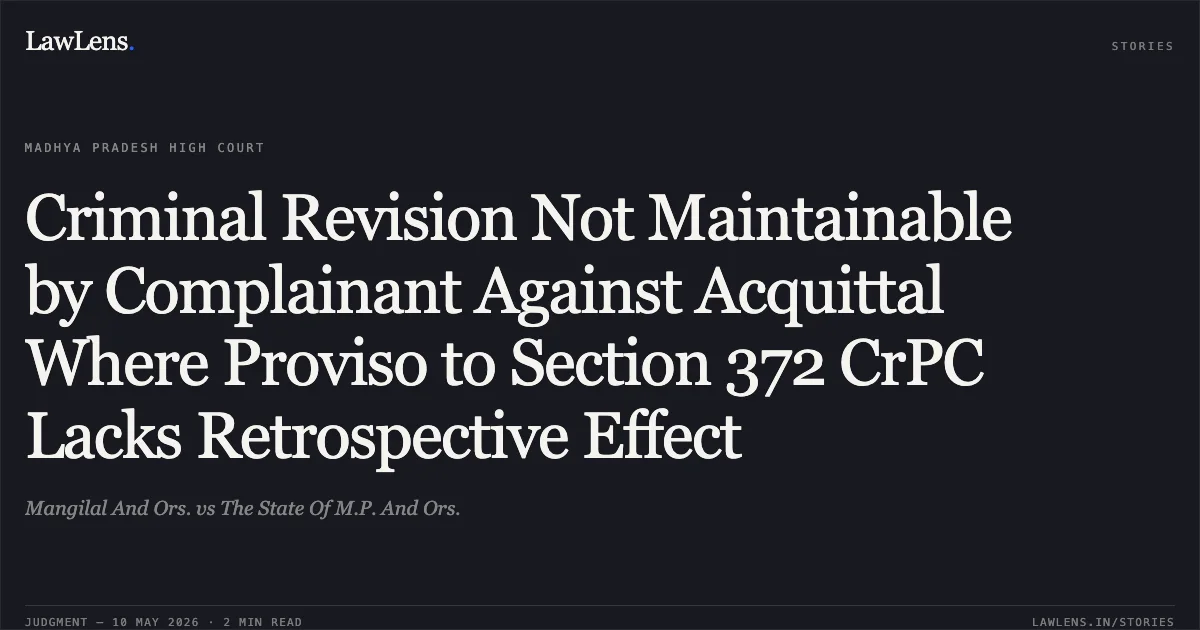
The revisionists (complainants) challenged the judgment dated 31.12.2004 passed by the Special Judge (Atrocities Act) and Additional Sessions Judge, Bhopal, in S.T. No. 308/2002.
Source reference: para. 2The trial court had acquitted five accused persons of charges under Sections 147, 148, 307/149, 324/149, and 323/149 of the IPC.
Source reference: para. 2The State did not prefer an appeal against the acquittal under Section 378 of the Cr.P.C.
Source reference: para. 3, 9During the pendency of the revision, the respondents raised a preliminary objection regarding the maintainability of a revision petition filed by a victim against an order of acquittal.
Source reference: para. 3Issues
1. Whether a criminal revision filed by a complainant/victim against an order of acquittal is maintainable in light of the 2009 amendment to Section 372 of the Cr.P.C.
Source reference: para. 3-42. Whether the proviso to Section 372 of the Cr.P.C., which grants a victim the right to appeal, can be applied retrospectively to judgments passed prior to the amendment.
Source reference: para. 7-8Law Applied
Section 401(3) of the Cr.P.C. expressly prohibits a High Court from converting a finding of acquittal into one of conviction in the exercise of its revisional jurisdiction.
Source reference: para. 6The 2009 amendment to Section 372 Cr.P.C. (creating a victim's right to appeal) is prospective and not retrospective, as established in Mahabir and Others v. State of Haryana (2025 SCC OnLine SC 184).
Source reference: para. 3, 8Revisional interference in acquittals is limited to exceptional cases of manifest illegality, as per Bindeshwari Prasad Singh v. State of Bihar (2002) 6 SCC 650.
Source reference: para. 5-7Section 401(3) reinforces the bar on converting an acquittal into conviction in revision as held in Joseph Stephen v. Santhanasamy (2022) 13 SCC 115.
Source reference: para. 5-7Reasoning
Since the trial court's judgment of acquittal was delivered in 2004, the complainant had no statutory right of appeal at that time, as the proviso to Section 372 Cr.P.C. was only introduced in 2009.
Source reference: para. 8Following the rule in Mahabir, this substantive right cannot be applied retrospectively to validate the challenge.
Source reference: para. 8, 10Section 401(3) strictly forbids the High Court from doing indirectly—via revision—what it cannot do directly, which is converting an acquittal into a conviction.
Source reference: para. 6Since the State failed to file an appeal under Section 378, and the complainant lacked the standing to appeal or seek a revision of acquittal under the then-applicable law, the petition remained legally untenable.
Source reference: para. 9-10Holding
The criminal revision is not maintainable as the complainant cannot challenge an acquittal through a revision petition, nor can the 2009 amendment to Section 372 Cr.P.C. be applied retrospectively to judgments passed in 2004.
The Court dismissed the revision petition while recording appreciation for the Amicus Curiae.
Source reference: para. 10-11Acts & Sections Cited
8 provisions across 2 statutes referred to in this judgment. Each provision opens on LawLens.
Indian Penal Code, 18605
Code of Criminal Procedure, 19733
Original Court PDF
Mangilal And Ors.vsThe State Of M.P. And Ors.
Click to open original judgment
Original judgment, available to read, download and summarize on LawLens.in