01Facts
The petitioner No. 1 is a Trust that runs an Ayurveda college (BAMS, intake 100) with an attached hospital since 2022-23.
¶ 2.1 · p. 2For renewal of permission for 2026-27, the Central Council (respondent No. 3) inspected the college on 14–15 May 2026 and issued a deficiency notice on 30.07.2026. The college replied on 05.08.2026.
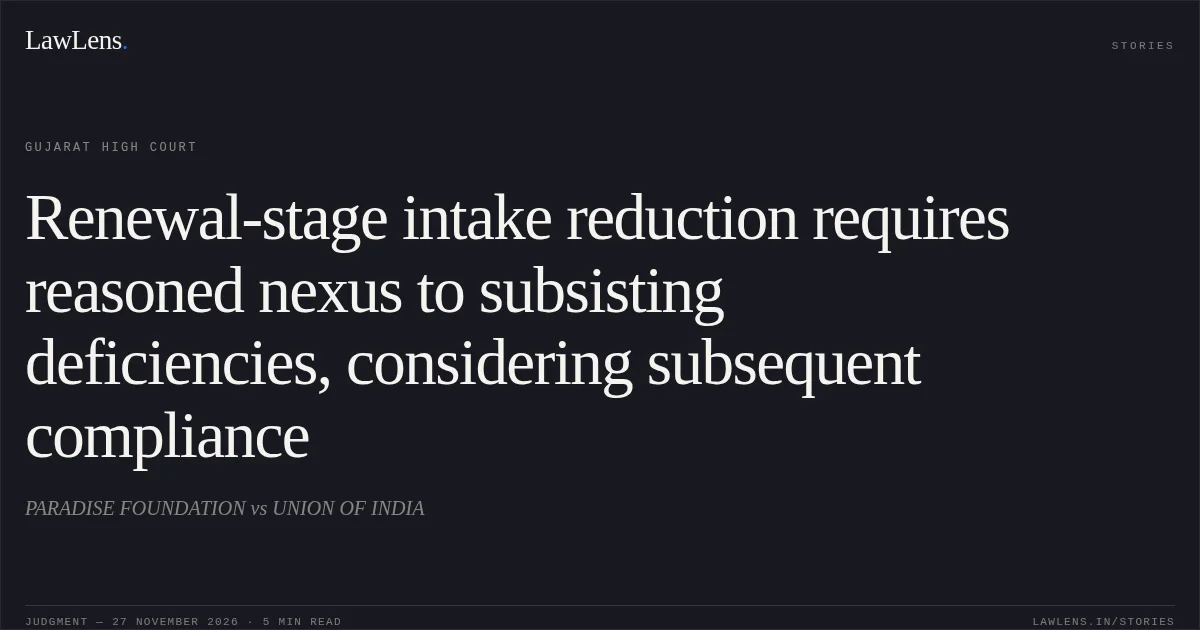
¶ 2.2 · p. 2By order dated 20.08.2026, the Board permitted admissions but reduced intake to 95, applying a 5% reduction for one deficient faculty post, an Associate Professor in Rog Nidan avum Vikriti Vigyan.
¶ 2.3 · pp. 2–3That post fell vacant on the resignation of Dr. Joel Antony on 05.12.2025. The college selected Dr. Ranjeet Nimbalkar, who accepted an offer dated 16.05.2026 but sought to join only from September 2026. He joined on 01.09.2026, after the Board's order.
¶ 2.4 · p. 3The First Appeal under s. 24(3) of the NCISM Act, 2020 was filed. The Commission recorded Dr. Nimbalkar's appointment but rejected compliance because it was made after eight months. It dismissed the appeal on 23.09.2026.
¶ 2.5 · pp. 3–4The Second Appeal under s. 9(6) was dismissed by the Union of India on 19.10.2026.
¶ 2.6 · p. 4The petitioners challenged that order under Arts. 226–227.
¶ 1 · p. 102Issues
i.1. Whether the reduction of the sanctioned intake from 100 to 95 seats, despite the faculty deficiency having been rectified before commencement of the academic session and brought to the notice of the appellate authorities, was rational, reasonable and non-arbitrary.
¶ 9 · p. 1303Law Applied
The Court relied on the NCISM Act, 2020, under which the Board's permission and the statutory appeals under ss. 24(3) and 9(6) operate.
¶ 2.3–2.6 · pp. 2–4The Court applied the MESAR Regulations, 2024, particularly Reg. 36, which requires a vacancy caused by resignation to be filled within three months and prescribes a penalty of three times the minimum salary for each month of delay, rather than any seat reduction.
¶ 6.7 · p. 8 · 10.7 · p. 15 · 13 · p. 18The Court followed Royal Medical Trust v. Union of India, (2015) 10 SCC 19, para. 29 (approving Priyadarshini), which holds that renewal assessment is confined to whether prescribed faculty and infrastructure are available. Inspection and verification for renewal must be completed in time so that existing institutions can rectify deficiencies or explain them.
¶ 11 · pp. 15–16 · ¶ 12 · pp. 16–17The Court invoked the principles of fairness, reasonableness and equal treatment.
¶ 14 · p. 19Provisions in the judgment · 2 · Linked ones open on LawLens
National Commission for Indian System of Medicine Act, 2020 Section 24Section 9
04Reasoning
The Court accepted that a deficiency existed on the date of inspection, since Dr. Nimbalkar had not joined.
¶ 13 · p. 17The Court held that the deficiency was curable and was cured before the academic session began. Dr. Nimbalkar joined on 01.09.2026, and the Commission itself recorded his appointment.
¶ 13 · pp. 17–18Rejecting compliance solely because the appointment was delayed was "unduly technical".
¶ 13 · p. 18Under the Regulations, delay attracts a monetary penalty, so delay alone could not justify a seat reduction, and the Commission could at most have imposed that penalty.
¶ 13 · p. 18 · ¶ 14 · p. 19The Court noted that Government colleges are permitted full intake on an undertaking to fill vacancies, although the Act and Regulations apply equally to all colleges. The petitioner was not seeking any such relaxation. It had already appointed the faculty, so the disparity reinforced the finding that the decision was unfair and not reasoned.
¶ 10.5–10.6 · pp. 14–15 · ¶ 14 · pp. 18–19The Court considered it relevant that Rog Nidan is taught in the second year, but its reasoning rests on the cure of the deficiency and the absence of a rational basis for reducing seats.
¶ 10.3 · p. 1405Holding
The Court answered the question in the negative. The reduction of five seats, despite the deficiency being rectified before the academic session and the appointment being brought to the appellate authorities' notice, is not rational or reasonable and cannot be sustained merely because the appointment was not in place on the date of inspection.
¶ 14 · p. 19 · ¶ 9 · p. 13The impugned orders are quashed and set aside, and the Rule is made absolute.
¶ 15 · pp. 19–20Respondent No. 4 (Admission Committee) is directed to treat the college as having an intake of 100 BAMS seats for 2026-27 and to conduct admissions and seat allotment accordingly, in accordance with law.
¶ 16 · p. 20Original Court PDF
AGRAWAL EDUCATION FOUNDATIONvsUNION OF INDIA
Click to open original judgment
Original judgment, available to read, download and summarize on LawLens.in