01Facts
The petitioners sought quashing of I-CR No. 11996006260457 of 2026, registered at Tharad Police Station, Vav-Tharad on 19.04.2026, for offences under ss. 140(3), 64(2)(m), 123, 351(3) and 54 of the Bharatiya Nyaya Sanhita, 2023 (BNS), with relief sought under Article 226 and s. 528 of the Bharatiya Nagarik Suraksha Sanhita, 2023 (BNSS).
p. 1 · ¶ 1The petitioners' counsel stated that the dispute had been settled and the complainant did not wish to pursue the matter.
p. 3 · ¶ 5The complainant, present in person and identified by counsel, confirmed the settlement in Court.
p. 2 · ¶ 3 · pp. 5–6 · ¶ 9The APP opposed quashing on the ground that serious allegations were made.
p. 3 · ¶ 6Respondent No. 2's counsel supported quashing and filed the complainant's affidavit.
p. 3 · ¶ 7In her affidavit, the complainant stated that the relationship and physical intimacy with Petitioner No. 1 were consensual and adult.
p. 4, affidavit para. 3In her affidavit, the complainant stated that her family opposed the relationship and the FIR was lodged under their influence.
p. 4, affidavit para. 4In her affidavit, the complainant stated that the parties married on 07.03.2026 and registered the marriage on 09.04.2026.
p. 5, affidavit para. 5In her affidavit, the complainant stated that she appeared in Habeas Corpus SCA No. 10082 of 2026 and expressed a wish to join Petitioner No. 1, and that the Court disposed of that petition by oral order dated 17.07.2026.
p. 5, affidavit para. 6In her affidavit, the complainant stated that she has no objection to quashing and that the affidavit is voluntary.
pp. 5, affidavit paras. 7–802Issues
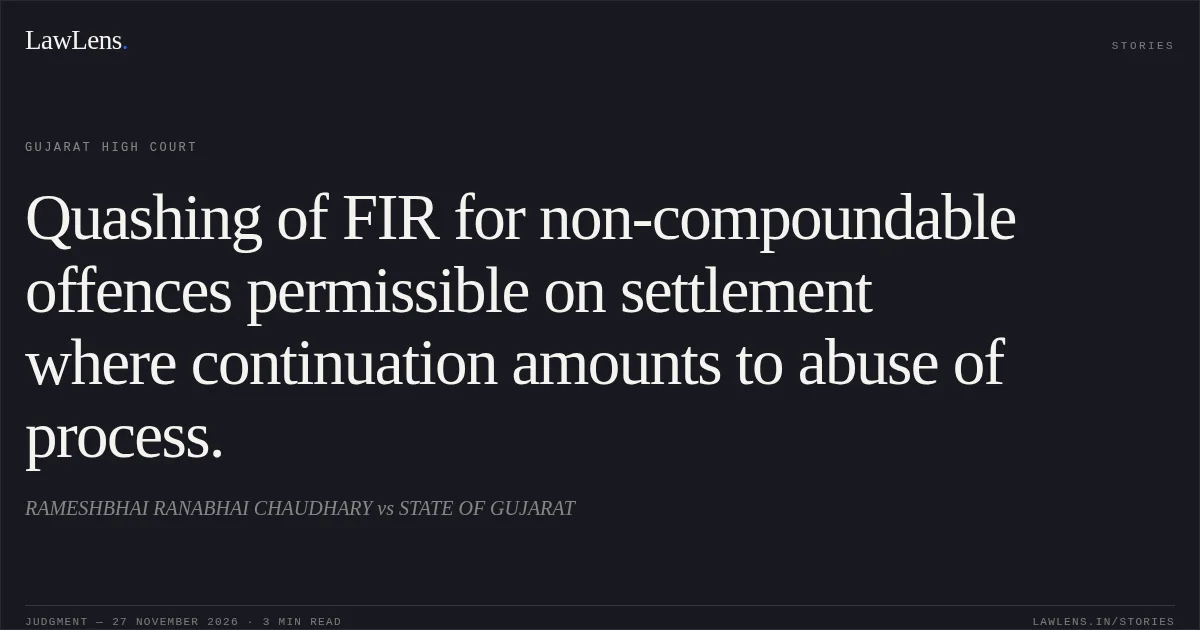
i.1. Whether the FIR and consequential proceedings for non-compoundable offences may be quashed under Article 226 read with s. 528 BNSS on the basis of a settlement between the parties, despite the seriousness of the allegations.
p. 3 · ¶ 6–7 · p. 6 · ¶ 10ii.2. Whether continuation of the criminal proceedings would amount to an abuse of the process of law, such that quashing is necessary to secure the ends of justice.
p. 6 · ¶ 1003Law Applied
Article 226 and s. 528 BNSS, the High Court's inherent power to quash proceedings to prevent abuse of process and secure the ends of justice.
p. 1 · ¶ 1Gian Singh v. State of Punjab, (2012) 10 SCC 303, under which the High Court may quash criminal proceedings on a genuine compromise even for non-compoundable offences where the dispute is predominantly private in character, with overtones of a civil or matrimonial nature, and not of a heinous or serious nature affecting society.
p. 2 · ¶ 5 · p. 6 · ¶ 10Madan Mohan Abbot v. State of Punjab, (2008) 4 SCC 582; Nikhil Merchant v. CBI, 2009 (1) GLH 31; Manoj Sharma v. State, 2009 (1) GLH 190; Narinder Singh v. State of Punjab, (2014) 6 SCC 466; and State of Haryana v. Bhajan Lal, AIR 1992 SC 604, which together hold that the power to quash on settlement is discretionary and extraordinary, that the gravity and nature of the offence must be considered, and that heinous or serious offences affecting society are generally excluded from quashing on compromise.
p. 2 · ¶ 5 · p. 6 · ¶ 10The judgment cites these authorities without reproducing their reasoning.
Provisions in the judgment · 6 · Linked ones open on LawLens
Bharatiya Nagarik Suraksha Sanhita, 2023 Section 528
Bharatiya Nyaya Sanhita, 2023 Section 140Section 64Section 123Section 351Section 54
04Reasoning
The Court accepted the complainant's sworn affidavit and her in-court statement, which showed a voluntary and settled position, and found that she had no grievance and that the FIR was lodged under family pressure.
pp. 4–5, affidavit paras. 4, 7–8 · pp. 5–6 · ¶ 9The Court treated her consent to the marriage and the earlier Habeas Corpus proceedings as corroborating that the dispute was between the parties rather than a matter of public interest, and on that basis held that continuing the prosecution would be an abuse of process and that no fruitful purpose would be served. The Court did not separately analyse the gravity of the offences under s. 64(2)(m) BNS or the other charges, nor did it discuss whether the allegations fell within the category of offences the Narinder Singh and Bhajan Lal line excludes from quashing. The order therefore rests primarily on the complainant's consent and the private character of the dispute, and not on a detailed evaluation of the nature of the alleged offences.
pp. 5, affidavit paras. 5–6 · p. 6 · ¶ 1005Holding
The Court answered both issues in the affirmative. It held that continuation of the proceedings would amount to abuse of process and that quashing was necessary to secure the ends of justice, given the settlement and the complainant's affidavit.
p. 6 · ¶ 10The application was allowed. The FIR I-CR No. 11996006260457 of 2026 registered at Tharad Police Station, Vav-Tharad, and all consequential proceedings were quashed and set aside qua the present petitioners, and the Rule was made absolute.
p. 6 · ¶ 11Original Court PDF
RAMESHBHAI RANABHAI CHAUDHARYvsSTATE OF GUJARAT
Click to open original judgment
Original judgment, available to read, download and summarize on LawLens.in